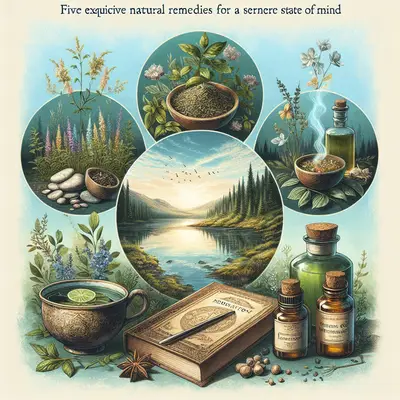
In an age of constant alerts and ambient urgency, true luxury is no longer an object—it is a nervous system at ease. Natural remedies, when approached with discernment, can become less about “quick fixes” and more about cultivating a quietly opulent inner landscape: clear, unhurried, and exquisitely attuned. This is not wellness as a trend, but as a craft—where every botanical, breath, and ritual is chosen with the same care one might devote to curating a wardrobe or designing a home.
This guide explores refined, evidence-informed approaches to natural remedies for mental calm, with five exclusive insights for those who seek not just relief, but a more elevated relationship with their own mind.
Refining the Foundation: Nervous System Care as Everyday Aesthetics
Before individual herbs, tinctures, or teas can truly make a difference, the terrain they act upon—the nervous system—must be treated as something to be curated, not merely “managed.” The most sophisticated approach to natural remedies begins with an appreciation of how finely tuned the stress response really is.
The autonomic nervous system constantly decides whether you are safe enough to rest or too threatened to relax. Natural remedies work best when they are aligned with this underlying rhythm: calming inputs (like gentle breathwork or warm herbal infusions) repeatedly signal safety to the body. Over time, this repetition becomes a subtle aesthetic: a life in which your baseline state is composed rather than reactive.
Instead of thinking of herbs and practices as isolated “hacks,” imagine them as layers in a well-composed interior—lighting, textures, and scents that make it easier for you to exhale without thinking. An evening chamomile-lavender infusion, for instance, does more than deliver apigenin and linalool; paired with soft lighting and an intentional end to digital noise, it becomes part of a daily sensory language that tells your brain, “We are done striving for the day.”
This approach reframes natural remedies not as occasional rescues for burnout, but as tools that help you design a daily atmosphere of safety and subtle delight. When the nervous system is consistently met with this level of care, “calm” stops being an achievement and becomes your default setting.
Botanical Companions: A Curated Approach to Calming Herbs
Among the abundance of herbs marketed for stress, a refined mental wellness routine calls for curation rather than accumulation. Not all calming botanicals feel or function the same. Some are grounding, others are clarifying, and some invite a gentle sense of warmth or emotional ease.
Chamomile, for example, has long been associated with reduced anxiety and improved sleep quality, thanks in part to its flavonoid apigenin, which may interact with benzodiazepine receptors in the brain. Lavender, whether inhaled or sipped as a tea, has shown promise in easing mild anxiety and tension, with standardized oral preparations demonstrating measurable effects in clinical studies. These are not simply “relaxing” herbs; they occupy a specific emotional register—softening, consoling, and supportive.
By contrast, adaptogens such as ashwagandha and rhodiola are less about immediate calm and more about enhancing resilience over time. Ashwagandha, in particular, has been investigated for its potential to reduce cortisol and perceived stress, which may translate into less reactivity during the day. When chosen with intention, adaptogens can feel like the equivalent of strengthening the frame of the house rather than merely dimming the lights.
A sophisticated herbal practice also respects timing and context. Grounding herbs like lemon balm or passionflower may be most effective in the late afternoon or evening, when your system benefits from gentle deceleration. Brighter adaptogens may be best in the morning, lending stamina without the jangling edges of stimulants. Instead of asking “Which herb is best?,” the more elegant question is: “What emotional tone do I want my day—and my mind—to have, and which plant ally complements that tone?”
Ritual as Medicine: When Delivery Becomes Part of the Remedy
The modern tendency is to distill plants into capsules and tinctures, reducing natural remedies to their most efficient form. Yet for mental wellness, the manner in which a remedy is taken can be as therapeutic as the substance itself. Luxury, in this context, is slowness you have chosen for yourself.
A carefully prepared herbal tea is a gentle invitation to presence: measuring the loose leaves, watching the steam rise, feeling the warmth of the cup against your palms. Each tiny sensory detail tells the brain that you have stepped out of urgency, even if only for five minutes. The polyphenols and aromatic compounds in the cup are active, yes—but so is the ritual of slowing down to receive them.
A similar principle applies to aromatic remedies. Diffusing a high-quality lavender or bergamot oil in the evening can be more than background fragrance; it can signal a daily transition from performance to restoration. The olfactory system has direct connections to the limbic system, the brain’s emotional center, which helps explain why certain scents can so powerfully influence mood and memory.
Even topical remedies—such as applying a magnesium-rich oil or cream before bed—can be transformed into a calming ritual rather than a mere “step.” When paired with slow, deliberate touch, they double as somatic reassurance: you are physically signaling to your body that it is safe, held, and not required to be productive.
This is the subtle art of natural remedies as ritual: treating each use as an opportunity to slip back into your own life with just a bit more grace and personal authorship.
Five Exclusive Insights for the Mentally Discerning
For those who approach mental wellness as a lifelong refinement rather than a short-term project, the following insights can shift natural remedies from pleasant extras to deeply integrated supports.
1. Think in Terms of Nervous System “Texture,” Not Just Calm vs. Stress
Most conversations reduce mental states to a binary: stressed or relaxed. A more elevated lens is to notice the texture of your nervous system—sharp, foggy, buoyant, heavy, spacious, or scattered. Each texture may call for a different natural response.
For example, a heavy, sluggish texture might respond better to bright, slightly stimulating botanicals like rosemary or gentle green tea, whereas a sharp, wired feeling may be soothed by oat straw, passionflower, or magnesium. This nuance allows you to pair remedies with felt states, rather than relying on generic “stress” solutions that may blunt rather than balance.
2. Treat Daytime and Nighttime Remedies as Two Distinct Wardrobes
Daytime remedies serve your capacity to focus, interact, and respond; nighttime remedies support release, integration, and repair. Mixing them carelessly can lead to either daytime drowsiness or restless nights.
A sophisticated practice might include:
- Morning: an adaptogen (ashwagandha or rhodiola, if appropriate for you) and a clarifying aroma such as rosemary or peppermint.
- Evening: gentle nervines like chamomile, lemon balm, or lavender, and magnesium-rich baths or topical applications.
This separation ensures that you are not merely sedating your system at all hours, but rather orchestrating an elegant arc to your day.
3. Micro-Rituals Outperform Occasional “Big Fixes”
One indulgent spa day or rare herbal bath cannot offset a month of unrelenting tension. Micro-rituals—30 seconds of breath before opening your laptop, a calming scent each evening, a single cup of thoughtfully chosen tea—help train your nervous system to expect regular intervals of safety and relief.
These small, repeated gestures function like compound interest. Over time, they create a baseline of internal stability that even high-pressure moments cannot easily overturn. In this sense, consistency becomes the most luxurious ingredient of all.
4. Pair Natural Remedies with Boundaries for Exponential Effect
No herbal formula can counterbalance a life where you never say “no.” The most powerful synergy arises when a calming or fortifying remedy is paired with a behavioral boundary: fewer late-night emails, a protected morning window without screens, or a weekly evening reserved for unstructured rest.
For example, taking a calming tea while still scrolling the news late into the night sends the nervous system contradictory signals—one toward rest, one toward vigilance. A more integrated approach might be: herbal tea, soft light, and a hard stop on digital input. In that space, the body can finally receive what the remedy is offering.
5. The Most Premium Practice Is Personalized, Not Maximal
There is a quiet sophistication in not needing every trending supplement or botanical. Working with a knowledgeable practitioner (clinical herbalist, integrative physician, or licensed naturopath) to tailor just a few high-quality remedies to your constitution, medications, and lifestyle is infinitely more effective than a crowded supplement shelf.
Personalization acknowledges variables that online lists rarely address: your nervous system’s innate sensitivity, your hormonal landscape, your sleep patterns, and any medical conditions or medications that require caution. True luxury is knowing that what you are taking has been chosen specifically for you—and that less, in this case, is genuinely more.
Integrating Natural Remedies into a Cultivated Mental Life
Natural remedies are not a substitute for professional care when it is needed, nor are they a guarantee of perpetual tranquility. What they can offer, when integrated with intention, is a more elegant relationship to your own mind: one in which you are no longer merely reacting to life, but quietly shaping the conditions under which your thoughts and emotions unfold.
A refined mental wellness practice might look simple from the outside: a morning adaptogen, a curated scent in your workspace, a single evening tea, a magnesium bath once or twice a week. Yet within that simplicity lies something profoundly rare in modern life—an inner world that feels coherent, deliberate, and suffused with an understated sense of ease.
Ultimately, the most exquisite natural remedy is the realization that your mind does not need to be constantly optimized to be worthy of care. It needs only to be met, daily, with the kind of patient, thoughtful attention you might reserve for something irreplaceable—because it is.
Sources
- National Center for Complementary and Integrative Health (NCCIH) – Herbs at a Glance – Evidence-based overviews of commonly used herbs like chamomile, lavender, and lemon balm, including safety considerations.
- Mayo Clinic – Ashwagandha: Is It Helpful for Stress? – Discusses research on ashwagandha for stress and anxiety, plus potential risks and interactions.
- Cleveland Clinic – Adaptogens: What They Are, Benefits & How They Work – Explains how adaptogenic herbs may support stress resilience and the body’s stress response.
- Johns Hopkins Medicine – Aromatherapy: Do Essential Oils Really Work? – Reviews evidence behind aromatherapy, particularly lavender and other calming oils.
- National Institutes of Health – Office of Dietary Supplements: Magnesium Fact Sheet – Provides detailed information on magnesium, its role in the body, and considerations for supplementation.
Key Takeaway
The most important thing to remember from this article is that this information can change how you think about Natural Remedies.