There is a particular kind of luxury that never appears on a receipt: the moment your nervous system remembers how to exhale. In an age of constant stimulus, natural remedies for mental ease are less about escaping modern life and more about editing it—curating inputs, textures, and rituals that coax the mind toward clarity. This is not the realm of quick fixes, but of quiet investments: subtle practices, botanicals, and sensory experiences that gradually re-educate the body in the art of calm.
Below are five exclusive, refined insights into natural mental remedies—approaches that lean away from trends and toward evidence-informed, elegantly sustainable habits.
1. The Micro-Dose of Nature: Precision, Not Escape
“Go outside” is common advice; “dose nature with intention” is more exacting. Rather than occasional long hikes, consider short, deliberate immersions in specific kinds of natural environments—what Japanese researchers call shinrin-yoku, or forest bathing.
Research suggests that even 10–20 minutes in green spaces can lower cortisol, blood pressure, and heart rate, while improving mood and cognitive performance. The key is not distance, but depth of attention. Leave your phone silenced in a pocket; walk slowly enough to notice the way light rests on leaves, how air feels against your skin, the layered soundtrack of birds and wind.
For the urban dweller, “precision nature” might mean:
- A particular tree-lined street you walk without checking your phone
- A consistent bench near water, visited at the same time each day
- A small botanical garden or conservatory that becomes a weekly ritual
Over time, the body learns to associate these micro-environments with decompression, much like a well-loved reading chair signals rest. This is not escapism; it is environmental calibration—curating an external landscape that quietly rehearses calm for your inner one.
2. Botanical Composure: Treating Herbs Like Fine Instruments
Herbal remedies are often treated like blunt tools—“take something calming” and hope for the best. A more sophisticated lens views botanicals as instruments in an orchestra: each with its own tone, tempo, and ideal context.
Consider three distinct “flavors” of calm:
- Grounded calm – For racing thoughts, sensory overload, and emotional volatility
- Herbs often used: ashwagandha, holy basil (tulsi)
- Ideal for: evening decompression, recovery from sustained stress
- Clear calm – For mental fog, scattered focus, and subtle anxiety
- Herbs often used: rosemary, rhodiola (used with care), green tea (L-theanine)
- Ideal for: daytime composure where alertness is required
- Soft calm – For difficulty unwinding, sleep onset issues, gentle emotional support
- Herbs often used: chamomile, lemon balm, lavender, passionflower
The refined approach is to:
- Consult a professional (integrative physician, clinical herbalist, or qualified naturopath) before introducing herbs, especially if you take medications, are pregnant, or have chronic conditions.
- Start with one botanical at a time, introduced at a consistent dose for a set period (e.g., two weeks), so you can clearly discern its effects.
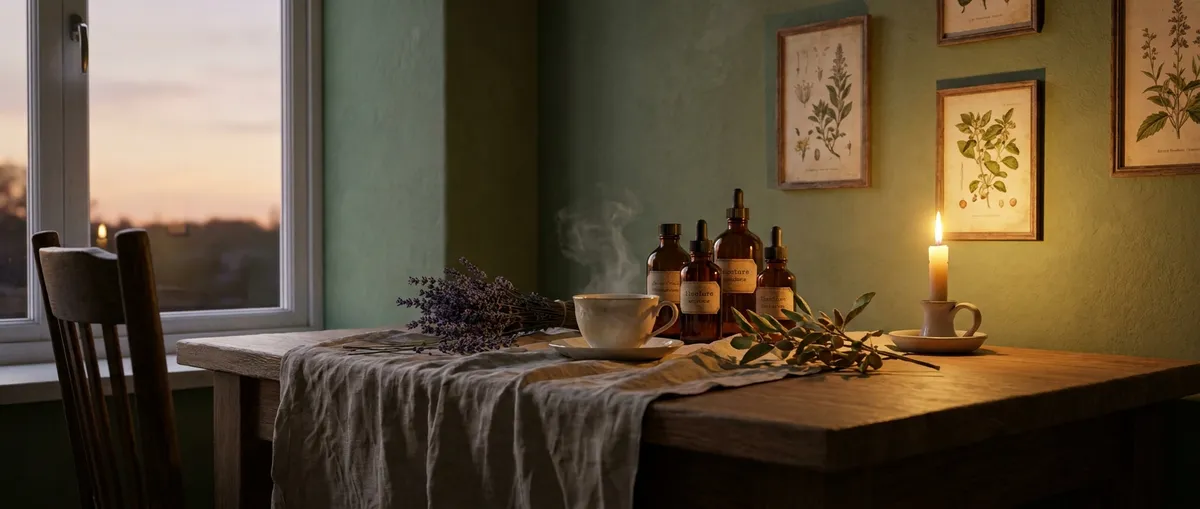
- Treat preparation as ritual, not transaction—a slow pour of hot water over loose herbs, a ceramic cup reserved for evening infusions, a mindful inhale of the aroma before the first sip.
This transforms botanicals from supplements into ceremonies—less about consumption, more about conversation with your own nervous system.
3. Sensory Architecture: Designing a Nervous-System-Friendly Home
The nervous system is continuously reading your environment for cues: safe or unsafe, urgent or relaxed. A refined mental wellness practice begins by making the spaces you inhabit less ambiguous.
Think of your home as a sensory instrument panel:
- Visual field – Clutter functions as cognitive noise. Curating a few calm focal points—a single framed photograph, a small vase of greenery, a tray with only your evening tea essentials—limits the number of stimuli your brain must constantly process.
- Soundscape – Replace default noise (TV in the background, random videos) with deliberate textures: soft instrumental music, low-volume nature sounds, or intentional silence in specific zones.
- Tactile landscape – A dedicated “calm texture” (a particular throw, robe, or pair of socks used only in the evening) becomes a somatic cue that the day is dissolving. Over time, simply touching it can begin to downshift your state.
- Lighting choreography – Bright, cool light in the morning; warm, lower light after sunset. A single soft lamp with a warm bulb can be infinitely more soothing than ceiling lights that flatten every surface.
None of this requires dramatic renovation. It is the disciplined luxury of editing: removing what agitates, amplifying what soothes, and allowing your space to practice calm with you, every day.
4. The Breath as Tailored Medicine: Matching Technique to State
Breathwork is often recommended as a universal solution, yet different patterns affect the nervous system in distinct ways. The sophisticated move is to match the technique to your current state, rather than reaching for a single default.
A few archetypes:
- For sharp anxiety or panic edges
- Extended exhale breathing: Inhale through the nose for 4 counts, exhale for 6–8 counts. The longer exhale helps engage the parasympathetic nervous system.
- Best used: in acute moments, several rounds until the body softens slightly.
- For mental agitation with fatigue
- Coherent breathing: 5–6 breaths per minute (inhale 5 seconds, exhale 5 seconds). This rhythm has been associated with improved heart rate variability and emotional regulation.
- Best used: 10–20 minutes, as a daily training for emotional resilience.
- For pre-sleep decompression
- Sighing practice: Two short inhales through the nose (the second deeper than the first), followed by a long, unforced exhale through the mouth. Repeat for several cycles.
- Best used: in bed or just before, as a way to ease tension accumulated through the day.
Treating breath like a bespoke prescription—selected and adjusted to your moment-to-moment reality—elevates it from a wellness cliché to a precise tool. Over time, familiarity with these patterns gives you a portable, silent remedy that travels anywhere your mind does.
5. Quiet Boundaries as a Natural Remedy: The Hidden Pharmacology of “No”
Among all natural remedies, one of the most potent is invisible: what you decline. The nervous system is not only shaped by what you ingest, but by what you allow into your schedule, your attention, and your emotional bandwidth.
Consider boundaries as a form of subtle medicine:
- Temporal boundaries – A non-negotiable “off-duty” window each day (even 30–60 minutes) where you are unreachable, screens are absent, and input is deliberately minimized. This is not a luxury; it is neurological maintenance.
- Social boundaries – A careful curation of whom you interact with when your resilience is low. You can be selectively available without being unkind. “I’d love to see you when I have more bandwidth” is a gentle yet firm prescription for yourself.
- Digital boundaries – Turning off non-essential notifications, especially after a set hour in the evening, is equivalent to removing a subtle stimulant from your system. Every ping is a micro-dose of adrenaline; reducing them is, in effect, biochemical editing.
- Emotional boundaries – Not every story needs to be processed in real time. Choosing when and with whom to unpack difficult experiences is a protective filter for your psyche.
These boundaries are not about austerity; they are about refinement. Just as a perfumer removes discordant notes to reveal a cleaner fragrance, you are distilling your life so that what remains supports a calmer, more coherent mind.
Conclusion
Natural remedies for mental wellness are often misunderstood as items to acquire: teas, supplements, essential oils. In truth, the most enduring remedies are patterns—of breath, environment, boundary, and attention—woven deliberately into daily life. A short, intentional walk in a particular pocket of green; a single botanical infusion prepared with unhurried care; lighting chosen as carefully as fragrance; a breath pattern matched to your inner weather; a single, well-placed “no” that silently protects your nervous system.
This is the quiet luxury of contemporary mental care: not an escape from your life, but a re-design of it—subtle, evidence-informed, and deeply personal. Over time, these practices do not merely soothe the mind; they teach it a new, more gracious way to exist.
Sources
- National Institutes of Health – Ashwagandha: Is it helpful for stress? – Overview of research on ashwagandha and its potential effects on stress and anxiety
- Harvard Health Publishing – The health benefits of strong relationships and social connection – Discusses how social dynamics and boundaries influence mental and physical health
- Yale Environment 360 – The Health Benefits of Nature – Examines scientific findings on how time in nature affects stress, mood, and cognition
- Cleveland Clinic – Breathwork: What It Is and How It Helps – Explains different breathing techniques and their impact on stress and anxiety
- University of Minnesota – How Does Your Environment Affect Your Mental Health? – Explores how physical surroundings influence emotional well-being and stress levels
Key Takeaway
The most important thing to remember from this article is that this information can change how you think about Natural Remedies.