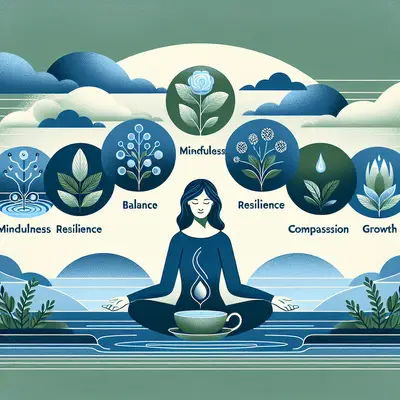
Mental wellness is often described in broad, gentle strokes: “self-care,” “balance,” “mindfulness.” Yet those seeking a truly composed inner life know there is a finer grain—a level of quiet precision that separates temporary relief from enduring clarity. This is the territory of intentional practice: thoughtfully designed, elegantly simple, and deeply effective.
What follows is a refined exploration of mental wellness, anchored by five exclusive insights crafted for those who value discretion, depth, and quiet excellence in their inner world.
Mental Wellness as Cognitive Craftsmanship
Think of mental wellness less as a mood and more as craftsmanship—a continuous, deliberate shaping of how you think, notice, and respond. Instead of chasing “feeling better” in a vague sense, cognitive craftsmanship asks: How does your mind construct stress, meaning, and memory? Where are the seams, the distortions, the refinements?
From a scientific perspective, mental wellness is not a static state but a dynamic process involving brain plasticity, emotional regulation, and behavioral patterns. Practices such as reframing thoughts, cultivating micro-pauses before reacting, and building small, consistent rituals literally alter neural pathways over time. Rather than trying to eliminate discomfort, a more sophisticated aim is to elevate the quality of your thoughts under pressure—clarity in motion, not calm in isolation.
Seen this way, wellness is no longer an amorphous goal. It becomes a series of precise, repeatable acts: the decision to respond instead of react, to inquire instead of assume, to notice a story you are telling yourself—and gently edit it.
Exclusive Insight 1: The “Cognitive Temperature Check”
Most people monitor their physical temperature when they feel unwell; very few monitor their cognitive temperature—how “hot” or “cold” their thinking is in a given moment.
A cognitive temperature check is a subtle, 30-second self-assessment used throughout the day:
Rate the heat of your thoughts: On a scale of 1–10, how emotionally charged are your thoughts right now?
Name the dominant “climate”: Is your mind stormy (catastrophic), foggy (uncertain), dry (disconnected), or clear (balanced)?
Identify one distortion: Are you assuming the worst, personalizing, mind-reading, or using all-or-nothing thinking?
This practice is a quiet sophistication: instead of getting swept into narratives, you notice the weather pattern of your thinking. Over time, you begin to recognize when your mind is running hot—when you are more likely to misinterpret, overreact, or ruminate.
Clinical research on cognitive behavioral therapy (CBT) has long shown that identifying cognitive distortions reduces anxiety and depression. The temperature check is a polished, portable variation: unobtrusive, fast, and elegant enough to be used in a boardroom, at a dinner table, or in solitary reflection without anyone else noticing.
Exclusive Insight 2: Curated Input as Psychological Hygiene
Mental wellness is often discussed in terms of output—habits, reactions, resilience. A more refined lens asks: What is the quality of what enters your mind?
Curated input is psychological hygiene: the intentional selection of information, conversations, and environments that your mind metabolizes. Just as nutrition science proves that food quality shapes physical health, emerging research suggests that ongoing exposure to negative news, digital overload, and conflict-heavy social feeds can elevate stress hormones and distort risk perception.
A sophisticated approach is not full withdrawal from the world but selective curation:
- Narrow your information channels: Choose a small number of trusted, evidence-based sources instead of scrolling endless feeds.
- Time-box your exposure: Allocate defined windows for consuming news or social media, followed by a brief “digest” moment—What truly matters here? What can I let go?
- Prioritize nourishing conversations: Seek exchanges that are future-oriented, solution-focused, or genuinely intimate over gossip, complaint loops, or chronic outrage.
When you treat your mental input as carefully as a sommelier treats a cellar, your baseline mood stabilizes. You feel less mentally “inflamed,” more able to discern what deserves your attention—and what simply does not.
Exclusive Insight 3: The Subtle Power of Micro-Closure Rituals
One reason the mind feels chronically overloaded is incomplete cycles—tasks not finished, conversations not resolved, emotions not acknowledged. This creates a subtle cognitive “open tab” effect, where your brain repeatedly revisits unfinished business, draining mental energy.
Micro-closure rituals are brief, elegant gestures that tell the nervous system: This is complete for now.
These might include:
- Writing a single sentence at the end of your workday: “Today is complete; tomorrow I will focus on…”
- Pausing after a difficult interaction to name the emotion, then intentionally exhaling as a symbolic close.
- Creating a small physical act—closing a notebook, dimming a light, placing a pen in a specific spot—to mark the end of a mental effort.
Neuroscience suggests that our brains crave narrative completion; even a modest sense of resolution can reduce rumination. Micro-closure rituals do not insist everything be perfect or fully solved; they merely acknowledge that a chapter has been read for now, so your mind does not keep re-reading it at 3 a.m.
This is mental wellness at its most understated: no grand declarations, just consistent signals to the brain that it may rest.
Exclusive Insight 4: Emotional Range as a Sign of Mental Wealth
In a culture that often equates mental wellness with perpetual positivity, a more nuanced reality is emerging: emotional range, not emotional sameness, is the mark of a well-resourced inner life.
A mentally wealthy person can experience sadness without collapse, anger without cruelty, fear without paralysis, and joy without denial. The nervous system is flexible, not rigid; it allows full, textured feelings while maintaining a steady sense of self.
Research on emotional regulation and resilience shows that the goal is not suppression but integration. People who can skillfully label their emotions—“irritation,” “disappointment,” “relief,” “anticipation”—often show better coping and lower reactivity. This fine-grained naming is called emotional granularity, and it acts like high-definition vision for your inner life.
To cultivate emotional range:
- Replace “I’m stressed” with more precise language: overwhelmed, under-resourced, overcommitted, uncertain.
- Allow emotions to be informative rather than definitive; they are signals, not verdicts.
- Practice holding two truths at once: “I’m grateful for this opportunity and I’m anxious about it.”
Over time, your emotional life becomes less like a single note and more like a well-tuned instrument—capable of subtle, complex music rather than blunt, repetitive noise.
Exclusive Insight 5: Designing a Personal “Mental Atelier”
An atelier is a studio where craftsmanship is refined—part sanctuary, part laboratory. Translating this concept to mental wellness means designing a personal mental atelier: a conceptual and, if possible, physical space where you attend deliberately to your inner life.
This is not simply “me time.” It is dedicated, structured refinement time: brief, regular intervals where you step into a higher standard of self-observation and adjustment.
Your mental atelier might include:
- A signature reflective question: “What did I learn about myself today?” or “Where did I act from fear instead of clarity?”
- A preferred tool: A high-quality notebook, a specific digital app, or a voice memo ritual that you reserve solely for self-inquiry.
- A consistent sensory cue: A certain chair, a particular light, a specific instrumental playlist that signals to your brain: We are in refinement mode now.
Research in habit formation and behavioral design suggests that context cues and ritualized environments powerfully shape behavior. By creating a distinct “studio” for your mind—even if it’s just the same corner of your sofa at the same time each evening—you train yourself to associate that space with deeper insight, calmer processing, and more refined decision-making.
The atelier is where you quietly recalibrate: not to become someone else, but to meet yourself with more precision, honesty, and grace.
Conclusion
Mental wellness, at its most elevated, is not a glossy aesthetic of perfection. It is the disciplined elegance of knowing how your mind works—and choosing, again and again, to work with it rather than be ruled by it.
Through cognitive temperature checks, curated input, micro-closure rituals, emotional range, and the creation of a personal mental atelier, you move beyond generic advice into a more exacting, deeply personal standard of inner care. The result is not loud transformation but something far more enduring: a mind that feels quietly precise, deeply capable, and unmistakably your own.
Sources
- National Institute of Mental Health – Caring for Your Mental Health - Overview of evidence-based approaches to maintaining and improving mental health
- American Psychological Association – Cognitive Behavioral Therapy - Explains how identifying and reframing cognitive distortions supports emotional wellbeing
- Harvard Health Publishing – How to Build Resilience - Discusses emotional regulation, flexibility, and strategies for psychological resilience
- Yale Medicine – Emotional Regulation and Mental Health - Explores the role of emotional awareness and regulation in overall mental wellness
- Pew Research Center – News Consumption and Well-Being - Examines how exposure to media and news relates to perceptions of mental health and stress
Key Takeaway
The most important thing to remember from this article is that this information can change how you think about Mental Wellness.