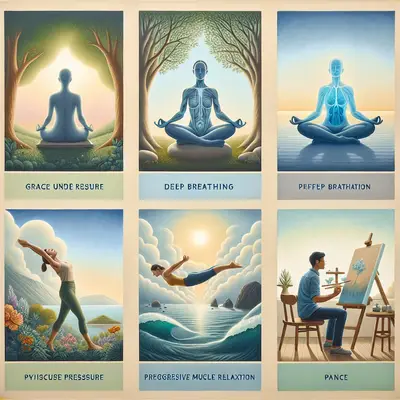
Stress does not only tighten the jaw or shorten the breath; it subtly rewires how the entire nervous system perceives the world. For a discerning mind, the goal is not to “eliminate stress” but to refine the way the body and brain respond to it. Instead of quick fixes and surface-level advice, this approach leans toward quiet recalibration—precise, intentional shifts that restore dignity, depth, and grace to everyday mental functioning.
Below are five exclusive, high-level insights designed for those who take their inner environment as seriously as their outer one.
Rethinking Stress: Moving from “Enemy” to “Intelligent Signal”
A sophisticated approach to stress begins with refusing to treat it as a personal failure. Stress is not simply a malfunction; it is an intelligent signal from a nervous system trying to adapt.
When the body enters a state of stress, hormones like cortisol and adrenaline mobilize resources: sharpening attention, elevating heart rate, and prioritizing immediate demands. In moderation, this response is both protective and productive. Chronic, unmodulated activation, however, distorts perception—what is merely urgent begins to feel existential, and the nervous system loses its nuance.
Instead of asking, “How do I get rid of stress?” a more refined question is, “What is this stress asking me to re-evaluate?” It might be the cadence of your day, the quality (not quantity) of your rest, or the boundaries you keep around your attention. Viewing stress as precise feedback, rather than an abstract adversary, allows you to make strategic, targeted adjustments, rather than episodic acts of self-care that never quite address the root pattern.
Insight 1: Curated Micro-Rest—Designing 90-Second Nervous System Resets
One of the most underappreciated arts in stress relief is the cultivation of “micro-rest”—short, meticulously designed intervals that signal safety to the nervous system without requiring a full break from life.
A 90-second reset is long enough for measurable physiological shifts yet brief enough to insert between calls, meetings, or tasks. The key is not just pausing, but offering the nervous system a distinct, sensory-rich experience of “not being under threat.” For example:
- Lower your gaze or softly close your eyes and consciously relax the muscles around the eyes and tongue—two areas tightly linked to the stress response.
- Exhale slightly longer than you inhale (e.g., in for 4 seconds, out for 6–8) to gently engage the parasympathetic “rest-and-digest” branch of the nervous system.
- Introduce a single, anchored sensory cue: the feel of cool glass in your hand, the texture of fabric beneath your fingertips, or a faint, deliberate scent such as cedar or bergamot.
These micro-rest intervals function as elegant “bookmarks” of calm throughout your day. Over time, the nervous system becomes familiar with this refined patterning and is less reactive by default, not because life is easier, but because your inner calibration is more sophisticated.
Insight 2: Nervous System Literacy—Knowing Your Personal Stress Signature
People with a refined approach to mental wellness often know their wine preferences, fitness metrics, and sleep data—but very few know their “stress signature” with equal clarity. Nervous system literacy is the capacity to recognize, with precision, how your body and mind uniquely express overload.
For some, stress begins as subtle impatience with small inefficiencies. For others, it first appears as a quiet withdrawal, a sense of emotional flattening, or an inability to enjoy what is usually nourishing. Physical tells can be equally nuanced—jaw clenching, shallow upper-chest breathing, a slightly racing mind at night, or digestive changes.
Documenting your stress signature over a few weeks—without judgment—is a sophisticated practice of self-observation. Note:
- Early physical shifts (posture, breathing patterns, muscle tension)
- Cognitive patterns (catastrophizing, over-planning, difficulty prioritizing)
- Emotional tones (irritability, numbness, fragile sensitivity)
This detailed awareness lets you intervene at the “whisper” stage, instead of waiting for stress to escalate into headaches, insomnia, or emotional exhaustion. The earlier your intervention, the more subtle—and therefore more elegant—it can be.
Insight 3: Attention Conservation as a Luxury-Level Stress Strategy
In a culture where attention is perpetually fragmented, preserving mental focus is becoming a form of luxury—both rare and deeply restorative. Chronic stress is not only about workload; it is also about how many directions your attention is pulled in at once.
Attention conservation is the practice of treating your cognitive bandwidth as a limited, premium resource—and defending it accordingly. This may include:
- Creating defined “unreachable” windows in your day where notifications are silenced and only one task is allowed to exist.
- Curating your digital landscape: unfollowing content that subtly agitates, inflames, or overstimulates your nervous system, even if it’s intellectually interesting.
- Reserving your most cognitively clear hours (often the first 90–120 minutes after waking) for deep, meaningful work, not reactive communication.
This is not about rigid control; it is about architectural elegance—reshaping the flow of attention so your nervous system is not forced into a perpetual state of low-grade alarm. When attention is less scattered, stress has fewer “hooks” to grab onto, and the mind can experience complexity without collapsing into chaos.
Insight 4: Ritualized Transitions—Protecting the Edges of Your Day
Stress is often amplified not by what we do, but by how abruptly we move between roles, responsibilities, and environments. Without conscious transitions, the nervous system is dragged from one state to the next without integration.
Ritualized transitions are small, repeatable gestures that signal to your body and mind: “We are shifting modes now.” These can be beautifully understated:
- After work, a deliberate wardrobe shift—even changing into a specific, comfortable piece of clothing—can act as a sensory cue that the performance layer is being released.
- Before sleep, a brief “closing scan” of the day—mentally acknowledging three tasks you completed and one you are intentionally leaving for tomorrow—prevents unresolved loops from occupying your mind at night.
- Between intense meetings, a 2-minute walk, even indoors, with gentle awareness of your footsteps and posture, offers the body a reset from sitting in a braced, performance-focused position.
These transitions function as elegant buffers. They keep stress from bleeding unchecked across every domain of life, preserving certain pockets—your home, your evenings, your sleep—as environments where the nervous system can reliably exhale.
Insight 5: Elevating Recovery: Treating Rest as Strategic, Not Passive
For many high-functioning individuals, rest is mistakenly equated with inactivity—collapsing on the sofa, scrolling, or half-watching something to “switch off.” True nervous system recovery, however, is precise, active, and thoughtfully curated.
First, distinguish between mental, emotional, and sensory exhaustion. A mentally fatigued brain may need undemanding physical movement and natural light rather than more sitting. Emotional exhaustion may require warm, regulated connection with one trusted person, or carefully chosen solitude. Sensory overload might best be addressed with dim lighting, minimal sound, and tactile comfort.
Consider upgrading your recovery practices with intentional detail:
- Replace undirected late-night screen time with a short, predictable wind-down sequence: warm beverage, dim light, one physical page of reading, a few gentle stretches. Consistency is more powerful than intensity.
- Create a “recovery menu” rather than a single default strategy: slow walk outdoors, restorative yoga, a brief guided relaxation, journaling to externalize mental clutter, or silent stillness with a weighted blanket.
- Protect sleep as a non-negotiable pillar of stress resilience, not a negotiable afterthought. The nervous system recalibrates and consolidates emotional processing while you sleep; treating this process casually is an invisible cost to mental clarity.
When rest is approached as a strategic, high-value investment rather than something squeezed into the margins, the nervous system becomes more tolerant of temporary pressure and less prone to chronic overload.
Conclusion
Stress relief, at its most refined, is less about dramatic interventions and more about impeccably subtle design: how you breathe between tasks, how you move between roles, how you guard your attention, and how you treat your nervous system when no one is watching.
By cultivating micro-rest, learning your personal stress signature, conserving attention, honoring transitions, and elevating recovery, you move beyond generic self-care into a more sophisticated relationship with your inner world. In that space, calm is not a performance—it is a quiet, reliable undercurrent that remains, even when life asks more of you.
Sources
- [American Psychological Association – Stress Effects on the Body](https://www.apa.org/topics/stress/body) – Overview of how stress impacts various systems in the body
- [National Institute of Mental Health – 5 Things You Should Know About Stress](https://www.nimh.nih.gov/health/publications/stress) – Accessible summary of stress, its signs, and management approaches
- [Harvard Health Publishing – Understanding the Stress Response](https://www.health.harvard.edu/staying-healthy/understanding-the-stress-response) – Detailed explanation of the biological mechanisms of stress
- [Cleveland Clinic – The Importance of Rest and Recovery](https://health.clevelandclinic.org/importance-of-rest-and-recovery) – Discusses how intentional rest supports physical and mental resilience
- [NIH MedlinePlus – Stress Management](https://medlineplus.gov/stressmanagement.html) – Evidence-based strategies and educational material on managing stress
Key Takeaway
The most important thing to remember from this article is that this information can change how you think about Stress Relief.