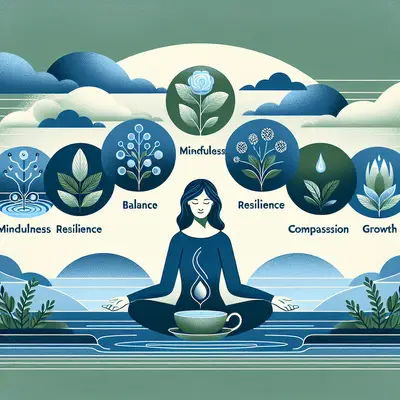
Mental wellness is often spoken of in emergencies—burnout, breakdowns, and “rock bottom” moments. Yet for a discerning mind, the true measure of wellbeing is not crisis management, but the quiet standard we uphold each day. Cultivated thoughtfully, mental wellness becomes less of a project and more of a craft: something refined, practiced, and subtly elevated over time.
Below are five exclusive, nuanced insights designed for those who wish to treat their inner life with the same care they devote to their home, wardrobe, or work. These are not quick fixes, but enduring practices for a more composed, intelligent, and beautifully regulated mind.
Mental Tone: Curating the “Atmosphere” of Your Inner World
Most discussions of mental health focus on thoughts and emotions as discrete events. More useful—and more elegant—is to think in terms of mental tone: the overall atmosphere your mind defaults to throughout the day.
Mental tone is the emotional “color temperature” of your mind: cool and clear, or harsh and overexposed. It is shaped by what you repeatedly consume, how you speak to yourself internally, and the pace at which you move through your hours. Instead of fighting individual thoughts, begin curating this atmosphere the way you might design a room: selectively, deliberately, and with restraint.
Subtle adjustments make a significant difference. Limiting exposure to low-quality digital noise, choosing your morning inputs with intention (long-form writing instead of frantic scrolling), and adopting a slower, more deliberate cadence in speech and movement all recalibrate your baseline. When your mental tone is composed, difficult thoughts still arise—but they do so in a climate that is less reactive and more thoughtful. Over time, this becomes your default: a mind that feels quietly well-appointed from the inside.
Cognitive Minimalism: Editing Your Inner Commitments
Busyness is no longer a status symbol; it is a form of mental clutter. Cognitive minimalism is the discipline of editing not only your schedule, but your mental commitments: every idea, project, obligation, and concern that quietly rents space in your mind.
Begin by distinguishing between what is yours and what is merely lodged in you. Are you carrying other people’s expectations? Old ambitions that no longer fit your life? Outdated self-criticism that once served a purpose but now only drains your energy? Instead of endlessly adding new routines and “hacks,” the sophisticated move is subtraction: loosening the grip of what no longer deserves your attention.
One practical refinement is to maintain a private “mental ledger” of commitments: not just tasks, but unresolved conversations, lingering decisions, and silent resentments. Review it weekly and decide what to complete, what to delegate, and what to release entirely. This is not laziness; it is precision. A mind with fewer, higher-quality commitments operates with more clarity, more stamina, and far more grace under pressure.
Nervous System Literacy: Understanding Your Inner Instrument
Mental wellness cannot be sustained without understanding the instrument on which your inner life plays: your nervous system. Nervous system literacy means recognizing not only your thoughts and feelings, but also the physiological patterns underneath them—subtle shifts in breath, muscle tension, heart rate, and energy.
Rather than labeling everything as “stress” or “anxiety,” begin to notice specific internal states: are you keyed-up and restless (hyperarousal), or foggy and withdrawn (hypoarousal)? Are your shoulders quietly clenched, your jaw slightly locked, your breath shallow? These micro-signals are your body’s early notifications, long before your mind declares a crisis.
With literacy comes the capacity for elegant intervention. Slow, lengthened exhales; a short walk without your phone; placing a cool glass of water in your hand and noticing its weight—each can gently recalibrate your system. You are not merely “calming down”; you are bringing your nervous system back into a window where thought is clearer, choice is easier, and emotion is less overwhelming. Over time, this becomes an inner form of good manners: you do not allow your system to become chronically overtaxed without response.
Inner Aesthetic: Choosing the Quality of Your Self-Talk
We often describe aesthetic choices in our outer life—architecture, clothing, typography—as a reflection of taste. Yet your inner aesthetic may matter more: the tone, language, and texture of how you speak to yourself when no one is listening.
Self-talk is often addressed in simplistic terms: “be positive,” “stop being hard on yourself.” A more refined approach is to consider quality rather than mere positivity. Is your inner voice coarse or precise? Sarcastic or respectful? Chaotic or measured? The goal is not to flatter yourself, but to cultivate an internal way of speaking that is both honest and dignified.
You might experiment with addressing yourself in the second person (“You handled that well,” “You’re tired, not failing”) or adopting a tone you would reserve for someone you deeply respect. Over time, your self-talk becomes less of a running critique and more of an internal counsel—firm when needed, but never cruel. This quiet refinement changes how you move through difficulty: not with self-indulgence, but with a level of inner civility that is increasingly non-negotiable.
Deliberate Recovery: Treating Restoration as a Non-Negotiable Ritual
High-functioning individuals often treat recovery as optional—something to attend to if there is time. Yet genuine mental wellness requires deliberate recovery: not mere rest, but consciously structured restoration that matches the demands placed on your mind.
This is less about “unplugging” and more about recalibrating. After intense cognitive work, scrolling a feed may feel like rest, but it often prolongs mental agitation. True recovery for the mind is usually quieter, slower, and more embodied than we initially reach for: a bath in low light, a brief walk in nature without headphones, a single page of a well-written book rather than 50 fragments of content.
The key is to design a personal recovery repertoire: a small set of practices you know move the needle for you—perhaps a precise bedtime ritual, a particular genre of music, a familiar breathing pattern, or a carefully prepared evening tea. When these are treated not as luxuries but as infrastructure, your days develop a rhythm: exertion followed by intentional restoration. It is this rhythm—not any single practice—that supports a mind capable of nuance, resilience, and sustained clarity.
Conclusion
Mental wellness, at its most refined, is not spectacle. It is the invisible standard you hold for how your inner life is tended, day after day. Curating your mental tone, editing your cognitive commitments, understanding your nervous system, elevating your self-talk, and ritualizing recovery are not dramatic gestures; they are quiet acts of craftsmanship.
Over time, these practices produce an interior experience that feels less like survival and more like stewardship: you are not merely getting through your days, but shaping them. And as with all finely made things, the true luxury is not in what others can see—but in how exquisitely it feels from the inside.
Sources
- National Institute of Mental Health – Caring for Your Mental Health – Overview of evidence-based practices and principles for maintaining mental wellbeing
- Harvard Health Publishing – The Science of Breathing – Explains how breath and relaxation techniques influence the stress response and nervous system
- American Psychological Association – Stress Effects on the Body – Detailed look at how chronic stress impacts physiological and psychological health
- Yale Medicine – Understanding the Nervous System and Stress – Discusses how stress interacts with the nervous system and implications for mental wellness
- Mayo Clinic – Positive Thinking and Self-Talk – Outlines the effects of self-talk patterns on mental health and resilience
Key Takeaway
The most important thing to remember from this article is that this information can change how you think about Mental Wellness.