In a culture that worships acceleration, true luxury is no longer what we acquire, but how we feel within our own skin. Mental clarity, emotional steadiness, and the quiet confidence of a well-regulated nervous system have become the new markers of an elevated life. Natural remedies—when chosen with discernment and practiced with intention—offer a subtle yet powerful way to cultivate this refined calm. Beyond quick fixes and trends, they invite us into a slower, more deliberate relationship with our own minds.
This guide explores a collection of natural practices and botanicals through a sophisticated lens, with five exclusive insights tailored for those who see mental wellness as a lifelong art, not a weekend project.
The New Luxury: A Nervous System That Doesn’t Startle Easily
The most understated form of opulence is a nervous system that does not live in constant alarm. Anxiety, over-stimulation, and chronic stress are not just emotional experiences; they are physiological states, rooted in how the brain and body communicate.
Natural remedies—such as adaptogenic herbs, grounding rituals, and mindful breathing—work not by numbing the mind, but by subtly recalibrating the stress response. Adaptogens like ashwagandha and rhodiola, for instance, are being studied for their potential to support the body’s resilience to stress, modulating cortisol rather than bluntly suppressing it.
Equally important is the micro-architecture of our day: the sensory inputs we allow, the pauses we create, and the quiet spaces between tasks. A truly premium approach to mental wellness is less about a single miracle remedy, and more about designing an ecosystem in which your nervous system can trust that it is safe.
Exclusive Insight #1: Think in terms of “nervous system design,” not just self-care.
Instead of asking “What can I take to feel calmer?” begin with “What would it mean to live in a way that my nervous system is not constantly ambushed?” Natural remedies are most effective when they support an already softened, decluttered inner environment.
Botanical Composure: Herbs as Subtle Emotional Architecture
Thoughtfully chosen botanicals can function like architectural elements for the mind—beams of support, softening edges, and adding structural calm where there was once only tension. They are not decorative; they are foundational.
Calming herbs such as lemon balm, chamomile, and lavender have been examined for their potential anxiolytic (anxiety-lowering) and sleep-supportive properties. For instance, lemon balm has been studied for its effects on mild anxiety and sleep quality, while chamomile has shown promise in reducing symptoms of generalized anxiety in some clinical populations. These herbs do not erase the complexities of life, but they can create a gentler internal backdrop against which those complexities are processed.
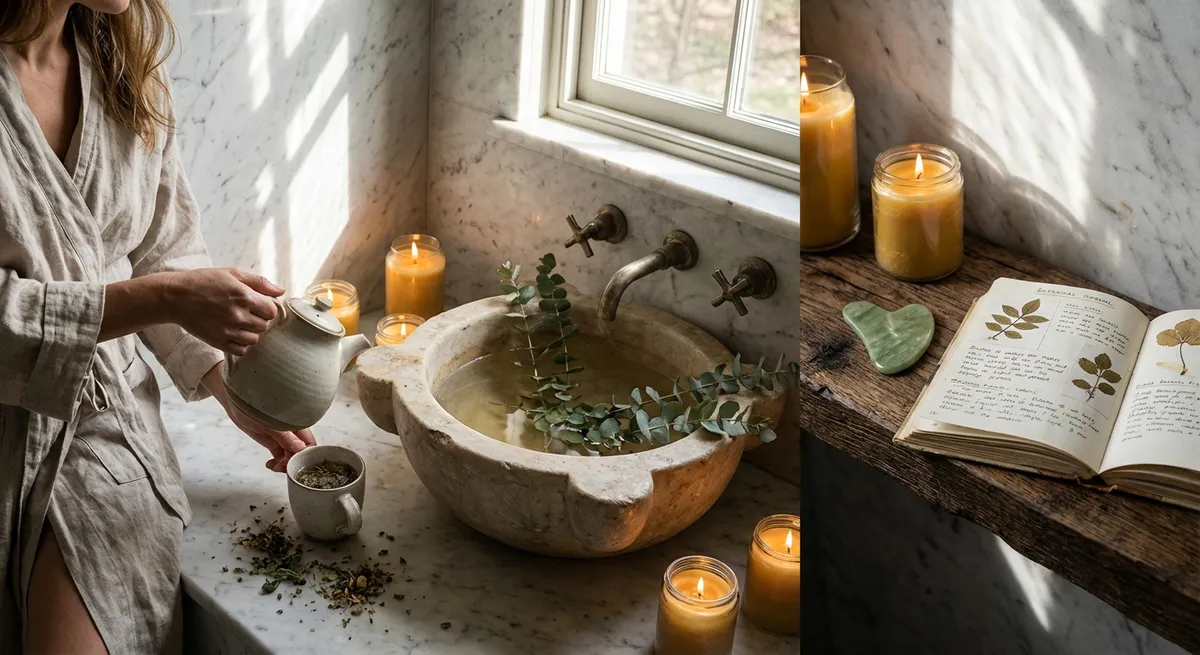
Preparation matters. A hastily brewed tea sipped while scrolling through a phone will never have the same effect as a perfectly steeped infusion, enjoyed in silence, with intentional breathing. The herb is the ingredient; the ritual is the delivery system.
Exclusive Insight #2: Treat botanicals as an experience, not a supplement.
Elevate a simple herbal tea into a nightly ceremony: select a specific cup you only use for this purpose, steep for the full recommended time, and sit without screens until you finish the last sip. Over time, your nervous system will begin to associate this sequence with release and rest, amplifying the effect of the herbs.
Precision Stillness: Breathwork as a Natural Neurochemical Lever
Among all natural remedies, intentional breathing is perhaps the most overlooked form of precision medicine for the mind. It requires no purchase, no device, and yet it exerts a measurable influence on heart rate, blood pressure, and perceived stress levels.
Slow, controlled exhalations can activate the parasympathetic nervous system—the body’s “rest and digest” mode—resulting in a tangible sense of calm. Techniques such as paced breathing (for example, inhaling for four counts, exhaling for six or eight) leverage the vagus nerve, a key player in regulating emotional and physiological states.
Breathwork can be used like a tailored perfume: specific patterns for specific moments. Quick, energizing breathing for mental clarity before a demanding conversation; slow, extended breathing in the evening to encourage rest. When integrated into daily life with finesse, it becomes less of a practice and more of a personal signature of composure.
Exclusive Insight #3: Match your breath pattern to your intention, not your mood.
Instead of breathing the way your current emotion dictates (shallow when stressed, constricted when anxious), choose a pattern that reflects how you want to feel. For calming: longer exhalations than inhalations. For mental clarity: balanced, rhythmic breathing. Over time, you’re not just managing emotions—you’re gently retraining them.
Quiet Light: Curating Natural Light and Darkness for Mental Poise
We often think of natural remedies as herbs and teas, yet light is one of the most potent “natural medicines” we can work with. Our circadian rhythm—our internal 24-hour clock—governs sleep, mood, hormonal balance, and cognitive performance. When light exposure is erratic, our mental state follows.
Morning light, especially within the first hour of waking, helps anchor your circadian rhythm, signaling to your brain that it is daytime and setting a timer for when melatonin (the sleep hormone) will rise later in the evening. Conversely, exposure to blue-rich artificial light late into the night can delay melatonin release, fragment sleep, and subtly destabilize mood.
A refined mental wellness practice treats light with the same discernment one might apply to fine fragrance or art. You curate it: bright, natural light in the early day; softer, warmer tones in the evening; intentional darkness before sleep.
Exclusive Insight #4: Design a “light etiquette” for your mind.
Instead of focusing only on screen time, establish personal light rules: seek 10–20 minutes of natural light outdoors most mornings; dim overhead lights after sunset; use warmer lamps or candles in the hour before bed. This elegant choreography of light and darkness can become one of the most powerful natural stabilizers of mood and mental clarity.
The Subtle Art of Consistency: When Natural Remedies Become Identity
The true magic of natural remedies emerges when they evolve from occasional interventions into quiet, defining habits—so integrated into your life that they become part of how you recognize yourself.
A magnesium-rich evening drink, a calming tincture before a demanding social event, a few minutes of breathwork during transitions, a non-negotiable evening “digital sunset”: taken alone, each of these is small. Repeated consistently, they form an invisible architecture of safety and predictability for the mind.
This is where sophistication enters: not in extravagance, but in curation. A refined mental wellness routine is not cluttered with everything that might help; it is composed of a select few practices that you have tested, felt, and chosen with intention. It is minimal, but deeply personal.
Exclusive Insight #5: Let your remedies reflect your values, not the trends.
Choose natural practices and botanicals that feel aligned with your deeper priorities—slowness, clarity, focus, relational presence—rather than simply following what is currently popular. When your remedies express who you are and how you wish to move through the world, adherence is no longer discipline; it is self-recognition.
Conclusion
In an era that confuses busyness with importance, mental wellness has become a quiet form of rebellion—and an unmistakable marker of taste. Natural remedies, when approached with discernment and artistry, offer more than symptom relief. They invite a reorientation: away from urgency, toward elegance; away from reactivity, toward intentionality.
A calm mind is not an accident. It is crafted. Through botanicals chosen with care, breath practiced with intelligence, light curated with sensitivity, and habits repeated with devotion, you can create an inner environment that feels both grounded and exquisitely alive. In that space, composure is no longer something you chase; it becomes the way you inhabit your life.
Sources
- National Center for Complementary and Integrative Health (NCCIH) – Herbs at a Glance - Overview of commonly used herbs like chamomile, lavender, and lemon balm, including safety and evidence summaries
- Harvard T.H. Chan School of Public Health – Stress and Health - Discusses how chronic stress affects the body and brain, and the importance of managing the stress response
- Cleveland Clinic – Breathing Exercises for Anxiety - Explains specific breathing techniques and how they influence the nervous system and anxiety levels
- National Institutes of Health – Circadian Rhythms - Describes the science of circadian rhythms and how light exposure affects sleep, mood, and overall health
- Mayo Clinic – Ashwagandha: Is it helpful for stress? - Reviews the evidence for ashwagandha as an adaptogen and its potential role in stress and anxiety management
Key Takeaway
The most important thing to remember from this article is that this information can change how you think about Natural Remedies.