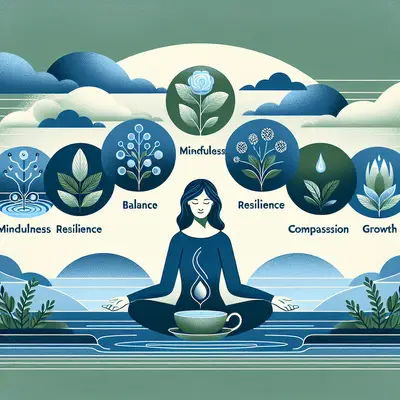
Mental wellness is no longer a luxury; it is the defining infrastructure of a considered life. In an era of relentless alerts, accelerating expectations, and curated perfection, the true premium is not what we own, but how serenely we inhabit our own mind. This is where mental wellness evolves from “self-care” into an art form—anchored in discernment, intentionality, and subtle yet powerful daily choices.
Below are five exclusive, quietly radical insights tailored for those who treat their inner world with the same care they give to their most important investments.
Redefining Well-Being as Mental “Texture,” Not Just Balance
Much of mainstream wellness still speaks in blunt terms: “stress vs. calm,” “burnout vs. balance.” For a more discerning mind, these binaries feel insufficient. A refined mental life is not simply “balanced”—it has texture, dimension, and nuance.
Instead of asking, “Am I balanced?” consider: “What is the texture of my mind today?” Is it taut, scattered, velvety, bright, porous, or heavy? This language shift is subtle yet transformative. It invites curiosity instead of judgment and allows you to respond with more precision.
For example, a “granular” mind might signal over-analysis and cognitive fatigue—call for simplification and less input. A “foggy” mind suggests sleep debt, emotional overload, or unprocessed stress—call for rest, hydration, or a slow walk without stimulation. A “sharp but brittle” mind may indicate high performance riding on adrenaline—call for nourishment and deliberate downshifting at the end of the day.
By refining how you describe your inner state, you refine how you intervene. You stop reaching for generic fixes and begin selecting appropriately matched remedies: lower light, gentler social contact, better boundaries around digital noise, or more substantial psychological support if needed. Over time, this attention to mental texture becomes a quiet but powerful form of self-leadership.
Curated Input: Treating Your Attention Like a Private Members Club
For a cultivated mind, attention is not merely a resource; it is an asset class. What you allow through the gates of your awareness either nourishes your equilibrium or corrodes it. A premium approach to mental wellness involves curating your informational and emotional intake with the selectivity of a sommelier designing a cellar.
Begin with two questions:
Does this deserve front-row access to my nervous system?
What is the emotional residue this leaves behind?
News consumption, for example, need not be eliminated but refined: fewer sensationalist headlines, more long-form, well-researched journalism at designated times of day. Social media can be pruned to accounts that offer education, inspiration, or grounded perspective rather than agitation and comparison.
This curated input principle extends to conversations as well. It is entirely appropriate—and mentally protective—to limit ongoing exposure to chronic complainers, perpetual dramatists, or those who treat your presence as an emotional dumping ground. The goal is not sterile positivity, but proportionate exposure: space for complexity and difficulty, without letting it colonize your mind.
Over time, this selective gatekeeping builds a quieter cognitive environment in which clarity can naturally arise. Your mind becomes less like a public square and more like a well-run, invitation-only salon.
Precision Rest: Upgrading “Taking a Break” into a Deliberate Practice
Most people rest reactively: they collapse into a break when exhaustion is no longer negotiable. A refined approach treats rest as a calibrated tool that resets the mind with intention and efficiency. This is precision rest—choosing the right kind of pause for the specific kind of fatigue you’re experiencing.
Mental fatigue is not monolithic. You might be:
- Cognitively depleted: difficulty focusing, slower processing
- Emotionally saturated: small things feel disproportionately intense
- Sensory overloaded: lights, noise, or crowds feel intrusive
- Decision-weary: irritation at small choices, avoidance of planning
Each state calls for its own micro-ritual. For cognitive depletion, short, structured breaks—like 5–10 minutes of looking at a distant view, gentle stretching, or a brief walk without your phone—help reset attention systems. For emotional saturation, regulating the body first (deep, slow breathing, warm shower, or physical stillness) allows the mind to loosen its grip.
Sensory overload responds well to quiet, dim environments and single-focus activities (a physical book, simple cooking, organizing a drawer). Decision fatigue improves when you temporarily outsource or pre-decide: set default meals, recurring outfits, or automated financial actions, reducing the number of choices your brain must make.
By matching rest type to fatigue type, you elevate “time off” into a strategic, deeply restorative practice that supports sustainable performance and emotional poise.
Understated Rituals: Designing Micro-Moments of Psychological Luxury
True mental wellness rarely hinges on grand gestures; it is whispered through the architecture of your small, repetitive actions. Understated rituals—elegant yet practical—quietly signal to your nervous system that you are safe, anchored, and attended to.
A psychologically luxurious ritual is less about opulence and more about deliberate quality. It might be:
- A consistent pre-sleep sequence: dimmer lights, warm beverage, brief journaling, and a strict boundary from late-night emails
- A thoughtfully arranged morning corner: a specific chair, one beautiful object, natural light, and a 7-minute reading or reflection window
- A transition ritual between “public” and “private” self: changing clothes when returning home, washing hands slowly, or taking three conscious breaths at the door
The power lies in repetition and intention, not complexity. These micro-rituals act as gentle cues to your brain, marking thresholds: work to rest, public to private, external obligations to internal restoration. With time, your nervous system begins to anticipate calm when these rituals begin, shortening the distance between agitation and ease.
For those with demanding lives, these practices become non-negotiable infrastructure—subtle but sturdy scaffolding that keeps your mental landscape from collapsing under chronic pressure.
Inner Governance: Making Decisions That Protect Your Future Mind
One of the most sophisticated forms of mental wellness is learning to make decisions on behalf of your future mind, not just your present mood. This is inner governance: treating your psychological state as something you actively steward over time.
This mindset reframes everyday questions:
- Instead of “Do I feel like going to bed earlier?” → “What will my mind need from me at 9 a.m. tomorrow?”
- Instead of “Can I squeeze in one more commitment?” → “What is the cumulative impact of this week on my mental bandwidth?”
- Instead of “Do I want to check my phone right now?” → “Will this fragment my focus and make my mind feel scattered afterward?”
Once you start thinking in these terms, boundaries stop feeling like deprivation and start feeling like allegiance—to the clarity, stability, and subtle confidence you want to inhabit. It becomes easier to decline invitations that require more emotional output than you can afford, to delegate when your bandwidth is not infinite, and to schedule recovery with as much seriousness as output.
Inner governance also means knowing when self-guided efforts are no longer sufficient. Seeking therapy, coaching, or medical evaluation for persistent anxiety, low mood, or cognitive fog is not a failure of self-management; it is a high-level decision to protect your most valuable asset: your mind’s long-term capacity to think clearly, feel fully, and live well.
Conclusion
Mental wellness, approached with refinement, is less about dramatic transformation and more about consistently elevated choices—curated inputs, precise rest, understated rituals, nuanced self-understanding, and decisions made in loyalty to your future self.
In a world that rewards speed and spectacle, choosing to cultivate a composed, well-governed inner life is quietly radical. It is also profoundly practical. The calmer, more coherent your mind becomes, the more elegantly you can move through complexity, lead others, and inhabit your own life with quiet confidence.
Mental wellness is not an accessory to success; it is the signature of a life intentionally, intelligently lived.
Sources
- [National Institute of Mental Health – Caring for Your Mental Health](https://www.nimh.nih.gov/health/topics/caring-for-your-mental-health) – Overview of evidence-based strategies and principles for maintaining mental health
- [Harvard Health Publishing – The Importance of Rest for Mental Health](https://www.health.harvard.edu/mind-and-mood/the-importance-of-rest-for-mental-health) – Explores how different forms of rest influence mood, cognition, and overall well-being
- [American Psychological Association – Managing Your Stress](https://www.apa.org/topics/stress) – Research-backed guidance on recognizing stress patterns and developing healthier coping strategies
- [Mayo Clinic – Mental Health: Strengthening Your Emotional Health](https://www.mayoclinic.org/healthy-lifestyle/adult-health/in-depth/mental-health/art-20044098) – Practical, medically reviewed recommendations for emotional self-care and resilience
- [Yale University – The Science of Well-Being](https://ysph.yale.edu/wellbeing/) – A research-informed overview of psychological practices shown to enhance mental well-being
Key Takeaway
The most important thing to remember from this article is that this information can change how you think about Mental Wellness.