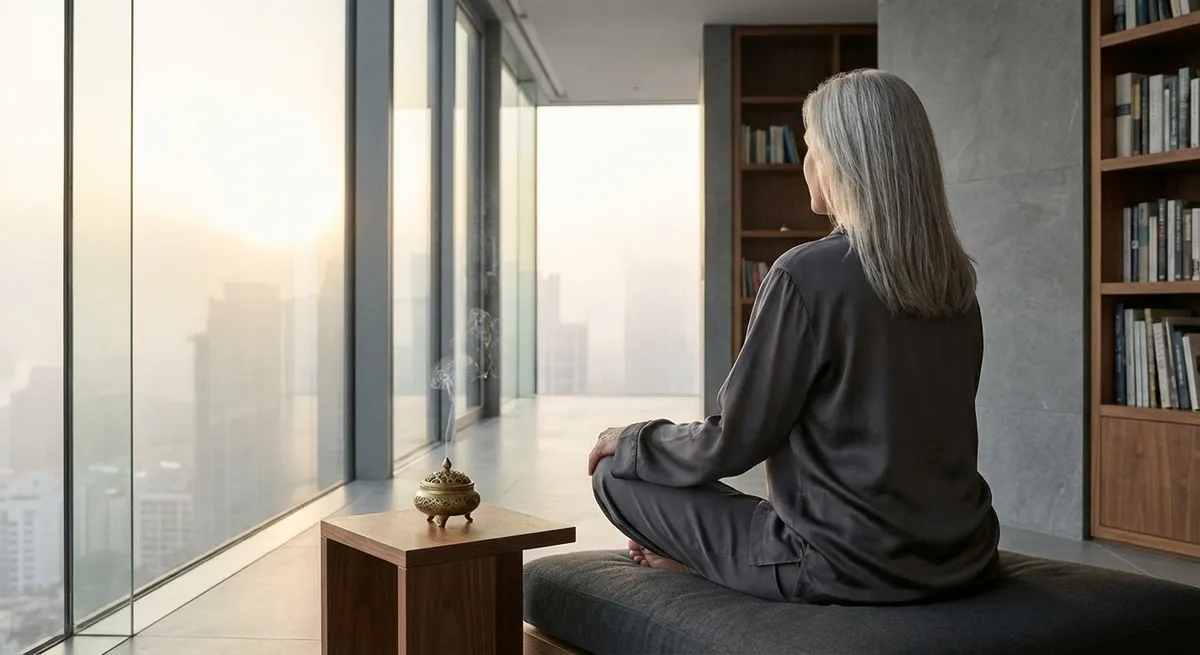
Meditation is no longer a fringe “wellness hack”; it is becoming a quiet hallmark of a well-curated life. For those who value discernment, craftsmanship, and intention, meditation offers a way to design the interior of the mind with the same care given to a favorite room, wardrobe, or travel itinerary. This is not about escape or denial, but about cultivating a mental environment that can hold complexity, ambition, and rest in equal measure. What follows are five exclusive, nuanced insights—less about techniques, more about standards—for integrating meditation into a life that aspires to depth, clarity, and understated excellence.
Meditation as Mental Curation, Not Self-Improvement
Most people approach meditation like a project: something to “optimize,” measure, and conquer. A more elevated frame treats meditation as curation, not correction. Just as an art collector does not frantically fix every piece but instead curates which works belong in a space, you can begin to curate what thoughts are given continued residence in your awareness.
Sit with the intention not to “be better” but to become more discerning about where your attention lives. Notice which thoughts feel like clutter—resentful loops, petty comparisons, unexamined fears—and which feel like structural beams: values, long-range aspirations, genuine curiosity. Over time, meditation becomes a high-level audit of your inner architecture. This posture replaces the frantic urge to fix yourself with a quieter, more assured act of mental taste-making: what deserves amplification, what deserves release, and what is simply passing through. The result is a mind that feels less like a crowded inbox and more like a thoughtfully edited gallery.
The Luxury of Unrushed Attention
In a culture obsessed with speed, the rarest luxury is not an object, but the experience of being unhurried. Meditation, practiced with intention, is essentially the discipline of uncompressed time. It is a daily refusal to allow your attention to be fractioned into micro-moments of distraction.
During practice, imagine that your awareness is moving as if in a slow, continuous pour—like a fine tea decanting, or honey flowing in a thin, unbroken stream. Instead of snapping from breath to thought to sound, allow your attention to travel with deliberate slowness. Observe each inhale and exhale as if you have nothing else to do and no one to prove anything to. This unhurried quality carries over: conversations feel more textured, meals more dimensional, work more intentional.
The gain is subtle but profound: you are no longer living in a state of constant “almost elsewhere.” Even five to ten minutes of meditation practiced with this ethos can soften the nervous system, reduce stress reactivity, and create a felt sense of internal spaciousness that is increasingly rare—and deeply regenerative.
Crafting a Signature Meditation Aesthetic
Most advice stops at “find a quiet space and sit comfortably.” For a refined practice, environment is not an afterthought; it is an instrument. Just as a bespoke suit or well-appointed interior alters how you move, a carefully curated meditation aesthetic can influence the quality of your inner stillness.
Consider light, sound, scent, and texture as deliberate design variables. Morning light filtered through sheer curtains, a single beeswax candle at dusk, or a discreet, non-intrusive soundscape (distant rain, a soft fan, or an analog clock) can anchor your nervous system. A natural fiber throw, a well-designed meditation cushion, or even a particular chair reserved only for this ritual creates a gentle sense of formality—this is not a casual scroll, this is an appointment with your mind.
The point is not performative perfection or elaborate staging but coherence: a physical atmosphere that quietly signals, “Here, we slow down. Here, nothing is urgent.” Over time, stepping into this environment becomes a somatic cue; your body begins to associate that particular arrangement of light, scent, and texture with ease, clarity, and psychological exhale.
Meditation as Emotional Decanting
Emotions that are never fully processed tend to behave like unfinished thoughts—returning at inconvenient times, clouding judgment, and fatiguing the nervous system. A sophisticated approach to meditation treats the practice as emotional decanting: not suppression, not indulgence, but measured airing.
When you sit, allow whatever is present—irritation, sadness, restlessness, quiet joy—to surface without commentary. Picture each emotion like a rich, young wine that needs time to breathe before its full profile can be understood. You are not trying to “solve” the feeling; you are allowing it to clarify. Naming emotions gently (“this is tension,” “this is disappointment,” “this is anticipation”) is often enough for the nervous system to begin down-regulating.
This approach is particularly valuable for high-functioning individuals who have learned to move past emotions to keep performance intact. Over time, meditation becomes a private, disciplined ritual of emotional housekeeping: experiences are aired, sediments settle, and you move through your day less encumbered by unexamined weight. The mind feels cleaner, not because nothing difficult exists, but because nothing remains chronically unacknowledged.
The Quiet Standard: Letting Meditation Shape Your Decisions
The most understated power of meditation is not what happens on the cushion, but what it quietly recalibrates off it. Instead of asking, “Did I feel calm during my session?” begin asking, “Did my practice refine my choices in the last 24 hours?” This is where meditation graduates from wellness activity to standard of living.
You may notice micro-shifts: a softer tone in a difficult conversation, the choice to pause before responding to a provocative email, or a subtle ability to distinguish between urgent and merely noisy demands. Over time, you start making decisions that are less fear-driven and more values-driven—whether that means saying no to overcommitment, creating firmer digital boundaries, or prioritizing rest with the same seriousness as work.
Treat meditation as the daily calibration of your inner compass. Ten minutes of seated practice can influence how you allocate your time, what you tolerate, and where you invest emotional energy. The true indicator of a mature practice is not the number of minutes meditated, but the degree to which your external life increasingly reflects an internal sense of steadiness, subtle confidence, and ethical clarity.
Conclusion
Meditation, practiced with elegance and integrity, is not a lifestyle accessory; it is an invisible scaffolding that supports a more composed, deliberate existence. By reframing meditation as mental curation, embracing the luxury of unrushed attention, designing a signature practice aesthetic, allowing emotions to decant, and letting stillness inform your decisions, you transform it from a self-improvement task into a quiet standard of how you live.
In a world that constantly invites haste, noise, and fragmentation, this standard is both rare and deeply restorative. The reward is not perfection, but a life that feels internally coherent—where your outer pace and inner tempo are no longer at war, and where your mind becomes a place you genuinely enjoy inhabiting.
Sources
- [National Center for Complementary and Integrative Health: Meditation and Mindfulness](https://www.nccih.nih.gov/health/meditation-and-mindfulness) - Overview of meditation, evidence-based benefits, and current research
- [American Psychological Association: Mindfulness Meditation – A Research-Proven Way to Reduce Stress](https://www.apa.org/topics/mindfulness/meditation) - Summarizes psychological research on how meditation affects stress, emotion regulation, and well-being
- [Harvard Health Publishing: Mindfulness Meditation May Ease Anxiety, Mental Stress](https://www.health.harvard.edu/mind-and-mood/mindfulness-meditation-may-ease-anxiety-mental-stress) - Discusses clinical findings on meditation’s impact on anxiety and stress responses
- [Mayo Clinic: Meditation – A Simple, Fast Way to Reduce Stress](https://www.mayoclinic.org/tests-procedures/meditation/in-depth/meditation/art-20045858) - Explains practical benefits, types of meditation, and guidance for beginners
- [National Institutes of Health: Meditation – In Depth](https://www.nccih.nih.gov/health/meditation-in-depth) - Detailed examination of how meditation works, safety considerations, and research directions
Key Takeaway
The most important thing to remember from this article is that this information can change how you think about Meditation.