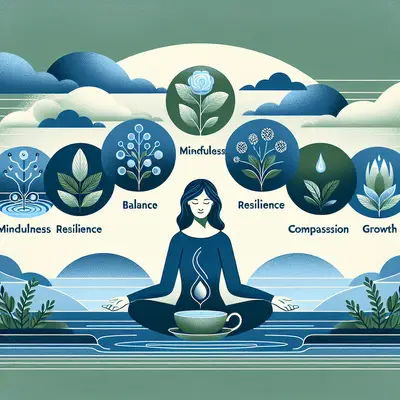
In an age of constant stimulation, true mental wellness is becoming a quiet luxury—less about dramatic breakthroughs and more about the understated elegance of how we inhabit our own minds. For the discerning individual, wellness is not a trend but a cultivated standard: how we attend to our inner world with the same discernment we bring to our homes, our wardrobes, and our relationships. This is not about perfection or relentless optimization; it is about small, deliberate refinements that make your inner life feel exquisite rather than merely functional.
Below are five exclusive, nuanced insights—less “tips,” more subtle upgrades—that can help you design a mental landscape that feels composed, intentional, and distinctly your own.
Insight 1: Treat Attention as Your Finest Currency
Most wellness advice speaks of “time management.” A more elevated frame is attention stewardship. Time is fixed; attention is curated. What you repeatedly notice, you quietly become.
Begin by tracing where your attention naturally drifts throughout the day—news cycles, messages, subtle anxieties, or ambient stress from others. Rather than forcing yourself to “focus,” think in terms of taste: What is worthy of your finest attention? Which inputs leave you feeling more intelligent, more grounded, more generous?
A refined practice is to create small “attention sanctuaries” in your day: a five-minute window with your phone in another room, a screen-free morning coffee, a deliberate pause before opening email. Over time, this becomes less about restriction and more about connoisseurship—choosing higher-quality mental inputs and allowing your mind to be nourished rather than constantly grazed upon.
Insight 2: Design Micro-Rituals of Psychological Reset
The modern nervous system rarely gets a full stop; instead, it lives in perpetual “almost-rest.” True mental wellness requires intentional punctuation—moments that signal to the body and mind that a chapter has closed and a new one is beginning.
Consider the transitions in your day: waking, beginning work, ending work, entering your home, preparing for sleep. Rather than letting these thresholds blur, elevate them into understated rituals. It could be as simple as:
- Lighting a particular scent when shifting from work to evening.
- Changing into a specific, comfortable garment that signals “off-duty.”
- Playing the same short instrumental track at the end of your workday.
- Rinsing your hands under warm water, deliberately, as a symbolic reset.
These gestures may seem modest, but they teach your nervous system that it is safe to move out of performance mode and into presence. Over time, the body learns to exhale more quickly, and your mind follows.
Insight 3: Curate an Inner Tone, Not Just Inner Thoughts
So much mental wellness advice focuses on “changing your thoughts.” Equally important—but more subtle—is changing the tone in which you speak to yourself. Two people can think the same sentence—“I can improve this”—yet one says it with quiet encouragement and the other with cold criticism.
Begin to notice the acoustic quality of your inner voice: Is it sharp or warm, impatient or measured, harsh or gently exacting? Instead of forcing affirmations that feel artificial, refine the tone of what is already there. You might keep the same content but upgrade the delivery:
- From “You’re behind again” to “Let’s bring this gently back on track.”
- From “You should have known better” to “There’s something to learn here for next time.”
- From “This is a disaster” to “This is challenging, but not beyond me.”
The aim is not to become indulgent, but to cultivate an inner authority that is firm, fair, and dignified. Over time, this tonal refinement shapes your emotional landscape more reliably than sporadic positive thinking.
Insight 4: Practice Emotional Etiquette With Yourself
We often extend exquisite courtesy to others—listening, allowing complexity, avoiding unnecessary bluntness—while being remarkably uncivil with ourselves. Emotional etiquette is the art of handling your own feelings with the same sophistication you would offer a respected guest.
Begin by retiring phrases that trivialize your internal world: “I’m being ridiculous,” “This is stupid,” “I shouldn’t feel this way.” Replace them with more educated acknowledgments: “This reaction is strong; I’d like to understand it,” or “There is something here asking for my attention.”
When a difficult emotion arises—envy, hurt, fatigue, dread—ask yourself: If this were a guest at my table, how would I receive it? You might not indulge it endlessly, but you would at least listen before deciding what to do next. This shift does not make you fragile; it makes you internally well-mannered. The result is an atmosphere inside your own mind that feels less adversarial, more gracious—and therefore more stable.
Insight 5: Align Your Calendar With Your Nervous System, Not Just Your Goals
Ambitious people often organize their lives around objectives, deadlines, and external commitments. True mental wellness requires an additional layer of discernment: aligning your schedule with the natural rhythms of your nervous system.
Begin observing when you tend to feel most mentally clear, emotionally porous, physically drained, or quietly energized. Then, wherever possible, appoint activities accordingly:
- Reserve your psychologically “expensive” tasks—deep thinking, delicate conversations, creative work—for your most regulated hours.
- Place restorative practices (a brief walk, breathwork, a quiet tea, a few stretches) immediately before or after high-stress obligations, as a kind of emotional buffer.
- Intentionally leave small, unspoken spaces in your week—unscheduled pockets that allow you to respond to how you actually feel, rather than how you planned to feel.
This is not about designing a life free of challenge, but about orchestrating intensity with more precision. When your calendar begins to respect your nervous system, burnout becomes less of a looming threat and more of a preventable design flaw.
Conclusion
Mental wellness at its highest expression is not a performance but a standard of inner living: the way you handle your attention, transitions, tone, emotions, and time. These are not dramatic interventions but quiet upgrades—subtle recalibrations that allow your mind to feel less like a battleground and more like a well-composed interior.
As you refine these practices, you may notice that wellness stops feeling like a project and starts feeling like a signature—an elegant, deeply personal way of moving through the world with composure, clarity, and a kind of understated inner luxury.
Sources
- National Institute of Mental Health – Caring for Your Mental Health – Overview of evidence-based approaches to maintaining and improving mental health
- Harvard Health Publishing – Relaxation techniques: Breath control helps quell errant stress response – Explores how simple practices can regulate the nervous system
- American Psychological Association – Mindfulness meditation: A research-proven way to reduce stress – Summarizes research on attention, presence, and stress reduction
- Mayo Clinic – Stress management: Strengthen your social support network – Discusses how emotional handling and support influence mental wellness
- Cleveland Clinic – Burnout: Symptoms, causes and prevention – Provides medical insight into burnout and the role of scheduling, rest, and nervous system demands
Key Takeaway
The most important thing to remember from this article is that this information can change how you think about Mental Wellness.