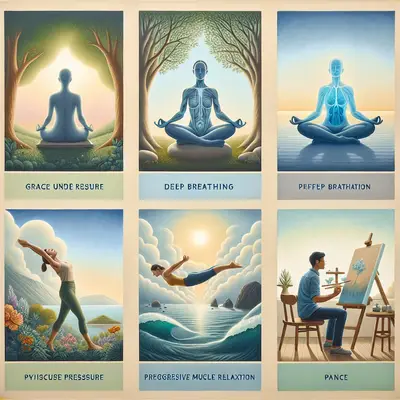
Stress may be universal, but the way you respond to it can be exquisitely personal. In a culture that rewards speed and reactivity, the true quiet luxury is the ability to reset—deliberately, gracefully, and without spectacle. This is not about escaping your life, but about inhabiting it with more composure, discernment, and ease. What follows are five elevated, nuanced insights into stress relief—designed for those who value subtlety over slogans and depth over quick fixes.
Reframing Stress as Useful Data, Not a Personal Failing
Stress is often treated as a sign that something is “wrong” with you: not resilient enough, not organized enough, not disciplined enough. A more refined approach is to view stress as a form of high‑resolution data—information about your limits, values, and misalignments.
Physiologically, the stress response is an adaptive system designed to protect you, not punish you. Elevated heart rate, shallow breathing, disrupted sleep, and irritability are all signals, not verdicts. When you interpret them as data, you can respond with curiosity rather than self‑criticism.
Begin by observing stress in three dimensions: bodily sensations, thoughts, and behavior. Notice where it lives in your body (jaw, shoulders, gut), the recurring narratives (“I’m behind,” “I’m not enough”), and the compensations (overworking, over‑scrolling, over‑promising). Instead of asking, “How do I get rid of this?” ask, “What is this trying to tell me?” Often, it’s a quiet indicator that your schedule is misaligned with your priorities, your boundaries are too porous, or your rest is too shallow.
This shift—from stress as enemy to stress as messenger—automatically lowers the emotional temperature. It moves you from defensiveness to design, allowing you to adjust your routines, agreements, and expectations with precision rather than panic.
Curating Micro-Rituals Instead of Chasing Grand Escapes
Many people tolerate chronic stress by fantasizing about large-scale escapes: the sabbatical, the long vacation, the total life overhaul. Elegant stress relief operates differently. It relies on micro‑rituals—small, repeatable practices woven into the fabric of your existing day.
Think of these as “pressure release valves” embedded into ordinary moments:
- Transition pauses between meetings: 90 seconds with eyes closed, one hand on the chest, one on the abdomen, three deep breaths with lengthened exhale.
- Threshold rituals at home: just inside your front door, stop, exhale slowly, and mentally “set down” the workday before crossing fully into your living space.
- Sensory anchors: one carefully chosen scent, texture, or sound that signals calm to your nervous system—perhaps a specific tea, a particular instrumental track, or a favorite cashmere throw used only during unwinding.
The sophistication is in the intentionality and the consistency, not the complexity. Neurobiologically, frequent short pauses are more effective at stabilizing your stress response than rare, dramatic breaks. Regular micro‑rituals teach your nervous system that recovery is not a special event; it is part of the normal rhythm of living.
When these practices are curated with aesthetic care—beautiful glassware for evening water, a well‑designed timer, a designated “reset” chair—they become something you look forward to, rather than one more obligation on your wellness to‑do list.
Designing Your Nervous System Environment, Not Just Your Schedule
Calendars are often meticulously managed, while environments are treated as afterthoughts. Yet your surroundings speak directly to your nervous system, often more powerfully than your plans do. Stress relief becomes more effortless when your spaces are silently working on your behalf.
Begin with visual load. Every item in your field of vision makes a small demand on your brain. Surfaces covered with paper stacks, charging cables, and scattered objects create a mild, continuous cognitive drag. Editing your space—removing nonessential visual noise, choosing a restrained color palette, giving every item a designated home—can lower this invisible mental tax.
Then consider sound. Background television, constant notifications, and harsh acoustics keep your system on low-level alert. Refinement here may look like setting specific “audio zones”: phone on silent during meals, soft instrumental music during focused work, and intentionally chosen silence for at least a few minutes each day.
Lighting is another subtle but potent lever. Cooler, brighter light earlier in the day supports alertness; warmer, lower light in the evening nudges your body toward rest. Simple changes—warm bulbs, dimmers, a single soft lamp instead of overhead glare—can gently guide your physiology without any additional effort from you.
The goal is not sterile minimalism, but considered design. When your environment is deliberately composed, it functions as a quiet ally, gently steering you away from agitation and toward ease.
Practicing Boundaried Generosity to Prevent Emotional Exhaustion
Stress is often less about what you do and more about how you relate to the people and requests around you. Many high‑functioning individuals carry a quiet fatigue rooted not in workload alone, but in unspoken resentment—the consequence of saying yes when their inner answer is no.
Boundaried generosity is an elevated alternative to both people‑pleasing and abrupt withdrawal. It asks: How can I be genuinely kind without abandoning myself?
This begins with internal clarity. Before responding to a request, pause and quickly scan three levels: energy (do I realistically have the bandwidth?), timing (does this fit the next week, or would a later date be more honest?), and desire (do I actually want to do this, or am I agreeing out of guilt or image?). Stress often spikes when these three are not aligned.
Then practice language that is both gracious and firm. Phrases such as:
- “I’d like to help, but I need to protect my bandwidth this week.”
- “This matters to me, and I can offer 30 focused minutes—not more.”
- “That’s a no for me, but I appreciate you thinking of me.”
This is not coldness; it is precision. Over time, boundaried generosity creates relationships that are cleaner, clearer, and less draining. Your energy is no longer scattered by habitual over‑giving, and your nervous system learns that you will not chronically sacrifice yourself to meet every external demand.
The result is a quieter, more sustainable inner life—less dramatic burnout, more steady presence.
Elevating Rest from Passive Collapse to Intentional Restoration
Many people confuse “not working” with “resting.” Mindless scrolling, late‑night streaming, or numbing with food or alcohol may feel like a break, but they often leave the nervous system jittery and under‑recovered. True rest is not merely the absence of activity; it is the presence of restoration.
A refined approach to rest begins with matching the type of restoration to the type of depletion:
- Mental depletion (decision fatigue, overthinking) responds well to structured, simple activities with clear edges: reading a physical book, doing a puzzle, folding laundry with quiet attention.
- Emotional depletion (conflict, grief, compassion fatigue) is better served by gentle connection or reflective practices: a slow walk without your phone, journaling in short, honest sentences, or speaking with someone you trust.
- Physical depletion (long hours sitting or standing) often requires movement, not stillness: stretching, yoga, or unhurried walking to signal safety to the body.
Prioritize low‑stimulation rest at least some of the time—no screens, no constant input. This might mean 15 minutes in the evening with soft lighting, a warm beverage, and nothing to consume or produce. To the productivity‑driven mind, this can feel “wasteful.” To the nervous system, it is exquisite.
Over time, treating rest as a crafted experience—rather than a last‑minute collapse—teaches your body that relief is predictable, not precarious. Stress levels soften not because life becomes easy, but because you are no longer running on permanent deficit.
Conclusion
Stress will always be part of a meaningful life. The distinction between a frayed existence and a composed one lies in the quality of your responses, not in the absence of demands. By treating stress as information, curating micro‑rituals, designing your environment, practicing boundaried generosity, and elevating rest into an intentional art, you create a quieter, more dignified inner landscape.
This is the refined reset: not a dramatic escape, but a series of elegant, repeatable choices that allow you to move through complexity with less noise and more grace. Over time, these practices do more than relieve stress—they re‑educate your nervous system to trust that, even in a fast world, you are willing to live at a humane pace.
Sources
- [American Psychological Association – Stress: The Different Kinds of Stress](https://www.apa.org/topics/stress) – Overview of stress types, their effects, and coping strategies, including the idea of stress as an adaptive response.
- [Harvard Health Publishing – Understanding the Stress Response](https://www.health.harvard.edu/staying-healthy/understanding-the-stress-response) – Explains the physiology of stress and how the body’s systems react, supporting the concept of stress as useful information.
- [National Institute of Mental Health – 5 Things You Should Know About Stress](https://www.nimh.nih.gov/health/publications/stress) – Summarizes how stress impacts mental and physical health and outlines basic strategies for management.
- [Mayo Clinic – Stress Management](https://www.mayoclinic.org/healthy-lifestyle/stress-management/basics/stress-relief/hlv-20049495) – Provides evidence‑based methods for stress reduction and lifestyle adjustments that align with micro‑rituals and environmental design.
- [Cleveland Clinic – The Importance of Rest and Relaxation](https://health.clevelandclinic.org/why-rest-and-relaxation-are-important) – Discusses why true rest matters for overall health and how intentional relaxation supports recovery from chronic stress.
Key Takeaway
The most important thing to remember from this article is that this information can change how you think about Stress Relief.