In an era of constant notifications and relentless pace, true calm is no longer an accident—it is a cultivated luxury. Natural remedies, when chosen with discernment and practiced with intention, can become more than “stress hacks”; they evolve into quiet rituals that shape how your mind experiences the world. This is not about escaping life, but about meeting it with poise, clarity, and a composed nervous system.
Below are five exclusive, elevated insights into natural remedies for mental wellness—each one designed less as a quick fix, and more as a refined practice that can anchor your day.
1. Botanical Pairing: Curating Herbs Like a Sommelier of Calm
Most people reach for a single herb—chamomile, lavender, or perhaps ashwagandha—and hope for the best. A more sophisticated approach treats botanicals the way a sommelier treats wine: as nuanced elements that can be paired, layered, and timed.
Instead of a catch-all “stress tea,” consider crafting a micro-apothecary of three to four targeted blends:
- Daytime composure: A combination of L-theanine–rich green tea with lemon balm to enhance focus while softening mental noise.
- Transition hour (late afternoon or early evening): Tulsi (holy basil) with rose petals to regulate stress hormones while inviting emotional softness.
- Nocturnal unwinding: Chamomile and passionflower to quiet mental chatter and support natural sleep rhythms.
This approach recognizes that your nervous system has a circadian personality—different needs at 10 a.m. than at 10 p.m. Curated pairing allows you to respond to those needs with precision instead of generic calm. Over time, your chosen blends become part of an intimate language with your own physiology, signaling the mind that it is safe to soften.
2. Sensory Architecture: Designing a Space That Lowers Cortisol Before You Sit Down
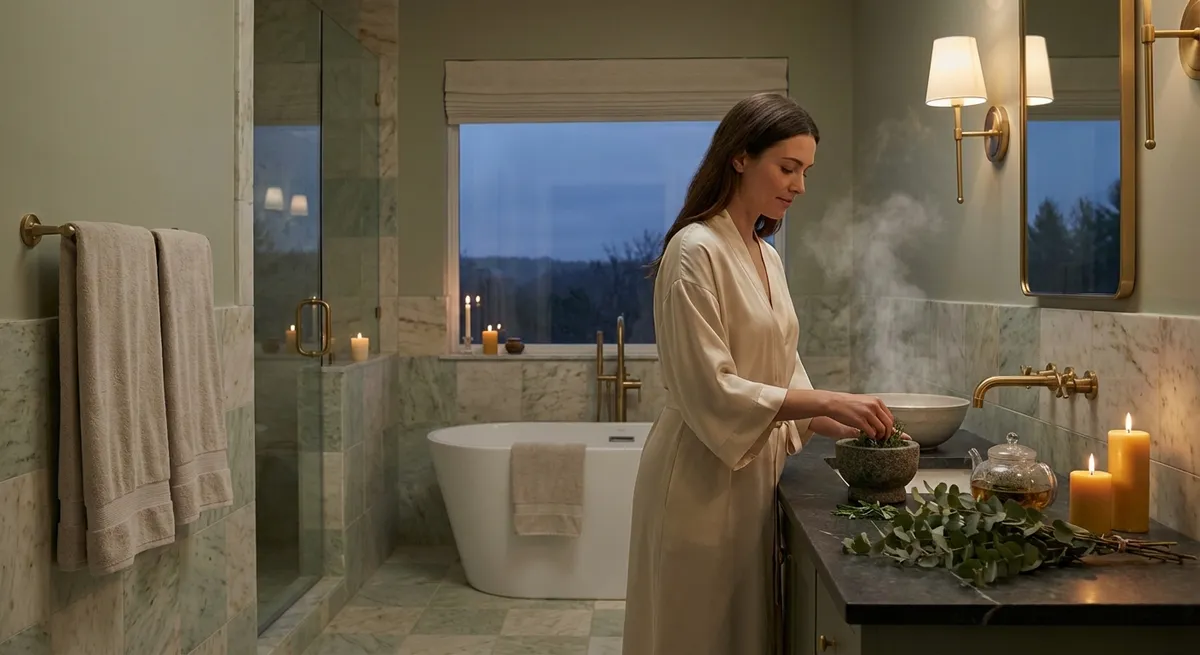
Most wellness advice starts with what you should do. A more refined strategy starts with what you should enter. Your environment can reduce stress hormones—sometimes before you’ve even taken a breath or a sip of tea.
This is where sensory architecture becomes a subtle but powerful natural remedy:
- Visual field: Keep your primary resting gaze on one or two calming focal points: a single plant, a candle flame, a piece of art with soft gradients or natural forms. Avoid busy walls in your direct line of sight.
- Olfactory cue: Choose one elevated, natural scent—such as neroli, sandalwood, or cedar—and reserve it exclusively for your calm rituals. Over time, this fragrance becomes a conditioned cue for your nervous system, a shortcut into ease.
- Tactile anchors: A weighted throw, a particular ceramic mug, or one smooth stone you hold in your palm can provide a subtle grounding effect. Texture, temperature, and weight all signal safety to the body.
The insight here is that you are not merely decorating; you are calibrating sensory input. A curated space turns each natural remedy—tea, breath, journaling—into a deeper experience because your surroundings are already whispering: “You may rest now.”
3. Nervous System Pacing: Treating Calm as an Elegant Tempo, Not a Destination
Natural remedies are often evaluated by a single question: Does it relax me? A more nuanced lens asks: How does this remedy influence my internal tempo—my pace of thought, breath, and reaction?
Calm is rarely an on/off switch. It is more honestly a tempo shift in the nervous system. Consider integrating remedies not to sedate yourself, but to retune your baseline speed:
- Breath as a pacing tool: Practices such as “extended exhale” breathing (inhaling for four counts, exhaling for six to eight) gently activates the parasympathetic system without inducing grogginess.
- Adaptogens as tempo moderators: Herbs like ashwagandha or rhodiola don’t merely calm; they can smooth the spikes and dips of stress reactivity, creating a more refined, continuous emotional rhythm.
- Micro-pauses, not long escapes: Thirty seconds of intentional breathing every hour is often more regulating than a single 30-minute session tacked onto a frantic day.
This perspective transforms natural remedies from emergency interventions into ongoing conductors of your internal orchestra. You are not “escaping stress” so much as conducting the tempo at which you move through it.
4. The Subtle Luxury of Consistency: Turning Remedies into Signature Rituals
There is a quiet luxury in being predictable to your own nervous system. While trying different teas, supplements, and practices can be intriguing, the body ultimately craves reliable patterns. Consistency itself becomes a natural remedy.
Rather than stacking dozens of wellness trends, choose three signature rituals and practice them with near-ceremonial devotion:
- A specific herbal infusion every evening, prepared in the same mug, at roughly the same time.
- A fixed pre-sleep sequence: light stretching, a particular calming scent, then a page or two of reflective writing.
- A morning grounding moment—sunlight on your face, warm water with lemon, a single minute of closed-eye breathing before opening any device.
Your system begins to anticipate these patterns. Anticipation is profoundly regulating; just as we can anticipate stress, we can also anticipate calm. Over weeks and months, these repeated rituals carve out neurological “paths of ease,” where your body learns exactly what to do when the mug is warm in your hands or the neroli diffuser clicks on.
In this way, you move from chasing calm to inhabiting it.
5. Discerning Between Numbness and True Ease
In a high-pressure world, nearly anything that takes the edge off can be mistaken for “relaxation.” But a truly refined mental wellness practice is discerning: it distinguishes between numbness and ease.
This distinction is crucial when exploring natural remedies:
- True ease feels spacious. Your thoughts slow but remain clear. You can still make decisions, access your values, and feel your emotions—just without being flooded by them.
- Numbness feels flattened. You may feel detached, checked-out, or indifferent. Your inner world is quieter, but not in a way that feels alive or attuned.
Some herbs or routines, especially in higher doses (for example, overly sedating blends or inappropriate use of certain supplements), can edge you toward emotional dullness rather than regulated calm. A sophisticated approach involves gentle self-auditing:
- After a remedy, ask: Do I feel more myself, or less?
- Can you still sense subtle joys—a piece of music, a sentence in a book, the warmth of water on your skin?
- Or do you simply feel uninterested, slowed, or vaguely disconnected?
Natural calm should heighten your capacity to inhabit your life, not anesthetize you from it. The most elevated remedies are those that leave you lucid, grounded, and exquisitely present.
Conclusion
Natural remedies, at their most refined, are not about collecting more products or chasing more dramatic effects. They are about composing your days with intention—curating botanicals, spaces, tempos, and rituals that speak a coherent language of safety to your nervous system.
When you approach calming practices as a crafted experience rather than a quick fix, your mental wellness stops being reactive and becomes quietly architectural. Over time, your life itself begins to feel like a well-designed sanctuary: still engaged with the world, yet deeply rooted in your own, cultivated calm.
Sources
- National Center for Complementary and Integrative Health (NCCIH) – Herbs at a Glance - Evidence-based overviews of commonly used calming herbs such as chamomile, lemon balm, and passionflower
- Harvard Health Publishing – Relaxation techniques: Breath control helps quell errant stress response - Explains how specific breathing patterns influence the nervous system and stress
- Cleveland Clinic – Adaptogens: What You Need to Know - Reviews the role of adaptogenic herbs like ashwagandha and rhodiola in stress modulation
- Mayo Clinic – Stress management - General framework for understanding stress and non-pharmacological approaches to relief
- American Psychological Association – Stress effects on the body - Details the physiological mechanisms of stress and why consistent calming rituals support long-term mental wellness
Key Takeaway
The most important thing to remember from this article is that this information can change how you think about Natural Remedies.