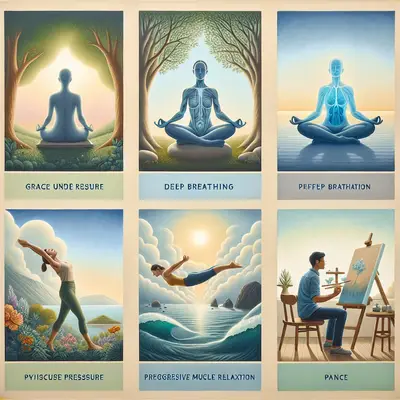
Stress rarely announces itself with fanfare; it arrives in tight shoulders, shallow breaths, and scattered attention. In a culture that glorifies urgency, the true luxury is not more productivity—it’s the capacity to pause with intention. At Calm Mind Remedies, we regard stress relief not as an emergency measure, but as a cultivated mental reset: precise, elegant, and deeply personal. Below are five exclusive, high-level insights designed for those who treat their inner world with the same discernment they bring to every other aspect of their life.
The Art of the “Cognitive Exhale”
Most people know how to exhale physically, but very few are skilled at exhaling mentally. A “cognitive exhale” is the deliberate release of accumulated mental noise—the unfinished thoughts, silent arguments, and background anxieties that crowd the mind.
Begin by giving your mind a defined container: set a three-minute timer. For those minutes, do nothing but observe the stream of thoughts arising, without editing, suppressing, or following them. Imagine each thought as a sentence appearing on a screen, then softly fading. You are not fixing anything; you are simply airing out the mind.
This brief, observational reset has a tangible physiological counterpart. By pairing it with slow, diaphragmatic breathing—inhale through the nose for four counts, exhale through the mouth for six—you subtly engage the parasympathetic nervous system, the body’s built-in counterweight to stress. Over time, this practice trains your brain to decelerate automatically when prompted, much like a well-tuned instrument that responds instantly to a gentle touch.
Curating Sensory Minimalism for Nervous System Ease
For many, stress is not just emotional; it is sensory overload. The nervous system is continually assaulted by notifications, harsh lighting, and fragmented noise. Sensory minimalism is not about deprivation—it is about intelligent subtraction.
Begin by curating a single “low-stimulus zone” in your environment: a chair near soft natural light, a corner with muted colors, or even a specific spot at your dining table. Remove anything that flickers, buzzes, or demands interaction: no screens, no scrolling, no visual clutter. Add one or two intentionally calming cues—perhaps a single textured throw, a small ceramic object, or a plant.
When the day becomes demanding, use this zone as a micro-sanctuary. Sit there for five minutes and give your senses something high-quality yet understated to rest upon: the feel of fabric under your fingers, the quiet rhythm of your breath, the nuance of ambient sound. Over time, your nervous system will learn to associate this particular space with decompression, allowing you to drop into calm more quickly and reliably.
Refining Your Personal Stress Signature
Stress is often discussed as a universal experience, yet its expression is exquisitely individual. Knowing your “stress signature”—the specific ways your mind and body respond under pressure—is one of the most sophisticated forms of self-care.
Begin by observing patterns, not episodes. Do you become hyper-productive or paralyzed? Do you reach for constant stimulation, or do you withdraw? Does stress first appear in your digestion, your sleep, your skin, or your mood? Keep a discreet log for one week, noting time of day, context, and how stress physically manifests.
Once you recognize your signature, you can design tailored interventions. If your thoughts race at night, you might adopt a consistent pre-sleep ritual that includes warm light, paper-based reading, and a strict boundary with digital devices. If your body tenses in the jaw and shoulders, regular micro-stretches throughout the day may be more effective than a single long workout. This refinement moves you beyond generic advice and into a realm of bespoke, responsive stress management that respects your unique biology and temperament.
Elevating Transitions: Turning In-Between Moments into Recovery
Most stress protocols focus on what you do before or after a demanding day. An often overlooked opportunity lies in the in-between: the subtle transitions that quietly shape your nervous system’s baseline.
Transitions—between meetings, from work to home, from screen to sleep—are typically rushed or ignored. Elevate them. Consider adopting a micro-ritual that marks each shift: closing your laptop with both hands and one intentional breath; stepping outside for two minutes of natural light; changing your fragrance or washing your hands with a subtly scented soap when moving from “public” mode to “private” mode.
Biologically, these small practices act as anchors that signal safety and closure. Psychologically, they prevent stress from blurring the boundaries between roles and responsibilities. Over time, polished transitions create a sense of life composed into distinct chapters, rather than an indistinct rush—an understated but potent form of mental protection.
Practicing Elegant Boundaries as a Nervous System Investment
Stress often amplifies in the space where our boundaries are unclear. Elegant boundaries are not rigid walls but finely tuned filters—designed to preserve your cognitive clarity and emotional equilibrium.
Begin by identifying one area where you consistently feel overextended: digital communication, social expectations, or work availability. Then, instead of attempting an entire life overhaul, refine a single, specific boundary. Perhaps you define a cut-off time for email, or you reserve one evening a week as a no-obligation zone, where nothing is scheduled and everything is optional.
Communicate this boundary in language that is firm yet gracious—polite, brief, and without elaborate justification. The sophistication lies not in how dramatic the boundary appears, but in how consistently you honor it. Over time, holding these elegant boundaries recalibrates both your self-respect and the expectations others have of you, reducing low-level chronic stress that often goes unnoticed yet deeply affects mental wellness.
Conclusion
True stress relief is less about grand gestures and more about subtle mastery: how you exhale mentally, curate your sensory world, understand your unique stress signature, honor transitions, and sustain elegant boundaries. When approached with this level of refinement, stress management ceases to be crisis control and becomes an ongoing, deliberate mental reset—a quiet, powerful luxury that you carry within you, wherever you go.
Sources
- American Psychological Association: Stress Effects on the Body - Overview of how stress influences different bodily systems and why regulation is vital
- National Institute of Mental Health: 5 Things You Should Know About Stress - Evidence-based insights on types of stress and coping strategies
- Harvard Health Publishing: Relaxation Techniques - Explanation of how breathing and relaxation practices calm the stress response
- Cleveland Clinic: Sensory Overload - Discussion of sensory overload and its impact on mental well-being
- Mayo Clinic: Setting Healthy Boundaries - Guidance on boundary-setting as a protective factor for emotional health
Key Takeaway
The most important thing to remember from this article is that this information can change how you think about Stress Relief.