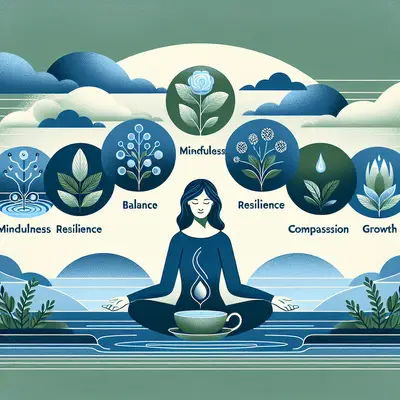
Mental wellness, at its most refined, is not a crash intervention but an ongoing, almost invisible craft. It lives in the subtleties of how you begin your day, curate your inputs, and design the interludes between obligations. For a discerning mind, wellness is less about dramatic reinvention and more about upgrading the texture of ordinary moments until they feel quietly luxurious.
Below are five exclusive, elevated insights—habits and perspectives that do not shout “self-care,” yet steadily cultivate a poised, resilient inner life.
1. Curated Silence: Treating Quiet as a Daily Appointment
Most people fall into silence only when noise happens to subside. A more sophisticated approach is to treat silence as a standing appointment: scheduled, protected, and deliberately designed.
This is not yet another meditation prescription. Curated silence is about withdrawing from the sensory and informational excess that constantly tugs at your nervous system. It might look like 12 minutes in a particular chair every afternoon with no phone, no music, no agenda—just a gentle, observational awareness of your own inner climate. By making this a fixed ritual, your nervous system begins to trust that relief is predictable, not accidental. Over time, these micro-retreats increase your capacity to think clearly, to respond rather than react, and to maintain your composure when the world accelerates.
What distinguishes curated silence from simply being alone is the quality of intention. The lighting, the seating, even the object you rest your gaze upon can be chosen with care. When silence is treated as a luxury good—rare, beautiful, and worth protecting—it begins to shape the overall tone of your life.
2. Emotional Tailoring: Custom-Fit Responses Instead of One-Size Reactions
Emotional maturity is often praised in broad strokes, but for a refined inner life, the details matter. Emotional tailoring means crafting responses that fit the situation, rather than defaulting to the oversized garments of habit: irritation, withdrawal, or overexplaining.
This practice begins with small, private questions before you respond to someone else:
- “What am I actually feeling—under the surface?”
- “What outcome would feel most aligned with who I want to be?”
Instead of “I’m stressed,” you might notice, “I feel threatened and rushed,” which invites a completely different response. Tailored emotions are precise, not theatrical. You may still feel frustration, but you decide its volume and its language. This granularity—called “emotional differentiation” in research—has been linked to better mental health and lower vulnerability to depression and anxiety.
Seen this way, your inner world becomes a bespoke wardrobe. You are no longer at the mercy of whatever reaction happens to present itself. You select your emotional tone with deliberation, aligning your responses with your deeper values rather than your most immediate impulses.
3. Cognitive Fasting: Restricting Mental Junk, Not Just Digital Noise
Digital detoxes are now common vocabulary, but a more elevated practice is cognitive fasting: a deliberate restriction of mental junk, independent of the device in your hand.
Cognitive junk includes speculative internal monologues, rehearsing arguments that will never occur, obsessively replaying minor social moments, or endlessly forecasting worst-case scenarios. These are not simply “thoughts”; they are unvetted mental content that consumes bandwidth and elevates stress.
A simple, sophisticated protocol might look like this:
- Morning boundary: The first 30–60 minutes of your day are reserved for neutral or nourishing input—no news, no email, no messages. You train your mind to begin the day unhurried and unprovoked.
- Midday audit: Once or twice a day, you pause and ask: “Is what I am thinking right now genuinely useful?” If not, you gently redirect to a concrete task or a sensory anchor (your breath, your posture, the sensation of your feet on the floor).
- Evening closing ritual: You provide your mind with a clear “off-duty” signal—a written list of tomorrow’s key tasks, followed by something aesthetically pleasing (reading, bathing, a walk), so your brain is not left to roam in anxious improvisation.
Rather than promising to “think positively,” cognitive fasting refines what you allow to occupy your inner stage. The result is a mind that feels less cluttered, less inflamed, and far more available for genuine creativity and insight.
4. Environmental Scripting: Letting Your Surroundings Do Some of the Work
High-level mental wellness is not achieved by willpower alone; it is quietly co-authored by your environment. Environmental scripting is the art of arranging spaces so that they nudge you toward easeful, healthful choices without constant internal negotiation.
This might mean placing a beautifully bound notebook and pen within arm’s reach of your favorite chair to encourage reflection instead of scrolling. It could be as subtle as dedicating one lamp and one throw blanket to your evening wind-down ritual so your body begins to associate that precise combination of light and texture with decompression. Your kitchen counter can host a water carafe and glass that make hydration feel like a small ceremony, not a chore.
By designing intentional “scripts” into your surroundings—visual cues that suggest certain behaviors—you outsource part of your mental workload. You need less discipline to read, to pause, to stretch, or to breathe consciously when the environment is already set up to invite these actions. In this way, your space becomes an ally in your mental wellness, functioning almost like a silent, elegant assistant.
5. The Art of Psychological Downgrading: Reclassifying What Does Not Deserve Power
One of the most exclusive inner skills is the ability to quietly downgrade the psychological status of things that do not merit your full emotional budget. Not everything in your life deserves to be treated as a crisis, a referendum on your worth, or a grand narrative about your future.
Psychological downgrading is not denial; it is discernment. It involves asking:
- “Is this inconvenience or catastrophe?”
- “Does this belong in the foreground of my day or the background?”
- “If I revisit this three weeks from now, how large will it appear?”
You then consciously place the issue in its rightful tier. A delayed reply does not hold the same rank as a health concern. A single awkward conversation does not equal a failed relationship. By downgrading what is merely uncomfortable to its appropriate scale, you free cognitive and emotional resources for what genuinely matters.
This is a luxury of perspective: the ability to refuse to be emotionally overcharged by minor storms. Over time, your interior weather stabilizes. You experience fewer violent swings and more of a refined, consistent climate—calm, alert, and resilient.
Conclusion
Mental wellness, when approached with nuance and discernment, becomes less like an emergency repair and more like an ongoing, elegant craft. Curated silence, emotional tailoring, cognitive fasting, environmental scripting, and psychological downgrading are not loud practices; they do not demand public declaration or dramatic transformation.
Instead, they operate quietly in the background, altering your relationship with time, attention, and emotion. The result is a mind that feels less at war with itself and more like a well-composed interior—subtle, deliberate, and deeply inhabitable. In that refined stillness, you begin to recognize mental wellness not as a distant achievement, but as an elevated standard of everyday living.
Sources
- National Institute of Mental Health – Caring for Your Mental Health – Overview of evidence-based mental wellness practices and lifestyle considerations
- Harvard Health Publishing – Mindfulness: What You Need to Know – Discusses how deliberate awareness and mental pauses support stress reduction and emotional regulation
- American Psychological Association – Emotional Intelligence – Explores emotional differentiation, self-regulation, and their links to mental health outcomes
- Centers for Disease Control and Prevention – Stress Management – Provides research-backed strategies for managing daily stressors and preserving mental wellness
- Mayo Clinic – How to Manage Stress with Lifestyle Changes – Details practical environmental and behavioral adjustments that contribute to calmer, healthier mental states
Key Takeaway
The most important thing to remember from this article is that this information can change how you think about Mental Wellness.