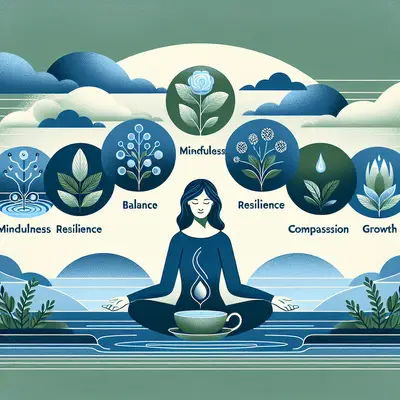
Mental wellness is increasingly recognized as a new form of quiet luxury—subtle, deeply personal, and profoundly transformative. Beyond quick fixes and wellness trends lies a more refined ambition: to cultivate a mind that feels clear, composed, and genuinely at ease, even when life is not. This is not about escaping reality; it is about inhabiting it with discernment, grace, and a deliberate sense of inner order.
Below are five exclusive, often overlooked insights for those who approach mental wellness with the same care and intentionality they devote to other aspects of a well-designed life.
Redefining Mental Wellness as Cognitive Aesthetics
For the discerning mind, wellness is not merely the absence of distress, but the presence of a certain inner elegance—a cognitive aesthetic. Just as a thoughtfully curated space avoids visual clutter, a refined internal life minimizes mental noise and distraction. This perspective shifts the goal from “fixing” the mind to “designing” it.
Seeing mental wellness as cognitive aesthetics invites you to notice the textures of your thoughts, the pacing of your days, and the emotional color palette that defines your weeks. You begin to ask: Which thoughts deserve a permanent place, and which are just mental clutter? Which commitments add depth, and which dilute your attention?
By framing wellness in this way, subtle practices—like pausing before responding to an email, taking a slow breath before entering a demanding conversation, or stepping outside between meetings—transform from trivial acts into deliberate design choices. You are not merely coping; you are curating your inner environment with the same care you might bring to a well-appointed home or a finely tuned wardrobe.
The Precision of Emotional Vocabulary
One of the most refined tools for mental wellness is not a supplement, a device, or a ritual—it is language. People who develop a precise, nuanced emotional vocabulary tend to navigate stress, conflict, and uncertainty with greater clarity and resilience.
Instead of defaulting to “stressed,” “tired,” or “overwhelmed,” a cultivated emotional lexicon might include: “mentally saturated,” “socially overextended,” “quietly disappointed,” “pleasantly anticipatory,” or “mildly apprehensive.” This granularity matters. Research suggests that emotional differentiation—the ability to identify and label emotions with specificity—is linked to better regulation and lower risk of mood disorders.
Precision does not dramatize experience; it refines it. When you can say, “I’m not anxious; I’m uncertain and underprepared,” your next step becomes clearer. Preparation, not self-criticism, becomes the intervention. When your language becomes more exact, your choices become more intelligent—and your inner dialogue more honest, measured, and kind.
Discerning Inputs: A Curated Diet for the Mind
For many, mental wellness is compromised not by a single crisis, but by a constant drip of low-quality mental inputs—sensationalist news, reactive social feeds, and emotionally draining conversations. A premium approach to wellness treats attention as a finite resource and information as a form of mental nutrition.
A curated mental diet might include deliberate boundaries around news consumption (specific times, trusted sources, limited duration) and a conscious separation between “keeping informed” and “being inundated.” It might mean reshaping your digital environment so that what you see first each day feels composed and intentional rather than chaotic and demanding.
Just as refined taste in food or design requires discernment, so does refined mental wellness. Ask regularly: Does this information clarify or confuse? Does this person energize or deplete? Does this account, show, or article elevate my thinking—or erode my equilibrium? Over time, such questions quietly transform the landscape of your inner life, replacing low-grade agitation with an understated sense of control and choice.
The Quiet Power of Micro-Restorations
Many people chase mental recovery in large gestures: extended vacations, wellness retreats, or complete digital detoxes. While valuable, these are often rare. A more sophisticated strategy is to design your days around micro-restorations—small, precisely placed moments that prevent emotional overdraft.
A micro-restorative practice might be a 90-second ritual of looking away from your screen and softening your gaze, a single minute of unhurried breathing between calls, a habitual walk around your space after a demanding conversation, or the simple act of holding a warm beverage with your full attention. These acts are not dramatic or performative; they are steadying.
Research on attention and fatigue suggests that the brain benefits greatly from short, intentional breaks to reset focus and regulate stress physiology. When mental wellness is approached as a daily craft rather than an emergency repair, these micro-restorations become non-negotiable—not because you are fragile, but because you are committed to operating at a consistently elevated level without burning through your reserves.
Refining Boundaries as a Form of Inner Architecture
Boundaries are often discussed in simplistic terms—saying “no,” stepping back, limiting access. For a more nuanced, elevated approach to mental wellness, boundaries can be understood as inner architecture: the deliberate structure that protects what is essential while still allowing for generosity, ambition, and connection.
This architecture is not rigid; it is discerning. It might look like time-bounded availability (you are deeply present, but not indefinitely accessible), or clearly defined “sacred hours” that are not up for negotiation—early mornings reserved for solitary thinking, an uninterrupted midday pause, or an electronics-free final hour before sleep.
Refined boundaries are rarely loud. They are communicated calmly, upheld consistently, and designed to honor both your commitments and your nervous system. Over time, these structures send a powerful message inward: my mental space is valuable, my energy is not infinite, and I am willing to protect both with quiet conviction. That sense of self-respect forms the backbone of long-term mental stability.
Conclusion
Mental wellness, approached with sophistication, is less about adopting dramatic practices and more about making a series of subtle, elevated choices: the language you use for your inner life, the information you allow in, the micro-moments you reserve for restoration, and the architecture you build around your time and attention.
In this light, mental clarity becomes a silent luxury—felt more than seen, expressed not in grand proclamations but in the way you move through your day: measured, attentive, and deeply at home within yourself. This is not indulgence; it is infrastructure for a life lived with depth, discernment, and enduring composure.
Sources
- Harvard Health Publishing – Mental Health – Overview of evidence-based perspectives on mental wellness and emotional health
- American Psychological Association – Emotional Granularity and Regulation – Discussion of research on how precise emotional labeling supports better regulation
- National Institute of Mental Health (NIMH) – Practical, research-based guidance on caring for mental health and managing stress
- Mayo Clinic – Stress Management – Explores small, daily strategies for stress relief and their impact on overall well-being
- Greater Good Science Center, UC Berkeley – The Science of Breaks and Focus – Reviews scientific insights on attention, breaks, and mental restoration
Key Takeaway
The most important thing to remember from this article is that this information can change how you think about Mental Wellness.