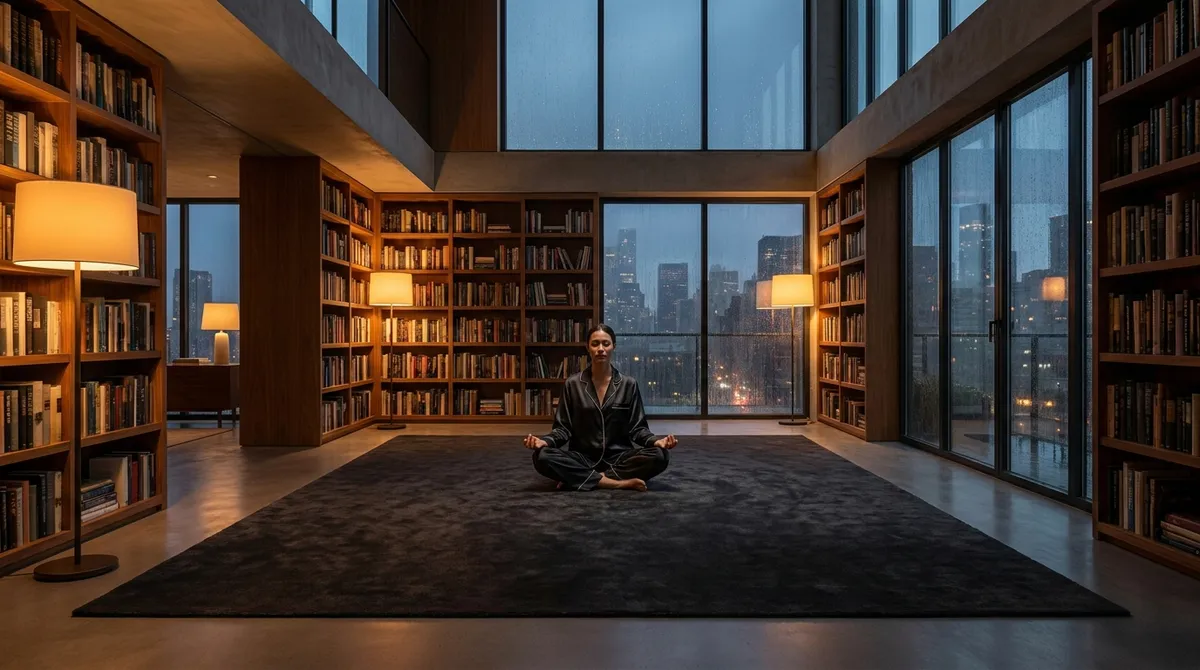
Mental clarity has become a rare commodity—quiet, coveted, and quietly competitive. In a culture that rewards constant availability, true stillness feels almost subversive. Meditation, when practiced with intention and discernment, is not merely a stress-reduction tool; it becomes an intellectual luxury, a way to refine perception, sharpen emotional nuance, and curate one’s inner world with the same care devoted to a well-edited wardrobe or a thoughtfully designed space.
This is meditation not as escape, but as elevation—an elegant, deliberate choice to inhabit your own mind with more precision and grace. Below are five exclusive insights that those seeking a more cultivated mental life will appreciate—subtle, powerful shifts that reposition meditation as an art of exquisite inner curation.
Meditation as Cognitive Curation, Not Emptying the Mind
The common advice to “empty your mind” is both misleading and unnecessarily daunting. A more sophisticated frame: meditation is cognitive curation—the deliberate refinement of what you allow to occupy mental real estate.
Rather than wrestling thoughts into silence, you treat the mind like a private gallery. Thoughts appear as pieces on display: some are worthy of extended contemplation, others are background clutter. In meditation, you practice noticing without purchasing—allowing a thought to arise, acknowledging it, and then letting it drift without acquisition.
This reframing is particularly suited to high-performing, mentally active individuals who fear that meditation will dull their edge. In truth, cognitive curation enhances selectivity. The mind becomes less easily hijacked by low‑value mental loops—resentment, replayed conversations, anticipatory anxiety. Over time, this cultivated selectivity can translate into more precise decision-making, greater intellectual stamina, and a quieter, more discerning internal dialogue.
The subtle elegance here lies in recognizing that you are not trying to become thoughtless. You are becoming more exacting in what you mentally entertain.
The Micro-Interval Practice: Luxurious Stillness in 90 Seconds
Many people imagine meditation as a 30-minute commitment in a perfectly quiet room. That standard, while ideal, often becomes an excuse to do nothing at all. A more refined approach integrates what we might call “micro-intervals” of stillness—high-quality, 60–90 second meditative pauses woven discreetly into the day.
These intervals are not a lesser version of “real” meditation; they are precision tools. Before a demanding conversation, you close your eyes for one minute, align your posture, and attend only to the coolness of the inhale at the nostrils, the warmth of the exhale. Between tasks, you sit at the edge of your chair, rest your hands lightly, and spend 90 seconds simply watching the rise and fall of breath in the chest, like the gentle swell of well-tailored fabric.
Practiced consistently, these small, deliberate interruptions begin to re-pattern your nervous system. They move your internal state away from constant low-level activation and toward a more regulated baseline. The benefit is cumulative: fewer impulsive reactions, more composed responses, and an increasingly effortless return to center when the day becomes demanding.
This is meditation not as an isolated event, but as a refined rhythm—quiet intervals that lend the rest of your day an unmistakable poise.
Sensory Minimalism: Using Subtle Details to Anchor the Mind
Rather than forcing the mind to focus on “nothing,” give it something exquisitely simple and precise. Sensory minimalism is the art of selecting one understated sensory detail and treating it as a focal point of elegant attention.
This might be the exact sound of air moving through a slightly open window, the delicate point where your fingertips touch, or the almost imperceptible pause between your in-breath and out-breath. The goal is not intensity, but refinement: to train your awareness to rest on something intentionally subtle.
Sensory minimalism has two advantages. First, it cultivates a more sophisticated form of concentration—less brute force, more finely tuned perception. Second, it gently retrains a mind accustomed to high stimulation (constant notifications, rapid media, ambient noise) to find interest and nourishment in quieter, more nuanced experiences.
In a world saturated with sensory excess, this practice becomes a quiet luxury. You are, in effect, reclaiming your attention from the loudest stimuli and offering it instead to what is delicate, understated, and easily overlooked.
Emotional Decanting: Letting Feelings Settle Before Responding
Meditation is often portrayed as purely cognitive, but its true refinement lies in emotional discernment. Imagine your emotions as a richly layered wine: shaken, it is cloudy and indistinct; left undisturbed, it separates into something more legible and nuanced. Emotional decanting is the meditative practice of allowing feelings to settle before acting on them.
When irritation, anxiety, or hurt emerges, the instinct is to resolve, reply, explain, or correct. Instead, emotional decanting asks you to pause. You sit, close your eyes, and locate the emotion in the body: tightness in the jaw, heat in the chest, agitation in the hands. You do not interpret; you witness. You stay with the pure sensation—temperature, pressure, rhythm—for several minutes, breathing steadily, saying internally, “This is what anger (or fear, or sadness) feels like in the body.”
As the nervous system settles, the emotion becomes more defined and less overwhelming. You can often distinguish between the initial surge (old patterns, past experiences, fear of judgment) and the smaller, more accurate signal of what is actually happening now. Your eventual response—if one is still needed—emerges from clarity rather than reactivity.
This is emotional elegance: not suppression, but a cultivated pause that respects the complexity of your interior life before translating it into words or action.
The Evening Reset: A Private Ritual of Mental Housekeeping
Many people approach bedtime with a mind still in motion—emails half‑resolved, conversations unresolved, future worries on a loop. An evening meditation need not be long to be transformative; what matters is its structure and intentionality. Think of it as mental housekeeping: a brief, dignified ritual that restores order before the day closes.
Begin by sitting somewhere comfortable but composed—ideally not in the bed where you sleep. Set a modest time frame, such as eight to ten minutes. The practice unfolds in three refined phases:
- Review (2–3 minutes): With eyes closed, replay the day at a high level, as though observing from above. Acknowledge what was done, what was left undone, and any moments of tension. No analysis, only recognition: “This occurred.” This simple witnessing prevents the mind from needing to rehash it all night.
- Release (3–4 minutes): Shift attention to the body, scanning from scalp to feet. On each exhale, imagine unhooking from the day’s residue—visual impressions, obligations, lingering dialogues. The breath becomes a quiet conveyor, moving the day away from the body and out of the nervous system.
- Reorientation (2–3 minutes): Finally, rest attention gently on the breath at the belly and introduce a simple phrase on the exhale, such as “For now, enough.” This phrase signals sufficiency—a refined declaration that, for this day, you have reached an endpoint. It cues the mind that analysis and planning can resume tomorrow, but not tonight.
Over time, this evening reset becomes a subtle luxury: the difference between collapsing into sleep and arriving at it with deliberateness, composure, and an unmistakable sense of inner order.
Conclusion
Meditation, approached with discernment, is far more than a wellness trend or productivity hack. It is a quiet elevation of how you inhabit your own mind—how you curate thoughts, refine emotions, and orchestrate the internal tempo of your day.
By embracing cognitive curation instead of mental emptiness, integrating micro-intervals of stillness, practicing sensory minimalism, allowing for emotional decanting, and closing the day with a composed evening reset, you transform meditation into something both rare and deeply practical: an intellectual and emotional luxury you carry everywhere.
In an increasingly noisy world, this level of inner refinement is not indulgent. It is a discreet, powerful advantage.
Sources
- National Center for Complementary and Integrative Health – Meditation: In Depth - Overview of meditation types, potential benefits, and research-backed findings
- Harvard Health Publishing – Mindfulness meditation may ease anxiety, mental stress - Discusses how mindfulness and meditation influence stress and emotional regulation
- American Psychological Association – Mindfulness meditation: A research-proven way to reduce stress - Summarizes psychological research on meditation’s effects on mood, attention, and well-being
- Mayo Clinic – Meditation: A simple, fast way to reduce stress - Explains practical approaches to meditation and its physical and mental health benefits
- Cleveland Clinic – What is Meditation? - Provides accessible definitions, benefits, and guidance on integrating meditation into daily life
Key Takeaway
The most important thing to remember from this article is that this information can change how you think about Meditation.