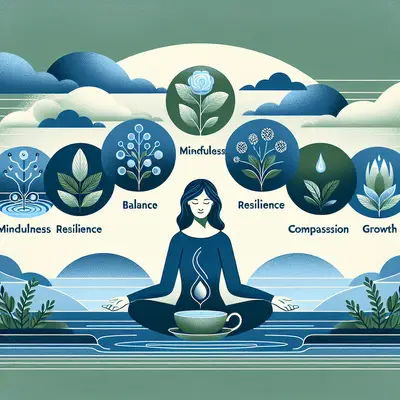
Mental wellness is not a finish line; it is a cultivated atmosphere—quiet, intentional, and exquisitely personal. In a world eager for quick fixes and loud solutions, the most transformative practices are often the most understated: a recalibrated boundary here, a refined ritual there, a subtle shift in how you speak to yourself. Together, these create an inner environment where your nervous system can finally exhale.
This is not about perfection or relentless self-optimization. It is about crafting a life that feels soft around the edges, even when your calendar does not. Below are five elevated, quietly powerful insights for those who are no longer interested in surviving their days, but in inhabiting them with grace.
1. Treat Your Attention as Your Most Luxurious Asset
Your attention is the finest currency you own—finite, influential, and constantly under quiet auction. Every tab open, every notification, every stray scroll is a bid on your mental clarity. When you begin to treat attention as a premium resource, your relationship with your own mind changes: you stop giving it away casually and start investing it intentionally.
Start by observing where your attention leaks. Notice the tiny, constant pulls on your focus: the reflexive email check, the background noise of group chats, the subtle compulsion to “just look something up.” None of these seem harmful alone, but together they create a permanently fractured inner landscape. Mental wellness begins with reclaiming this landscape. Curate your inputs the way you would curate your home: remove what is visually and emotionally noisy, and keep only what feels nourishing, expansive, or genuinely necessary.
This might mean setting specific “viewing hours” for news, pruning your social feeds to accounts that leave you calmer rather than agitated, or turning your phone into a deliberately uninteresting object—muted, simplified, almost quiet. Over time, as your attention becomes more concentrated, your thoughts become less scattered and your nervous system less alarmed. The result is not just productivity; it is a more dignified experience of your own mind.
2. Design Micro-Sanctuaries Instead of Waiting for a Vacation
Many people wait for weekends, retreats, or rare holidays to feel restored, as if calm can exist only in large, uninterrupted chunks of time. This is a fragile strategy. A more elegant approach is to weave restoration into the architecture of your everyday life, creating micro-sanctuaries—small islands of deliberate mental ease—within an otherwise full day.
A micro-sanctuary is less about scented candles and more about emotional permission. It might be three intentional breaths before you answer a message that triggers you. It might be a quiet two-minute ritual of placing your hand over your heart before you open your laptop. It might be the decision to drink your morning tea or coffee without a device, allowing your senses to fully register warmth, aroma, and stillness.
The key is to give these moments a sense of ceremony, however subtle. When you elevate them from “breaks” to rituals, your mind begins to recognize them as reliable signals of safety. Over time, these micro-sanctuaries train your nervous system to downshift quickly, rather than waiting for complete escape. Your day may remain busy, but it becomes speckled with oases: brief, consistent reminders that you are not owned by your schedule.
3. Refine Your Inner Tone, Not Just Your Inner Talk
Affirmations and positive self-talk are often presented as the primary tools for mental wellness. Yet the words themselves matter less than the tone in which you say them internally. You can repeat a kind sentence to yourself with a harsh, impatient, or skeptical tone—and your body will believe the tone, not the text.
Begin by listening, almost as an observer, to how your mind speaks to you in moments of small error: a forgotten appointment, a clumsy comment, a missed message. Do you default to subtle contempt (“Of course you did that”), irritation (“Seriously?”), or quiet resignation (“Here we go again”)? These micro-moments of inner tone, repeated over years, can erode your self-trust more than a single dramatic event.
Refining your inner tone does not mean becoming saccharine or falsely upbeat. Think of it instead as adopting a more composed, compassionate manner with yourself—like a calm mentor, not a relentless critic. You can still be honest: “That didn’t go as you hoped.” But you can add a second sentence that keeps the nervous system grounded: “And we can learn from it without attacking ourselves.” This shift is subtle and sophisticated; it won’t make a headline, but it can quietly change the way you inhabit your own mind.
4. Practice Emotional Elegance Instead of Emotional Perfection
Modern wellness culture often frames emotional stability as a kind of flawless serenity—no anxiety, no anger, no overwhelm. This is neither realistic nor human. Emotional elegance is different: it is the capacity to move through your emotional landscape with a certain grace, even when the weather is stormy.
Emotional elegance starts with allowing emotions to be information, not indictments. Anxiety might be a signal that a boundary is missing. Irritation might reveal a quiet resentment you’ve been too polite to name. Sadness might be an honest reflection of something you valued and lost. When you treat feelings as data rather than defects, you can respond with precision instead of shame.
This approach can look like saying, “I feel tightness in my chest and a racing mind; this might not mean something is wrong with me, but that I’ve had three days of poor sleep and constant stimulation.” Or, “I feel a heaviness after seeing that person; this may be my body telling me that the relationship no longer feels safe or reciprocal.” Emotional elegance does not rush to solve or suppress. It observes, names, honors, and then chooses a measured response. The result is not a life without emotion, but a life where emotion does not constantly hijack your sense of self.
5. Curate Rest With the Same Care You Curate Achievement
Achievement is meticulously planned: calendars, to-do lists, project timelines. Rest, by contrast, is often treated as something that “just happens” when you collapse at the end of the day. This imbalance quietly undermines mental wellness. To feel truly restored, rest must be curated with the same intentionality and discernment you give your most important work.
Begin by distinguishing between passive escape and active restoration. Hours of unfocused scrolling might feel like rest, but often leave the mind more agitated and fragmented. True restoration has an aftertaste of clarity, softness, or groundedness, even if it is brief. This might mean a slow walk without your phone, a bath with deliberate silence, journaling to release mental static, or simply sitting near a window and letting your gaze rest on something natural.
Curated rest also involves boundaries: choosing a time each evening when work-related thoughts are gently but firmly set aside, or designating one night a week when you do not schedule anything that requires performance, output, or social effort. Protect these times with quiet rigor. When rest is not an afterthought, your mind no longer has to beg for recovery through burnout, illness, or emotional collapse. Instead, restoration becomes a built-in, non-negotiable part of your life’s design.
Conclusion
A well-tended mind is not necessarily a quiet mind, but it is a considerate one. It respects attention as a precious resource, invites restoration into ordinary minutes, softens its internal tone, navigates emotion with poise, and treats rest as a deliberate practice rather than a leftover.
Mental wellness at its most refined is not loud or performative. It reveals itself in the way you move through your days: a little less hurried, a little more anchored, a bit more discerning about what you allow to touch your nervous system. With small, intentional shifts, your inner world can begin to feel less like a battleground—and more like a carefully crafted refuge you are proud to inhabit.
Key Takeaway
The most important thing to remember from this article is that this information can change how you think about Mental Wellness.