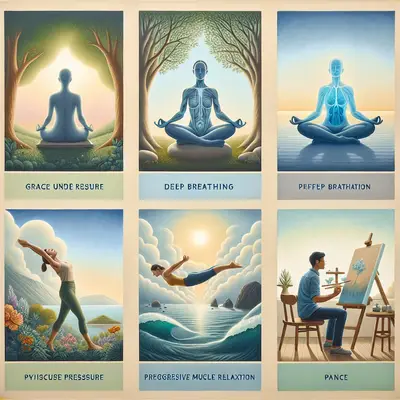
Stress does not always arrive loudly. Often, it slips in through the smallest cracks of our day—a late email, a crowded calendar, a restless night—and quietly rearranges our inner world. For those who value a refined, intentional approach to living, stress relief is less about escape and more about elegant recalibration: a deliberate returning to poise, clarity, and understated strength.
This article explores five exclusive, understated insights into stress relief—designed for those who seek not quick fixes, but elevated, enduring mental ease.
Stress as “Cognitive Clutter” — Curating Your Inner Environment
Stress is frequently described in emotional terms, but high performers often experience it as mental crowding: too many tabs open, too many threads to hold at once. Reframing stress as “cognitive clutter” can be a powerful starting point for relief.
Instead of asking, “How do I stop feeling stressed?” consider, “What mental items no longer deserve premium space in my mind?” This subtle reframe treats your attention as a carefully curated gallery rather than an overstuffed storage room. It positions you not as a victim of stress, but as a discerning curator.
Begin by noticing which recurring thoughts consume the most bandwidth: unfinished obligations, vague worries about perception, imagined outcomes that never arrive. Then, act like an editor. Which items require concrete action? Which simply need to be acknowledged and released? Which can be scheduled for later consideration, rather than carried all day?
This quiet, cognitive decluttering replaces frantic multitasking with composed selectivity. You are not trying to think less; you are choosing to think more precisely.
The Elegance of Micro-Rest: Redefining Recovery in Minutes, Not Hours
Many people imagine stress relief as something that requires an entire evening, a weekend away, or a complete lifestyle overhaul. In reality, the nervous system responds exquisitely to small, intentional doses of recovery—what we might call micro-rest.
Micro-rest is not scrolling a phone or passively consuming content; it is brief, high-quality restoration. Think 60–180 seconds, practiced consistently, with deliberate presence. A few refined examples:
- Closing your eyes and taking six slow, nasal breaths, lengthening each exhale
- Allowing your gaze to soften and rest on a single, calming object—a candle flame, a favorite piece of art, the view from a window
- Placing one hand over your chest and another over your abdomen, simply noticing warmth and movement
- Standing up, rolling your shoulders slowly, and consciously relaxing your jaw, brow, and throat
These minimal yet potent resets communicate safety to the nervous system. They reintroduce a sense of spaciousness into a crowded day without demanding dramatic changes to your schedule.
When performed throughout the day, micro-rest becomes a refined ritual: a quiet signature of how you choose to move through pressure—with discretion, calm, and control.
Stress as a Signal of Misaligned Boundaries, Not Personal Failure
Those who are conscientious, ambitious, and deeply responsible often misinterpret stress as a flaw: “If I were more organized, more capable, more resilient, I wouldn’t feel this way.” This is rarely true. Chronic stress is often a precise indicator of misaligned boundaries, not personal inadequacy.
The body—through increased heart rate, tension, irritability, or cognitive fatigue—may be quietly announcing: “You have agreed to more than your inner ecosystem can support.” Stress in this light becomes a highly intelligent signal rather than a shameful symptom.
A sophisticated response is not to push harder, but to perform a boundary audit:
- Where have you said “yes” when your inner response was “not now” or “not this”?
- Which obligations reflect old versions of you—old priorities, old expectations?
- Where do you feel overexposed—too available, too reachable, too responsible for others’ comfort?
Boundary refinement can be subtle, not dramatic. It might mean limiting your response window to non-urgent messages, quietly reducing unnecessary social obligations, or introducing gentle phrases: “I’m at capacity this week,” or “I can do this, but at a later date.”
Seen from this angle, stress becomes a sophisticated barometer for alignment. When honored, it guides you toward a life in which your responsibilities and your inner resources are artfully matched.
The Power of Ritualized Transitions Between Roles
One of the most overlooked sources of stress is the constant, unmarked shifting between roles: professional, partner, parent, caregiver, friend, host, decision-maker. Without clear transitions, the mind never truly arrives anywhere—it remains partially tethered to the previous scene.
Ritualized transitions are a refined, almost ceremonial way to signal to your nervous system: “That role is complete for now; this new role is now receiving my full presence.”
These need not be elaborate. Consider:
- After work, pausing in your car, elevator, or entryway for 90 seconds of deep breathing before stepping into your home space
- Changing into different clothing when moving from “public” to “private” life—signaling a change in energy and expectations
- Using a specific scent (a subtle essential oil, a favorite candle) reserved only for winding down in the evening
- Writing a one-sentence closing note at the end of the workday: “Today, I completed enough; tomorrow, I will handle the rest.”
Over time, these transitions develop a kind of psychological elegance. Instead of dragging one role’s residue into another, you arrive more fully—less scattered, more grounded, and more emotionally available.
This is not merely pleasant; it is strategic. Clear transitions help prevent role fatigue and emotional spillover—the two quiet saboteurs of balanced mental health.
Refining Stress Response Through Sensory Precision
For those who live in fast-moving environments, stress can feel abstract—like an all-over fog. Precision is your ally here. The more specifically you can locate stress in your body and senses, the more skillfully you can respond.
Ask yourself, at intervals:
- Where, exactly, is my body holding tension—neck, jaw, stomach, hands?
- What does my breathing actually feel like—shallow, hurried, held?
- Which sensory inputs are amplifying my stress—noise, screen brightness, clutter, temperature?
Then, intervene with sensory refinement instead of sheer willpower:
- If your jaw is tight, consciously release your tongue from the roof of your mouth and let your teeth part slightly
- If sound overwhelms you, choose momentary quiet or a single, calming auditory anchor (soft instrumental music, white noise)
- If visual clutter agitates you, clear or simplify a small area—a desk, a nightstand, a digital home screen
By responding at the sensory level, you bypass unproductive overthinking and work directly with the nervous system. Stress relief then becomes not a vague aspiration but a tangible, almost artisanal practice of adjusting light, sound, texture, breath, and posture until your inner experience feels more composed.
Conclusion
Truly elevated stress relief is not an escape from reality; it is an elegant reconfiguration of how you inhabit it. By treating your mind as something to be curated, not conquered—by honoring micro-rest, heeding the wisdom of boundaries, sanctifying transitions, and refining sensory input—you transform stress management into a quiet, sophisticated craft.
These practices do not shout their presence. They work quietly, consistently, like fine tailoring: almost invisible from the outside, but unmistakable in how they make you feel—supported, composed, and discreetly powerful in the midst of a demanding world.
Sources
- American Psychological Association – Stress: The Different Kinds of Stress – Overview of stress types, impacts on the body and mind, and evidence-based coping strategies
- National Institute of Mental Health – 5 Things You Should Know About Stress – Concise, research-informed explanation of how stress affects health and approaches to management
- Mayo Clinic – Stress Management – Practical techniques for managing stress, including relaxation, boundaries, and lifestyle adjustments
- Harvard Health Publishing – Understanding the Stress Response – Detailed discussion of the physiological stress response and how practices like breathing and relaxation can modulate it
- Cleveland Clinic – The Benefits of Deep Breathing – Explores how intentional breathing exercises support the nervous system and reduce stress responses
Key Takeaway
The most important thing to remember from this article is that this information can change how you think about Stress Relief.