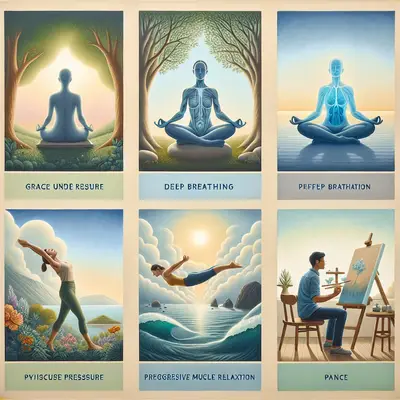
Stress is no longer a fleeting visitor; for many, it has become the quiet undercurrent of daily life. Yet relief does not always require radical reinvention. Often, it emerges from precise, almost imperceptible adjustments—small, intentional gestures that restore a sense of inner spaciousness. For a discerning mind, stress relief is less about escape and more about refinement: editing what does not belong, amplifying what nourishes, and designing an inner environment that feels both grounded and exquisitely calm.
Below are five exclusive, elevated insights—each intended not as a quick fix, but as a subtle recalibration for those who treat their mental state as something to be curated with care.
1. Curating Mental Input: Treating Attention as a Finite Luxury
Stress is not only about what happens to us; it is also about what we continuously allow into our cognitive space. Much like a thoughtfully designed room, the mind becomes calmer when it contains fewer, more intentional elements.
Begin by treating your attention as a luxury resource, rationed with discernment. Audit your daily inputs: the constant news pings, background conversations, overloaded inboxes, and endlessly scrolling feeds. Notice which of these leave you subtly agitated, even when they seem small or “normal.” The nervous system does not distinguish much between a looming deadline and a relentless stream of minor alerts; what it registers is unbroken vigilance.
You might designate “quiet corridors” in your day—uninterrupted windows in which no new input is allowed. Silence notifications, step away from screens, and allow your senses to register reality as it actually is: the weight of your body in the chair, the texture of your clothing, the ambient sounds of your environment. This deliberate reduction of noise is not asceticism; it is curation. In time, the mind begins to exhale, relieved to no longer be treated as an open-door policy for everything and everyone.
2. The Micro-Ritual of Transition: Ending One Moment Before Beginning the Next
Modern life often demands seamless transitions—straight from a demanding meeting into family conversation, from emails into sleep. The result is an internal “carryover effect”: mental residue from the last activity invades the next, amplifying stress and dulling presence.
Introducing a refined practice of “micro-rituals” between phases of your day can create psychological thresholds that signal to the nervous system: this chapter is closed; a new one begins. These rituals need not be elaborate. They must simply be consistent and intentional.
You might develop a 60–90 second practice at key transition points:
- After finishing work, but before leaving your desk, take ten deliberate, unhurried breaths, lengthening each exhale.
- Before entering a meeting, place one hand on the desk or your lap, notice three things you can see, two you can hear, one you can feel.
- Before bed, turn off your devices, dim the lights, and wash your hands with warm water as if you are “rinsing off the day.”
In time, these small, repeated gestures become psychological markers—quiet cues that it is safe to put down what you were carrying. The mind, trained to recognize these rituals, becomes more adept at releasing tension rather than allowing it to accumulate invisibly.
3. Nervous System Etiquette: Moving as Though Your Body Is Listening
Stress is not confined to thoughts; it is stored and expressed through the body. The way you move, stand, and breathe informs your nervous system whether it is safe or under threat. Refining your physical language can therefore become a discreet yet powerful form of stress relief.
Begin by observing your posture and micro-movements during moments of strain: shoulders inching upward, jaw tightening, breath held or shallow, hands gripping devices. This is the body’s etiquette when it believes it must brace for impact.
Now experiment with a different kind of etiquette—moving as though your body is already safe and deeply respected:
- Lower your shoulders slightly and soften your jaw, as if releasing a small, unnecessary effort.
- Place both feet flat on the ground when you type, speak, or think through something important.
- Lengthen the exhale by just two or three counts, without forcing the inhale.
- When you stand, imagine your spine as a vertical line of quiet dignity rather than a tense column holding everything together.
These are not mere posture corrections; they are messages. The body, treated respectfully, begins sending calmer signals back to the mind. Over time, stress becomes less of a default and more of a specific state you can recognize and gently unwind.
4. Elegant Boundaries: Designing Constraints That Reduce Cognitive Friction
Many people associate boundaries with confrontation or deprivation. In reality, skillfully chosen constraints can feel luxurious—like a well-tailored garment that allows you to move freely while maintaining form.
Stress often thrives in environments of vague expectations and endless possibility: an always-open calendar, messages allowed at all hours, projects without clear edges. To reduce this invisible strain, consider boundaries as design elements that protect your mental clarity.
Examples of refined constraints include:
- A personal rule that your first 20 minutes of the day are screen-free, reserved only for coffee, tea, reflection, or quiet planning.
- A clearly defined end-of-day time for digital communication, after which you are intentionally “off-duty,” even if only for two or three sacred hours.
- A curated set of “yeses” for your week: consciously selecting one or two priorities that truly matter, and allowing yourself to decline or defer the rest without apology.
Such boundaries do not restrict your life; they frame it. With fewer ambiguous commitments and clearer edges, your mental load becomes more manageable—and with that, stress often dissipates not through force, but through intelligent structure.
5. Rest as Refinement: Pursuing Quality, Not Just Quantity
Sleep and rest are often prescribed as solutions for stress, yet many people discover that more hours in bed do not automatically translate into feeling restored. True nervous system recovery has less to do with sheer duration and more to do with the quality and texture of your rest.
Begin by examining not only how long you rest, but how you arrive there. Racing from intense stimulation to bed—scrolling, answering messages, rapid-fire multitasking—asks the mind to execute an abrupt emotional U-turn. A premium approach to rest is transitional: it gently escorts the nervous system from alertness into ease.
You might create an evening atmosphere that feels like a soft descent:
- Dim the lights earlier than you think necessary; the nervous system responds to gradual changes in light.
- Reserve the final 30–60 minutes before sleep for low-stimulation activities: quiet reading, stretching, soft music, or a brief reflection on one or two moments you genuinely appreciated.
- Reduce blue-light exposure, not as a rigid rule but as an act of respect for your body’s rhythm.
- Notice if pre-sleep thoughts tend to be problem-solving loops. When they arise, gently redirect your attention to physical sensations—the weight of your body, the softness of the bedding, the rhythm of your breath—without forcing anything to change.
In this way, rest becomes an art form rather than an afterthought. Over time, better-quality rest stabilizes mood, sharpens focus, and makes you less vulnerable to everyday stressors. Your baseline becomes quieter; your resilience, more refined.
Conclusion
Stress relief, at its most elegant, is not about escaping life, but inhabiting it differently. It is the slow, deliberate craft of reducing unnecessary mental noise, honoring the body’s signals, and designing days that feel internally coherent rather than frayed at the edges.
By curating what enters your mind, honoring transitions, moving with nervous system awareness, designing intelligent boundaries, and elevating the quality of your rest, you begin to unburden the mind in ways that are subtle yet profound. The shift may not announce itself loudly, but you will notice it in the spaces between moments—in the quiet certainty that you are no longer at the mercy of stress, but gently guiding the inner climate of your own life.
Sources
- National Institute of Mental Health – Stress – Overview of what stress is, its impact on health, and foundational management strategies
- American Psychological Association – Stress Effects on the Body – Explains how stress influences the nervous system, body posture, and overall health
- Centers for Disease Control and Prevention – Sleep and Sleep Disorders – Evidence-based information on the role of quality sleep in mental and physical well-being
- Harvard Health Publishing – Give your brain a break: Why mental downtime is important – Discusses cognitive load, mental input, and the importance of breaks for stress relief
- Mayo Clinic – Relaxation Techniques: Try These Steps to Reduce Stress – Outlines practical approaches to calming the nervous system through breathing, body awareness, and structured relaxation
Key Takeaway
The most important thing to remember from this article is that this information can change how you think about Stress Relief.