Most people attempt to “manage” stress the way they manage email: quickly, reactively, and only when it becomes overwhelming. Yet the nervous system does not respond to urgency; it responds to atmosphere. To create lasting calm, we don’t need louder solutions or more elaborate routines—we need quieter, more intentional signals of safety woven into the texture of our days.
Think of stress relief less as a task and more as an environment you curate. The goal is not to escape your life, but to refine the way your mind, body, and surroundings interact. The following practices are not quick fixes; they are subtle, elegant recalibrations that invite your nervous system to exhale.
1. Regulating by Texture: Turning Everyday Objects into Soothing Anchors
Your nervous system is constantly sampling the world through your skin. The textures you touch all day—keyboards, clothing, bedding, furniture—either agitate or ease you, often below conscious awareness. Instead of reserving softness for rare spa days, elevate the tactile quality of the things you touch most frequently.
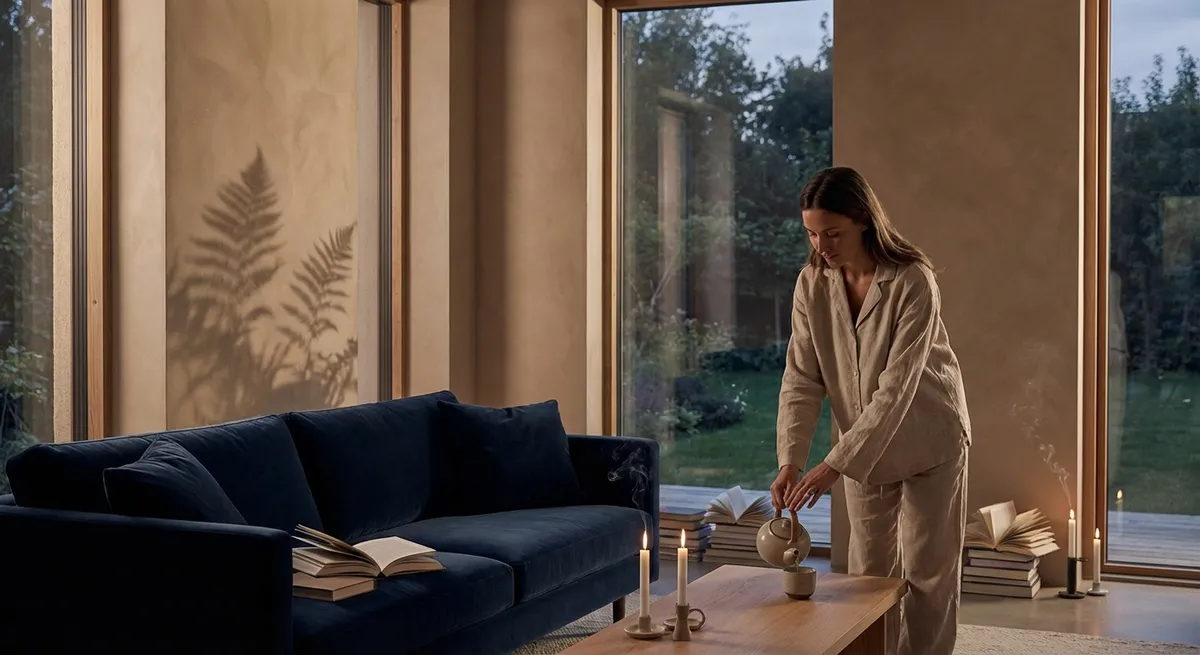
Begin with what greets your hands and body repeatedly: the handle of your mug, your desk chair, the throw on your sofa, even the fabric of your sleepwear. Choose materials that feel slow, grounded, and gentle—brushed cotton instead of synthetic shine, a weighted knit instead of scratchy acrylic, a mug with a satisfyingly solid grip instead of thin, fragile porcelain. Each time you touch these items, your body receives a quiet, repetitive cue of comfort. Over time, these micro-moments of tactile reassurance accumulate, teaching your nervous system that safety is not an event, but a default setting.
2. The Luxurious Pause: Redefining Transitions as Mini-Retreats
Stress often hides not in the tasks themselves, but in the frantic way we move between them. We rush from call to email to family to errands without a true sentence break in our day. Instead of chasing a long, elusive vacation, refine the quality of your transitions and treat them as small, luxurious intermissions.
Before you move from one role to another—worker to partner, parent to friend, host to guest—insert a deliberate 60–90 second pause. Close your eyes or soften your gaze. Feel the weight of your body in the chair or through your feet. Let your exhale be slightly longer than your inhale. You might even add a simple ritual: a slow sip of water, a gentle stretch of the shoulders, or a single line in a journal: “I am closing this chapter; I am entering the next with intention.” These miniature retreats signal to the nervous system that it does not have to sprint through the day. Instead of one dramatic reset, your entire schedule becomes gently cushioned with moments of decompression.
3. Curating Your Soundscape: Designing Audio That Softens the Mind
We often discuss “digital detox,” but rarely consider “audio detox.” Yet sound is one of the most potent influences on the nervous system. Constant notifications, overlapping conversations, streaming content, and ambient city noise keep your system slightly braced, as if something important is always about to happen.
Treat your sound environment as you might a carefully curated fragrance or playlist at a fine hotel. First, identify the most stressful audio intrusions in your day: aggressive alerts, constant news cycles, loud multitasking. Replace shrill notification tones with softer, lower-frequency sounds—or better yet, disable non-essential alerts altogether. Introduce intentional sounds that signal calm: low-volume instrumental music while you work, gentle pink or brown noise in the background, or a single track you reserve exclusively for unwinding in the evening. Over time, your brain will associate these sounds with decompression, like a personalized acoustic sanctuary you can carry everywhere.
4. Precision Rest: Matching Restorative Practices to Your Stress Pattern
Not all rest is equal, and not all stress responds to the same remedy. Many people attempt to relax with generic advice—“go for a walk,” “take a bath,” “watch something light”—without understanding what kind of depletion they are actually experiencing. Luxury, in this context, means precision: choosing the exact form of rest that speaks to your particular exhaustion.
If your mind is racing, you may need structured mental rest: journaling to empty thoughts, guided meditation, or a single-task activity like slowly preparing tea. If your body feels wired but tired, you may benefit from sensory rest: dimming lights, lying down with a weighted blanket, or practicing slow, deliberate stretches. If you feel emotionally saturated, relational rest can help: a brief boundary around communication, a quiet hour without social media, or a conversation with someone who requires nothing from you. Once you learn to diagnose your own pattern—mental, physical, emotional, or social overload—you can select the exact restorative practice that meets it. This level of tailored care transforms rest from a vague concept into a calibrated tool.
5. Ritualizing the First and Last Ten Minutes of Your Day
The bookends of your day wield disproportionate influence over your nervous system. The first ten minutes set your baseline; the last ten minutes teach your body how safe it is to surrender to sleep. Treating these windows as sacred, rather than incidental, subtly rewires your overall experience of stress.
In the morning, resist the gravitational pull of your phone for just a few minutes. Instead, orient yourself to physical reality: light, air, temperature, the weight of your body. Open a blind, take three unhurried breaths, and ask a single gentle question: “What would make today feel more spacious?” At night, create a small but consistent closing ceremony. This could be placing your devices outside the bedroom, applying a few drops of a favorite oil, writing a single sentence about something you’re releasing, or reading two pages of a calming book. These bookend rituals don’t need to be elaborate; they need to be consistent. Over time, your nervous system begins to anticipate softness at the edges of each day, reducing the sense that life is one continuous, unbroken demand.
Conclusion
True stress relief is less about dramatic escapes and more about the subtleties of how you live: what you touch, hear, and allow between moments. When you refine textures, transitions, sounds, rest, and daily bookends, you’re not simply “coping” with stress—you’re redesigning the conditions under which it arises.
This is the quiet luxury of mental wellness: a life in which calm is not an occasional intervention, but an elegant, ever-present undertone.
Key Takeaway
The most important thing to remember from this article is that this information can change how you think about Stress Relief.