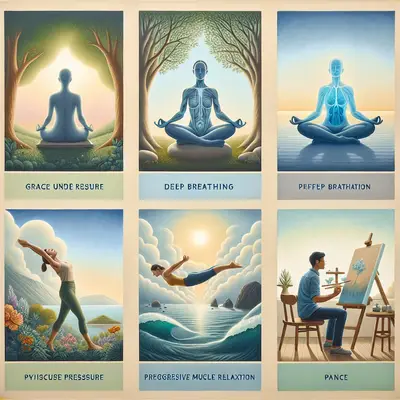
Stress rarely announces itself with drama in a discerning life. It creeps in between back-to-back meetings, threads itself through late-night emails, and tugs gently at the edges of your focus. You function, you deliver, you perform—but the cost is quiet, cumulative, and corrosive. This is not an article about “relaxing more.” It is a blueprint for cultivating a more exquisite relationship with your own nervous system—where stress relief becomes less of an emergency and more of an art form.
Below are five exclusive, nuanced insights designed for those who expect more from their mental wellness practices than generic advice and temporary distraction.
Stress as an Information System, Not an Enemy
Stress is often framed as a villain to be defeated. Yet for a high-functioning, thoughtful person, stress is better understood as an information system—a refined internal messenger rather than a blunt threat.
From a physiological standpoint, the stress response is a precise, evolutionarily honed mechanism driven by hormones like cortisol and adrenaline. When chronic, yes, it disrupts sleep, digestion, mood, memory, and even immune function. But in its earlier stages, stress is essentially your body signalling misalignment: overcommitment, poor boundaries, mismanaged energy, or unresolved emotion.
Reframing stress in this way reshapes your approach. Instead of asking, “How do I get rid of this?” you begin asking, “What is this asking me to notice?”
This might manifest as:
- A spike in irritability during a specific weekly meeting—pointing to an unresolved dynamic or boundary that needs attention.
- Subtle insomnia on nights before particular commitments—suggesting anticipatory anxiety or a misfit between your values and obligations.
- A quiet, recurring headache during late-night screen work—highlighting cognitive overextension and digital fatigue.
By observing patterns with the curiosity of a researcher rather than the panic of a patient, you convert stress into data. This information becomes the foundation for elegant, precise interventions rather than generic coping strategies.
Precision Recovery: Matching the Remedy to the Strain
Most stress advice treats recovery as one-size-fits-all: meditate, exercise, sleep more. Sophisticated stress relief, however, is about precision—matching the modality to the nature of the strain.
Consider three primary domains of stress:
Cognitive Strain (mental overload)
Characterized by decision fatigue, scattered attention, and reduced creativity. Refined remedies: - Cognitive offloading rituals: Structured end-of-day “brain dumps” into a notebook or digital document, separating “needs action” from “harmless noise.” - Single-task immersion windows: Protected 25–50 minute blocks to focus on one high-impact task, restoring a sense of mastery and mental coherence.
Emotional Strain (relational and inner tension)
Manifesting as resentment, anxiety, or emotional exhaustion. Refined remedies: - Elegantly boundaried communication: Scripts prepared in advance for difficult conversations, reducing anticipatory stress. - Deliberate emotional closures: A brief nightly check-in where you identify one unresolved emotion of the day and give it 3–5 minutes of full, non-judgmental attention before releasing it through writing or breath.
Physiological Strain (body-level load)
Revealed by muscle tightness, shallow breathing, headaches, or digestive issues. Refined remedies: - Micro-somatic resets: 60–90 seconds of deliberate, slow exhale breathing (for example, inhale for 4, exhale for 6–8) before transitions like entering a call or replying to critical emails. - Invisible posture corrections: Small, frequent adjustments throughout the day: relaxing the jaw, lowering the shoulders, and placing both feet firmly on the ground to signal safety to the nervous system.
Matching the remedy to the dominant mode of strain ensures that your efforts are not only soothing, but efficiently restorative.
The Luxury of Unfragmented Attention
Constant partial attention is the silent tax of modern productivity. Every notification, tab switch, and micro-interruption tugs your nervous system into a subtle state of alarm. Stress is not just about intensity—it is also about fragmentation.
A truly premium form of stress relief is the deliberate cultivation of unfragmented attention: experiences where your mind is allowed to be fully in one place without negotiating competing demands.
This does not require a silent retreat. It can be practiced elegantly in daily life:
- Single-source mornings (even for 20 minutes)
For the first small slice of your day, interact with only one type of input: a physical book, a single notebook, or a single task. No notifications, no parallel scrolling. This sets a tone of quiet authority over your attention before the world makes its requests.
- Protected transition moments
Before moving from one context to another—work to home, meeting to deep work, daytime to evening—pause for 30–60 seconds to ask: “What deserves my full attention next?” This micro-ritual reduces cognitive drag and lowers stress by closing mental tabs instead of letting them accumulate.
- Luxury of monotasking
Choose one modest daily activity—brewing tea, cleansing your face, brushing your hair, walking down a hallway—that you perform without multitasking. No phone, no thinking through emails, no planning your response in advance with someone. The act becomes a daily rehearsal of being where you are.
As your nervous system relearns how to inhabit single-focus states, the feeling of being perpetually chased by your to-do list softens. Stress begins to ebb not simply because you are doing less, but because you are doing things in more psychologically coherent ways.
Stress as a Design Problem, Not Just a Discipline Problem
It is tempting to assume that if you were more disciplined, you would be less stressed. In reality, much of modern stress is not a willpower failure; it is a design issue—a mismatch between your environment, schedule, and nervous system.
Rather than asking yourself to “try harder,” consider asking, “What can I design differently so that calm is the default, not the exception?”
Elegant design shifts might include:
- Creating “friction” around overwork
- Logging out of work applications on your personal devices so that late-night checking is possible, but not effortless.
- Setting an automatic reminder at a certain time that simply asks, “Is this task worth sacrificing your recovery this evening?”
- Architecting recovery into your calendar
Instead of seeing recovery as optional, place small, non-negotiable pauses directly into your schedule: a 10-minute decompression after demanding calls, a stretch or walk between strategy sessions, a non-work lunch at least twice a week. These become structural commitments, not aspirational ideals.
- Protecting cognitive “quiet zones”
Reserving a specific time each week, even 30 minutes, where nothing is scheduled, and no input is allowed—no podcasts, no social media, no email. You are free to think, walk, stare, or write. This is not wasted time; it is fertile space where your mind integrates, resolves, and recalibrates.
When calm is engineered into your environment, your stress response is no longer fighting an uphill battle. Your surroundings and systems begin to collaborate with your nervous system rather than work against it.
Refining Your Personal Signature of Calm
Stress relief becomes truly elevated when it is tailored—when your rituals feel like an extension of your taste, temperament, and values, not borrowed routines from someone else’s routine.
This is where you move beyond generic “self-care” and curate a personal signature of calm.
To uncover this, explore three dimensions:
Sensory Preferences
- Do you decompress best in visual minimalism or layered textures and warmth? - Are you more soothed by silence, gentle soundscapes, or subtle ambient noise? - Does your body settle more quickly with warmth (baths, heated blankets, warm tea) or coolness (fresh air, cool water, open windows)?
Curating your sensory landscape—lighting, scent, textiles, sound—creates a bespoke sanctuary effect, even in a modest space.
Pace Preferences
- Some people restore through deliberate slowness: unhurried cooking, stretching, journaling. - Others feel calmer after refined intensity: a brisk walk, a short but focused workout, or deliberate breathwork.
Aligning your decompression methods with your natural pacing prevents stress relief from feeling like a performance or a mismatch.
Meaning Preferences
- Activities that feel empty or purely escapist rarely produce deep relief. - Identify rituals that carry quiet meaning for you: caring for a plant, preparing a favorite herbal blend, arranging your workspace with aesthetic intention, reading something that nourishes your perspective rather than just filling time.
Over time, you can refine your own “calm portfolio”—a small, well-chosen collection of practices that feel distinctly yours. The goal is not to escape your life, but to inhabit it with more elegance, authority, and ease.
Conclusion
Stress in a modern, ambitious life is inevitable—but the quality of your relationship with it is entirely transformable. When you treat stress as information, match remedies to specific strains, reclaim unfragmented attention, redesign your environment, and curate a personal signature of calm, relief stops being a temporary intermission. It becomes a quiet standard.
This is not about withdrawing from intensity; it is about meeting it with a nervous system that is respected, listened to, and exquisitely supported. In that space, your mind does not just cope—it begins to truly flourish.
Sources
- National Institute of Mental Health – 5 Things You Should Know About Stress – Overview of what stress is, how it affects the body, and basic management principles.
- American Psychological Association – Stress Effects on the Body – Detailed explanation of how chronic stress impacts different physiological and psychological systems.
- Harvard Health Publishing – Understanding the Stress Response – Clear review of the biology of the stress response and implications for health.
- Mayo Clinic – Chronic Stress Puts Your Health at Risk – Discussion of chronic stress risks and general strategies for management.
- University of California, Berkeley – Greater Good Science Center: How to Calm Your Brain – Research-informed insights on calming the nervous system and improving emotional regulation.
Key Takeaway
The most important thing to remember from this article is that this information can change how you think about Stress Relief.