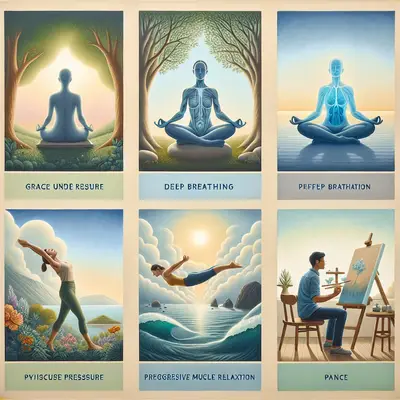
Stress, when left unattended, does not simply “pass.” It accumulates quietly in posture, breath, tone of voice, and ultimately, in health. For a discerning mind, stress relief is not about quick fixes or escapism; it is about cultivating a way of living in which composure, clarity, and quiet focus are the default settings. This is less a wellness trend and more a standard of self-respect. Below, you’ll find five exclusive, refined insights designed for those who view mental wellness as a craft—something to be honed with care, discretion, and elegance.
Reframing Stress as Data, Not Drama
Stress is often treated as a personal failing: a sign that one is not coping “well enough.” In reality, stress is information—your system signalling overload, misalignment, or neglect. When you stop moralizing stress and start reading it, your relationship with it changes.
Begin by naming your stress clearly but neutrally: “My body is in high alert,” “My calendar is overloaded,” or “My mind is anticipating threat.” This shifts you from being inside the storm to observing it from a slight distance. That subtle detachment is neurologically meaningful; research shows that labeling emotions activates the prefrontal cortex, helping to regulate the amygdala’s stress response.
Over time, you can treat stress like a private dashboard. Instead of ignoring it until burnout forces a reset, you take its early readings seriously: tightening in your jaw, shorter breaths, fragmented focus. Each signal becomes a call for recalibration—perhaps a boundary, a pause, a renegotiation, or a deliberate simplification. The goal is not a stress-free life, but a finely tuned one.
Designing Micro-Oases in a Demanding Day
The modern schedule rarely offers spacious afternoons for restoration. What it does offer—if you design for it—are pockets of exquisite calm woven directly into your day. These micro-oases are not indulgences; they are maintenance for a high-functioning mind.
Think in intervals, not hours. Ninety seconds of intentional breathing between meetings. Three minutes of standing by an open window, letting your gaze rest on a distant point to soften digital fatigue. Five minutes in the car before entering the next environment, hands rested on the steering wheel, shoulders released, breath slowing.
To elevate these pauses, attach a small sensory signature to them: a particular scent reserved only for your breaks, a specific playlist with instrumental pieces, a textured object on your desk that signals “reset” when you touch it. Over time, your nervous system begins to associate these cues with exhale and safety. What looks like a brief pause from the outside becomes a surprisingly potent physiological recalibration from the inside.
Curating Your Inputs as a Form of Nervous System Hygiene
Stress relief is not only about what you do; it is about what you allow in. Your nervous system is in constant dialogue with your environment—news cycles, conversations, notifications, and social feeds form a continuous stream of micro-stressors or micro-settlers.
Treat your informational world with the same discernment you bring to what you eat or wear. Schedule windows for news consumption rather than allowing headlines to puncture your day at random. Opt for written summaries over video when possible; they are usually less emotionally triggering and more time-efficient. Curate your digital feeds so they lean towards the nourishing—longform journalism, art, science, genuine education—rather than chronic outrage or comparison.
This is not about retreating into denial, but about managing dosage. High performers understand that attention is a finite resource; so is emotional bandwidth. By curating your inputs, you create more internal space for deep work, thoughtful relationships, and genuine rest—each of which is, in its own way, a quiet remedy for stress.
Negotiating With Your Body Instead of Overriding It
Many sophisticated minds have been trained to override the body: push through fatigue, ignore tension, “power” past signals of depletion. Over time, this strategy extracts a tangible cost—sleep issues, digestive discomfort, chronic pain, emotional reactivity. A more refined strategy is to negotiate with your body collaboratively.
Begin by noticing your earliest physical indicators of stress: perhaps your shoulders rise, your breath becomes shallow, your jaw locks, or your thoughts quicken. These are invitations, not inconveniences. When you sense them, instead of mentally scolding yourself (“I don’t have time for this”), ask a quiet question: “What is the smallest relief I can offer right now?”
That relief might be a two-minute stretch, a glass of water, stepping away from your screen, or choosing to speak one important sentence you’ve been suppressing. None of these gestures are dramatic, yet they send a potent message to your nervous system: “You are being listened to.” In physiological terms, this strengthens your capacity for self-regulation—your ability to return to baseline after stress rather than remaining subtly activated for hours.
Over time, you develop an internal partnership: your mind offers structure and clarity; your body offers signals and thresholds. Stress relief becomes less about heroic recovery and more about constant, nuanced course correction.
Practicing Intentional Endings to Close the Stress Loop
One of the most overlooked sources of chronic stress is the absence of clear endings. Days blend into nights as emails arrive at any hour; work thoughts leak into weekends; unresolved conversations linger in the mind long after the call ends. The nervous system remains on standby, never fully allowed to power down.
Creating intentional endings is a remarkably elegant antidote. Consider a brief “shutdown ritual” at the close of your workday: list the three most important tasks you completed, note the top priority for tomorrow, and physically close your laptop or clear your workspace. This signals completion to your brain.
Likewise, closing emotional loops matters. If a conversation felt tense or incomplete, decide on a next step rather than quietly ruminating: schedule a follow-up, draft a message, or consciously choose to release it for now. Even this act of deliberate choice reduces mental noise.
Before sleep, replace aimless scrolling with a short, consistent ritual: perhaps five minutes of reading something non-work-related, a warm shower, or a few stretches by the bed. These small acts tell your system, “The day is done; you are safe to rest.” In time, your body begins to anticipate these cues, transitioning more gracefully out of stress mode and into restoration.
Conclusion
Stress relief, at its most refined, is not a single practice but a philosophy of living. It is the decision to treat your inner world with the same discernment you apply to other areas of your life—your time, your environment, your commitments. By reading stress as data rather than drama, weaving micro-oases into your day, curating your inputs, honoring your body’s signals, and closing each day with intention, you construct a quiet architecture of calm beneath even a demanding life. This is not about stepping away from ambition or complexity; it is about ensuring that your nervous system is exquisite enough, and supported enough, to carry them well.
Sources
- [National Institute of Mental Health – 5 Things You Should Know About Stress](https://www.nimh.nih.gov/health/publications/stress) – Overview of what stress is, how it affects the body, and basic strategies for management
- [American Psychological Association – Stress Effects on the Body](https://www.apa.org/topics/stress/body) – Detailed explanation of the physiological impact of chronic stress and why regulation matters
- [Harvard Health Publishing – Understanding the Stress Response](https://www.health.harvard.edu/staying-healthy/understanding-the-stress-response) – Explores the biology of the stress response and ways to activate the body’s relaxation response
- [Mayo Clinic – Stress Management](https://www.mayoclinic.org/healthy-lifestyle/stress-management/basics/stress-relief/hlv-20049495) – Practical, evidence-informed approaches to reducing and coping with stress
- [UCLA Mindful Awareness Research Center](https://www.uclahealth.org/programs/marc/mindfulness) – Research and resources on mindfulness practices that support nervous system regulation and stress reduction
Key Takeaway
The most important thing to remember from this article is that this information can change how you think about Stress Relief.