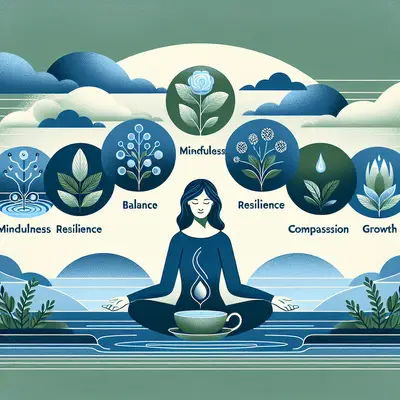
Mental wellness, at its most refined, is not a dramatic transformation but a quiet recalibration. It is the art of living with emotional order rather than emotional urgency—of designing your inner world with the same discernment you might bring to a beautifully composed room. This is not about perfection or relentless self-optimization; it is about cultivating a stable, elegant interior life that can hold both joy and difficulty without being overwhelmed by either.
Below are five exclusive, deeply nuanced insights for those who are no longer satisfied with generic advice and are ready to treat mental wellness as a deliberate, high-level practice.
Redefining Rest as Emotional Recovery, Not Mere Inactivity
In a culture that idolizes being “busy,” rest is often mistaken for simply doing less. For a truly composed mind, however, rest is not the absence of activity; it is the presence of high-quality recovery.
Emotional recovery has a particular texture: you emerge from it more spacious, not merely distracted. Scrolling through your phone or binge-watching a show may feel like “downtime,” but these activities frequently stimulate the nervous system rather than soothe it. A refined approach to rest asks a different question: Does this restore my capacity for clarity and kindness, or merely numb me for a while?
You might experiment with tiers of recovery:
- Micro-recovery (2–5 minutes): intentional breathing, looking out a window at a distant horizon, stretching the neck and shoulders, or a single page of reflective reading.
- Mid-level recovery (20–40 minutes): a walk without audio, a short nap, a guided relaxation, or preparing a simple, nourishing drink with ritualistic care.
- Deep recovery (60+ minutes): an unhurried bath, a massage, a quiet afternoon alone, or a device-free evening.
The aim is to curate a personal “recovery repertoire”—a set of reliably restorative practices you can call upon, rather than leaving your emotional state to chance or habit.
Curating Your Emotional Environment with the Precision of an Aesthetic
Emotional states are not random; they are heavily shaped by context. Just as a poorly lit room affects how we feel without our conscious awareness, a cluttered emotional environment—constant news alerts, chaotic conversations, unfiltered social media—gradually erodes composure.
Those who approach mental wellness with refinement become meticulous curators of their emotional surroundings. This does not mean withdrawing from reality; it means choosing the manner in which reality enters your life.
Consider three quiet upgrades:
- Information hygiene: Decide when and how you consume news, rather than grazing on headlines throughout the day. Designate a narrow window for news intake and choose a limited number of reputable sources.
- Relational boundaries: Treat your time and emotional energy as you would a treasured resource. You can be kind and firm simultaneously—especially with recurring sources of unnecessary drama or emotional chaos.
- Sensory calibration: Light, sound, and texture affect the nervous system. Soft, indirect lighting, intentional soundscapes (gentle instrumental music, for example), and uncluttered spaces subtly signal safety to the brain.
The question to keep returning to is: Does this environment help my nervous system feel safe enough to think clearly and feel deeply without being flooded? Over time, the answer to that question becomes the compass for how you design both your spaces and your schedule.
Treating Attention as a Luxury Asset, Not a Casual Commodity
A composed mind is, above all, a well-directed mind. In a world engineered to fragment attention, the ability to hold focus on a single thing—without agitation or compulsion—is the modern equivalent of understated luxury.
Instead of treating attention as something constantly available to be claimed by the loudest stimulus, begin to treat it as a finite, premium asset you allocate deliberately. This mindset shift alone transforms mental wellness from something reactive into something strategic.
Subtle practices that honor your attention include:
- Single-task appointments with yourself: Schedule focused blocks for thinking, reading, or creating, as though they were meetings with someone you deeply respect.
- Deliberate interruptions: If you must shift tasks, do it consciously: a breath, a sentence to yourself (“I am now moving from email to deep work”), and a resetting of posture. This tiny ritual signals intentionality rather than scattered reaction.
- Attention “fasts”: Periodically, step away from algorithm-driven content—no endless feeds, no reactive scrolling. Even 24 hours of abstaining from digital noise can recalibrate your internal pace.
Over time, this approach creates a kind of mental quietude in which more subtle emotions and thoughts can be perceived—much like dim stars that only become visible when city lights recede.
Practicing Emotional Precision Instead of Vague Overwhelm
Many people experience their inner world in broad strokes: “stressed,” “anxious,” “overwhelmed.” While understandable, these vague labels can trap the mind in a general sense of distress. Emotional precision—the ability to name your state with specificity—is a quiet but powerful refinement.
Instead of “I’m stressed,” you might notice:
- “I feel pressured because I fear disappointing someone.”
- “I am overstimulated from too many demands in too little time.”
- “I feel uncertain about what matters most right now.”
This granular awareness is not mere semantics; research suggests that people who can identify their emotions with more nuance tend to regulate them more effectively. Once the emotion is precisely named, the appropriate response becomes clearer: negotiation, rest, clarification, boundary-setting, or simply self-compassion.
You can elevate this practice by:
- Keeping a language palette for emotions nearby—expanding your vocabulary beyond happy/sad/angry.
- Asking, “Where in my body is this feeling located?” and “What is the story my mind is attaching to it?”
- Distinguishing between primary emotions (the initial, often vulnerable feeling) and secondary emotions (the louder, more reactive ones layered on top).
Over time, emotional precision turns internal chaos into something more legible and therefore more manageable—a kind of psychological tidying.
Designing Micro-Rituals That Anchor Your Psychological Identity
Many wellness practices focus on what you do. A more sublime approach considers who you quietly become through the way you do it. Micro-rituals—small, repeatable acts done with intention—anchor not just your day, but your identity.
These rituals need not be elaborate or performative. Their power lies in consistency, subtlety, and personal meaning. A morning cup of tea prepared the same way, with full presence, can become a daily rehearsal of calm. A nightly moment of writing one clear sentence about the day can become a practice of mental closure and emotional housekeeping.
Consider designing rituals in three key zones:
- Transition rituals: Short practices that mark the shift between roles—professional to personal, public to private, day to night. This might be changing into specific “evening clothes,” a short walk after work, or a deliberate phone-in-drawer moment before dinner.
- Stability rituals: Anchors that happen regardless of mood—such as a few minutes of stretching upon waking, reading a page of a favorite author, or lighting a candle before you begin deep work.
- Repair rituals: Practices specifically reserved for emotionally difficult days: a certain playlist, a walk in a familiar place, a soothing body-care routine. These rituals become your personal “emotional first-aid kit.”
When thoughtfully chosen, these micro-rituals begin to whisper something reassuring to your psyche: This is who I am, even when life is unpredictable. That quiet continuity is one of the most elegant foundations of mental wellness.
Conclusion
An emotionally orderly life is not sterile, rigid, or detached. It is spacious enough to feel deeply, resilient enough to bend without breaking, and intentional enough to resist being shaped entirely by external chaos.
By redefining rest as true recovery, curating your environment with discernment, treating attention as a luxury asset, cultivating emotional precision, and designing identity-anchoring micro-rituals, you create a mental landscape that is both refined and robust. This is the quiet privilege of a well-tended inner world: not the absence of challenge, but the presence of a stable, dignified way of meeting it.
Sources
- National Institute of Mental Health – Caring for Your Mental Health – Overview of practical strategies and principles for maintaining mental well-being
- Harvard Health Publishing – Why We All Need to Practice Emotional First Aid – Explores the importance of intentional emotional care and self-regulation
- Greater Good Science Center, UC Berkeley – How to Name What You’re Feeling – Discusses emotional granularity and its impact on mental health
- American Psychological Association – The Case for Mindful Attention – Examines how intentional attention and mindfulness affect emotional regulation
- Cleveland Clinic – Digital Detox: Why and How to Do It – Provides evidence-based guidance on reducing digital overload to support mental wellness
Key Takeaway
The most important thing to remember from this article is that this information can change how you think about Mental Wellness.