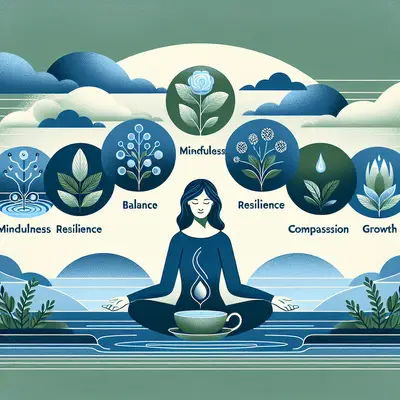
In a culture that idolizes acceleration, genuine calm has become a rare luxury—less an accident, more an art form. Mental wellness today is not simply the absence of distress; it is the deliberate cultivation of an interior climate where clarity, composure, and depth can reliably flourish. For the discerning mind, the question is no longer, “How do I cope?” but rather, “How do I design a life in which my nervous system is quietly respected, every single day?”
What follows are five exclusive, finely tuned insights that move beyond generic advice. Each one invites you to treat your inner life as something curated rather than merely endured—an elegant practice rather than an emergency response.
1. Trading Stimulation for Texture, Not Silence
Many people attempt to feel calmer by stripping away all stimulation—muted phones, closed tabs, quiet rooms. Yet a completely blank environment can feel more unsettling than soothing, like a gallery with no art. The nervous system often relaxes more easily when offered subtle, layered “texture” rather than a jarring void.
Consider replacing harsh stimuli (constant alerts, bright overhead lighting, frantic scrolling) with intentionally chosen, low-intensity inputs: a single instrumental playlist, a warm table lamp instead of overhead LEDs, a textured throw or weighted blanket within reach, a candle with a quietly complex scent. These are not decorative indulgences; they’re sensory parameters that tell your body, “You are safe. You are allowed to soften.”
The key is constraint: one or two sensory anchors at a time. A single, steady sensory thread—soft music, the feel of linen, the glow of a salt lamp—gives your mind just enough to rest on, rather than sending it searching frantically for novelty. This is how you move from numb silence to cultivated ease.
2. Practicing “Cognitive Minimalism” in Micro-Moments
Much of modern mental strain isn’t emotional in origin; it’s cognitive clutter. Our brains are constantly asked to juggle unfinished loops: messages to answer, decisions to make, small concerns hovering in a perpetual “later.” Cognitive minimalism isn’t about having no responsibilities; it’s about reducing open loops in strategic, minimalist strokes.
Begin with the smallest possible unit: a 90-second mental audit, two or three times a day. Without judgment, ask: “What am I mentally carrying right now that doesn’t need to be active?” Briefly name the item: “That email,” “That conversation,” “That worry about next month.” Then assign each one to a category: schedule it, let it be unresolved for now, or consciously drop it.
Over time, this discipline becomes a refined habit: your mind stops trying to solve everything, all at once, at all times. You will notice that true calm is less about heroic self-control and more about not forcing your brain to hold ten mental tabs open simultaneously. It’s mental wellness as quiet curation—choosing what deserves bandwidth, and letting the rest wait without guilt.
3. Aligning Your Nervous System With Your Natural Signature Rhythm
Most wellness advice assumes you can simply overlay “healthy habits” onto any schedule. But mental ease often emerges when your rhythms—sleep, focus, activity—are tailored to your nervous system’s natural pattern rather than a generic ideal.
Begin by observing, without trying to fix anything, for a week or two: When do you feel naturally most clear-headed? When are you consistently restless? When do you reach for your phone out of agitation, not interest? This is data, not failure. Many high-functioning minds operate best in tightly focused, time-bound bursts followed by deliberately unproductive interludes.
Use these observations to design a rhythm with three pillars:
- A prime mental window (60–120 minutes) reserved for your most demanding thinking, shielded from interruptions.
- A gentle wind-down ritual (20–40 minutes) before sleep that repeats almost identically every night, so your body learns the pattern.
- One non-negotiable oasis each day—a time where the only rule is psychological off-duty: a walk with no podcast, a bath, or simply sitting with tea and nothing to optimize.
Instead of forcing yourself to mimic someone else’s ideal morning or evening routine, you are refining your own internal signature rhythm—personal, sustainable, and deeply regulatory for the mind.
4. Raising Your Emotional Standards, Quietly
We often talk about setting standards for work, relationships, or lifestyle—but rarely for our emotional environment. Mental wellness elevates when you quietly raise your standards for what you will and will not normalize emotionally in your daily life.
This doesn’t mean avoiding difficult feelings; it means refusing to accept chronic emotional states that erode your inner stability: ongoing contempt, constant urgency, perpetual comparison, or ambient dread masquerading as “just how life is now.” Begin by identifying one emotional pattern you experience almost every day that feels corrosive. Perhaps it’s the subtle panic of your morning scroll, or the low-grade resentment that appears every time you check work messages at night.
Then, instead of vowing to “never feel that way again,” design a single, specific boundary or counter-ritual around it. For instance:
- No phone for the first 20 minutes after waking—replace with a glass of water and three slow breaths by a window.
- Email shut down completely after a specific evening time, with a brief end-of-day note to yourself: “Tomorrow’s first move is ___.”
The premium shift here is expectation: you begin to treat your emotional experience as something worthy of standards, not as an afterthought once everything else is handled.
5. Treating Small Restorations as High-Value Investments
Many people treat restoration as something they’ll “fit in” once real work is done. Yet the most mentally resilient individuals treat restorative practices as investments that increase the quality—and sometimes the brevity—of their future effort.
Reframe brief, intentional restoration as part of your professional and personal excellence strategy, not a reward for it. Five to ten minutes of structured restoration can be remarkably effective:
- A brief body scan, simply noting where tension has accumulated, without trying to fix it.
- A deliberate sensory reset: stepping outside, feeling the air, letting your eyes focus on distant objects to counteract screen strain.
- A single page of a physical book or a tangible magazine, to reacquaint your mind with linear, non-fragmented attention.
What distinguishes this from mere “breaks” is intentionality. You are not escaping effort; you are refining your capacity for it. This mindset turns small, daily restorations into a form of quiet luxury—micro-rituals that preserve the clarity and steadiness that make everything else more precise.
Conclusion
Mental wellness at its most elegant is less about dramatic breakthroughs and more about subtle recalibrations—exchanging harsh stimuli for thoughtful texture, pruning cognitive clutter, aligning with your natural rhythms, elevating your emotional standards, and protecting restoration as a non-negotiable investment. These practices do not shout. They do not demand grand declarations or public reinventions.
They gently but insistently redesign the conditions in which your mind lives. Over time, the result is not just feeling “less stressed,” but inhabiting a different quality of inner life: measured, attentive, and quietly assured. In a world that constantly pulls you outward, these choices are a way of returning, again and again, to a mind that feels like a well-appointed, deeply familiar refuge.
Sources
- National Institute of Mental Health – Managing Stress - Overview of how stress affects mental health and evidence-based strategies for regulation
- Harvard Health Publishing – Relaxation Techniques: Breath Control Helps Quell Errant Stress Response - Explains physiological mechanisms behind calming practices and their impact on the nervous system
- American Psychological Association – Multitasking: Switching Costs - Discusses cognitive overload and why reducing mental “tabs” improves focus and well-being
- Cleveland Clinic – Sleep Hygiene: Tips for a Better Night’s Sleep - Details how consistent routines and environmental cues support mental and emotional stability
- Mayo Clinic – Positive Thinking: Stop Negative Self-Talk to Reduce Stress - Explores how shifting internal standards and patterns of thought can foster more resilient mental states
Key Takeaway
The most important thing to remember from this article is that this information can change how you think about Mental Wellness.