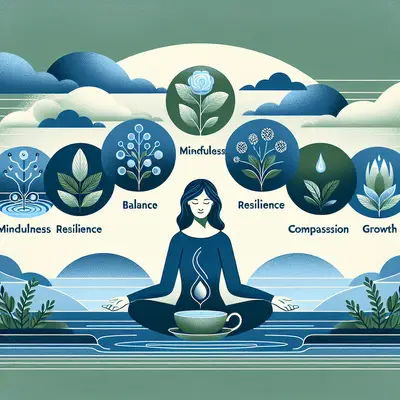
In an age of relentless notifications and ambient pressure, the most luxurious experience available is not a five-star retreat, but a mind that feels unhurried, lucid, and quietly self-possessed. Mental wellness is no longer a fringe aspiration; it is the new marker of a discerning life—one in which your attention, your energy, and your emotional climate are curated with the same care you might devote to a beautifully designed home. This is not about quick fixes or aspirational slogans. It is about cultivating a subtle discipline of inner clarity—an ongoing, intelligent relationship with your own mind.
Below are five refined, deeply practical insights for those who want their mental wellness practice to feel less like damage control and more like an elevated, lifelong craft.
Mental Energy as a Luxury Resource, Not a Renewable Free Good
We often treat mental energy as if it were endlessly available, something that can be stretched, fragmented, and demanded on command. Yet cognitive science increasingly suggests that attention and decision-making capacity are finite and highly sensitive to overuse. When we begin to regard mental energy as a luxury resource—akin to fine timepieces or curated art—our choices naturally become more discerning.
This shift begins with auditing your “hidden costs”: the tabs left open on your phone, the half-watched series, the conversations you replay in your head. Each is a silent withdrawal from your mental energy account. Instead of aspiring to do more, consider upgrading the quality of what receives your attention. Decide which projects, people, and pursuits merit your clearest hours, and protect those hours with unapologetic boundaries. The result is not a smaller life, but a more concentrated one—where your best mental resources are directed at what genuinely matters, rather than scattered across digital noise and emotional clutter.
Designing a Thoughtfully Curated Inner Environment
We understand the value of a beautifully designed room: calming colors, intentional lighting, tactile materials that invite ease. Yet we rarely extend this same intentional design to our inner environment—the recurring thoughts, narratives, and internal tones that quietly determine how we feel in our own minds.
Begin with observation rather than judgment. Notice the “ambient soundtrack” of your day: the way you speak to yourself after a mistake, the stories you tell about your own capacity, the expectations you silently carry. These inner elements can be rearranged, upgraded, and refined. For instance, replacing harsh internal commentary with precise, neutral language (“I missed a detail” instead of “I always fail”) immediately changes the emotional décor of your inner space. Over time, this curation becomes a subtle, lived art form: you notice which thoughts nurture poise and which thoughts corrode it, and you quietly redecorate from the inside out.
Emotional Precision as a Quiet Superpower
Many of us navigate our days with a blunt emotional vocabulary: “stressed,” “tired,” “overwhelmed.” While understandable, this imprecision can keep us stuck, because we cannot effectively address what we cannot accurately name. Emotional precision—learning to distinguish between, say, disappointment, resentment, anxiety, and mental fatigue—is one of the most underappreciated skills in modern wellness.
Research suggests that the more granular your emotional language, the better your capacity for regulation and resilience. Instead of “I’m stressed,” you might identify, “I’m mentally overloaded and also a bit uncertain about what matters most right now.” That distinction invites targeted solutions: perhaps you need to offload decisions, clarify priorities, or rest your cognition, rather than simply “relax.” In practice, this looks like pausing several times a day to ask, “What exactly am I feeling, and what might this feeling be asking for?” This level of refinement transforms vague unease into actionable insight—and invites you to relate to your emotions with respect rather than resistance.
Elegant Boundaries as an Act of Cognitive Hygiene
Boundaries are often portrayed as blunt instruments—firm lines drawn in anger or exhaustion. In the context of elevated mental wellness, boundaries become something more elegant: an ongoing act of cognitive hygiene, where you protect the clarity of your mind the way a conservator protects a painting from excessive light and dust.
Consider boundaries in three dimensions: relational, digital, and internal. Relational boundaries might mean limiting exposure to chronically chaotic conversations or politely declining invitations that come at the expense of recovery. Digital boundaries might involve consciously choosing “edges” to your day—no screens during the first and last 30 minutes, or designating specific times for messages instead of perpetual availability. Internal boundaries are more subtle: declining to mentally rehearse imaginary arguments, refusing to catastrophize beyond the facts, and deciding that not every provocation deserves a full narrative. These boundaries are not acts of withdrawal; they are acts of curation, ensuring that what enters—and stays—in your mind is worthy of the emotional and cognitive space it occupies.
Rest as Strategic Refinement, Not Passive Collapse
For many, rest is something that happens when we finally reach the point of collapse: we binge-watch, scroll aimlessly, or simply go numb. This is not restorative rest; it is recovery from depletion. A sophisticated approach to mental wellness treats rest as a strategic, deliberate refinement of one’s inner state, rather than a last resort.
Begin by distinguishing between three forms of rest: cognitive, emotional, and sensory. Cognitive rest might mean periods with no problem-solving, planning, or information intake—short walks without a podcast, baths without a device, or simply gazing out a window. Emotional rest can involve stepping back from roles that require constant empathy and availability, allowing yourself moments where you are not holding space for anyone else. Sensory rest might include dim lighting, reduced noise, and gentle, non-stimulating environments. By intentionally rotating among these modes, rest becomes a curated ritual rather than an accident. Over time, you will likely notice a calmer baseline, clearer thinking, and a quieter nervous system—not because you do less, but because you recover with intention.
Conclusion
The pursuit of mental wellness need not be loud or performative. It can be subtle, intelligent, and exquisitely personal—a set of refined practices that shape how you inhabit your own mind. When you treat your attention as a luxury resource, curate your inner environment with care, develop emotional precision, uphold elegant boundaries, and approach rest as a strategic refinement, mental wellness ceases to be a distant ideal. It becomes the quiet, consistent quality of your everyday life.
The true hallmark of a calm mind is not the absence of challenge, but the presence of inner clarity—even in the midst of it. That clarity is not gifted; it is cultivated. And it is available, moment by thoughtfully chosen moment.
Sources
- National Institute of Mental Health – Caring for Your Mental Health – Overview of evidence-based practices and considerations for maintaining mental health
- Harvard Health Publishing – Train Your Brain: The Power of Mindfulness – Explores how attention and awareness practices influence emotional regulation and cognitive clarity
- American Psychological Association – The Road to Resilience – Discusses emotional skills, boundaries, and habits that support psychological resilience
- Greater Good Science Center, UC Berkeley – The Science of Emotional Granularity – Reviews research on emotional precision and its impact on mental health
- Mayo Clinic – Stress Management: Strengthen Your Coping Skills – Practical, research-informed strategies for stress reduction, rest, and recovery
Key Takeaway
The most important thing to remember from this article is that this information can change how you think about Mental Wellness.