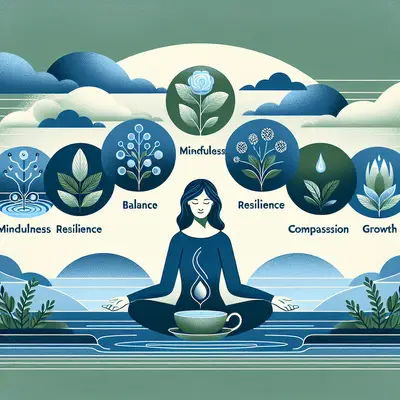
In a world that applauds velocity and visible achievement, mental wellness often becomes an afterthought—tended to only when it begins to fray. Yet for those with a discerning eye, calm is not a happy accident; it is a cultivated discipline, a quiet form of luxury that shapes how you think, decide, and relate. This is not about “quick fixes” or feel-good clichés. It is about understanding the subtler mechanics of a composed inner life, and elevating your daily habits to match the standard of excellence you expect from every other area of your world.
Below are five exclusive, refined insights—less about hacks, more about high-quality mental hygiene—that can reshape the way you approach your own mind.
Mental Energy as Currency, Not an Endless Resource
We often plan our days as though mental energy were limitless, assigning tasks purely by time slots rather than cognitive cost. A more sophisticated approach treats attention as a scarce, premium currency.
Begin by noticing which activities truly drain you: not simply because they are difficult, but because they are noisy—emotionally, socially, or digitally. Then, do the inverse audit: which activities reliably restore a sense of inner clarity? For some, this may be solitary reading in the early morning; for others, a brief walk without audio, simply accompanied by one’s own thoughts.
Design your schedule to honor this economy. Place demanding decisions when your attention is sharpest and most spacious, often early in the day. Reserve the late hours for tasks that feel structurally simple or even pleasantly repetitive. As you refine this, you will discover that mental wellness is less about rigid routines and more about wise allocation—spending your best attention where your life’s highest stakes actually are.
The Art of Deliberate Micro-Transitions Between Roles
Modern life asks us to change roles constantly: executive to partner, parent to colleague, strategist to caregiver. The mind, however, is not as instantaneous as your calendar’s back-to-back blocks. Emotional residue accumulates and bleeds from one role to another, quietly increasing stress and diminishing presence.
Micro-transitions are small, intentional rituals between activities that act like psychological doorways. This may be as discreet as one minute of seated stillness between calls, a deliberate change of lighting at dusk to mark the end of “work mode,” or a brief note-to-self at the day’s end capturing what you did well before you close your laptop. These gestures are not ornamental; they are structural.
By treating each role shift as an opportunity to reset your internal state, you reduce cognitive “drag” and emotional carryover. Over time, this transforms your day from a single, noisy stream into a series of composed chapters—each with its own tone, demands, and level of engagement. The result is a life that feels more curated and far less chaotic, even when responsibilities are extensive.
Emotional Precision as a Form of Inner Elegance
Many people describe their internal landscape with vague, blunt language: “stressed,” “tired,” “off.” While understandable, such imprecision makes it difficult to respond intelligently to what you feel. Emotional granularity—the ability to name your state with nuance—is a sophisticated form of mental self-care.
Rather than “stressed,” are you actually overloaded, apprehensive, under-challenged, or perhaps resentful? Instead of “tired,” are you mentally saturated, socially depleted, or physically fatigued? Each of these states calls for a different response. Overload may require boundaries and prioritization; under-stimulation might call for creative challenge; resentment may point to misaligned expectations or unspoken needs.
Practicing emotional precision might involve briefly journaling with more specific vocabulary, or pausing once a day to ask, “If I had to describe what I’m feeling in three more exact terms, what would they be?” Over time, you become less likely to overreact or self-medicate with distraction, and more likely to choose an intervention that is actually aligned with the real issue. This subtle refinement in language often precedes a profound refinement in behavior.
Curating Cognitive Inputs with the Same Care as Your Environment
We are selective with our clothing, interiors, and dining experiences—but many of us are astonishingly indiscriminate with what we allow into our minds. Relentless news cycles, low-quality content, and scattered digital conversations carry a hidden cost: they set a low baseline for your mental environment, often without your explicit consent.
A more elevated approach is to curate your cognitive inputs as carefully as you would a well-designed space. This might mean establishing defined “windows” for news consumption rather than a constant drip, unfollowing accounts that reliably agitate rather than inform, or upgrading part of your digital diet to sources that are thoughtful, well-researched, and measured in tone.
This is not about building a bubble of ignorance, but about cultivating a standard: if it lives in your mental ecosystem, it should either inform, enrich, or quietly delight. Over weeks and months, this curation shifts your default mental background from reactive and scattered to informed yet composed—a far more stable foundation for genuine wellness.
Quiet Self-Respect as the Foundation of Sustainable Calm
Beneath many wellness practices lies a single, often unspoken question: “Am I someone whose wellbeing I take seriously?” Quiet self-respect is not boastful confidence; it is the understated conviction that your mental state warrants care, planning, and protection—just as much as your career, family, or investments.
This attitude subtly reshapes daily decisions. You are more likely to say no to commitments that erode your stability, and more inclined to design evenings that actually restore you instead of merely distracting you. It becomes natural—not indulgent—to seek support when needed, whether through therapy, coaching, or well-chosen peer conversations, because you recognize your mind as a long-term asset, not a disposable tool.
One useful practice is to periodically ask: “If I truly respected my mind as my most valuable instrument, what would I change in the next month?” The answer may be surprisingly practical: a refined sleep routine, a clearer morning boundary around devices, a single protected hour each week for reflection. These small, dignified acts accumulate. Over time, your life begins to mirror a quiet promise you’ve made to yourself: to treat your inner world with the same standard of excellence as everything else you value.
Conclusion
Mental wellness, at its most refined, is not a performance or a trend. It is an ongoing discipline—subtle, sometimes invisible, but deeply felt in the way you move through your days. By treating your attention as currency, honoring micro-transitions, cultivating emotional precision, carefully curating what your mind consumes, and anchoring it all in quiet self-respect, you create something rare: a life that feels internally harmonious, even amidst external complexity.
This is the understated luxury of a well-tended mind: not the absence of challenge, but the presence of composure, clarity, and an unhurried confidence that you can meet what comes—with grace.
Sources
- National Institute of Mental Health – Caring for Your Mental Health – Overview of evidence-based principles for maintaining mental wellbeing
- Harvard Health Publishing – Train Your Brain: How to Boost Your Mental Health – Discusses cognitive habits, emotional awareness, and lifestyle factors that support mental health
- American Psychological Association – Emotional Intelligence – Explores the importance of emotional awareness, precision, and regulation in psychological functioning
- Mayo Clinic – Stress Management – Practical, research-informed strategies for managing stress and protecting mental wellness
- Yale Center for Emotional Intelligence – Research and resources on emotional granularity and how naming emotions affects wellbeing
Key Takeaway
The most important thing to remember from this article is that this information can change how you think about Mental Wellness.