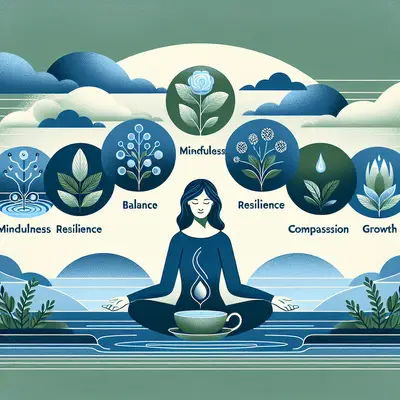
Mental wellness, at its most refined, is less about fixing what feels broken and more about curating an interior life that feels quietly exquisite. It is the art of thinking, feeling, and choosing in a way that preserves your energy, protects your focus, and honours your emotional depth. Rather than chasing the latest trend in self-care, a truly elevated approach treats mental wellness as a subtle craft—something to be designed with discernment, not improvised out of urgency.
Below are five exclusive, nuanced insights for those who treat their inner life with the same care they reserve for their most valued possessions.
1. Emotional Minimalism: Curating What Deserves Your Energy
Minimalism is often discussed in terms of objects, rarely in terms of emotions. Yet one of the most sophisticated practices in mental wellness is emotional minimalism: consciously choosing which feelings, narratives, and digital inputs earn your limited mental bandwidth.
Instead of striving to feel “positive” at all times, emotional minimalism focuses on clarity and selectivity. You begin by noticing which interactions and habits consistently leave you mentally cluttered—doomscrolling, unfiltered group chats, or conversations that always veer into drama. You then create a quiet filter: What genuinely requires my emotional presence, and what merely invites my reactivity?
This approach is not avoidance; it is curation. It may look like limiting emotionally dense conversations to certain times of day, muting non-essential notifications, or stepping away from relationships that treat your attention as an endless resource. Over time, your emotional landscape becomes less crowded, making room for depth—genuine connection, considered thought, and feelings that are fully experienced rather than half-felt and constantly interrupted.
2. Cognitive Aesthetics: Designing a Mind That Feels Beautiful to Live In
We often design our homes with intention but leave our mental environment to chance. Cognitive aesthetics is the practice of shaping how your mind feels from the inside—prioritizing thoughts, habits, and mental rhythms that create a sense of understated beauty and coherence.
This begins with your inner dialogue. You can think of self-talk as the “interior design” of your mind. Are your thoughts harsh, cramped, and fluorescent, or spacious, warm, and precise? Replacing blunt self-criticism (“I failed again”) with refined self-inquiry (“What data did this give me about what I actually need?”) elevates your thinking from punitive to constructive.
Cognitive aesthetics also includes how you structure your day. Short transitions—60 seconds of deliberate breathing before a meeting, a screen-free five-minute reset between tasks, a single handwritten line to mark the shift from work to evening—create a sense of mental architecture. Your day no longer feels like a blur; it becomes a sequence of considered spaces. What emerges is not just productivity, but a mind that feels elegantly organized from within.
3. Nervous System Literacy: Treating Calm as a Physiological Craft
Calm is not a character trait; it is a physiological state that can be learned, rehearsed, and refined. Nervous system literacy means understanding how your body signals stress, how it returns to equilibrium, and how you can participate in that process with precision rather than guesswork.
Begin by noticing your earliest stress signatures: a slight tightening in the jaw, shallow breathing, restless scrolling, perfectionistic thoughts. These subtle cues appear long before full-blown overwhelm and offer a window for intervention. In that window, short, methodical practices matter more than dramatic ones: three slow exhales longer than your inhales, relaxing your tongue from the roof of your mouth, or placing a hand gently on your chest and naming what you feel in simple language.
Over time, you become an informed collaborator with your own biology. Instead of pathologizing every spike in anxiety or irritation, you view them as signals from a finely tuned system, asking for adjustment rather than self-blame. This reframes mental wellness from “fixing my mind” to “learning my instrument”—an elevated, highly respectful relationship with your own physiology.
4. Distinct Boundaries Between Solitude and Isolation
For discerning minds, solitude is not a luxury; it is a necessity. Yet in a hyperconnected world, the line between restorative solitude and draining isolation can blur, especially for those who are introspective by nature.
Solitude is intentional and time-bound. It has edges and a purpose—even if that purpose is simply to think quietly, read, or be unobserved. Isolation is vague, unstructured, and often accompanied by a subtle sense of disappearing from your own life. The distinction lies less in how much time you spend alone and more in how clearly you are choosing it.
One refined practice is to ritualize the beginning and end of solitude. You might “enter” solitude by turning off notifications, lighting a candle, or changing your environment, and “exit” it with a short text to someone you trust, a walk outdoors, or a brief journaling line about what emerged in that space. This framing turns being alone into a deliberate container for reflection rather than an amorphous drift away from others. Done well, solitude becomes a renewable source of stability, clarity, and emotional elegance.
5. Quiet Standards: Holding High Internal Expectations Without Self-Cruelty
Many people seeking mental wellness are not lazy or unmotivated; they are often privately exacting. The challenge is that high personal standards, when unmanaged, easily turn into self-censure. The sophisticated alternative is to maintain quiet, high standards for yourself—paired with equally high standards for how you speak to yourself when you inevitably fall short.
This starts with rewriting the internal contract: “I will pursue excellence, but not at the cost of my self-respect.” When you miss a goal, instead of defaulting to contempt (“I’m incapable of consistency”), you can ask more incisive questions: Was this expectation realistic for my current capacity? What would this look like at 80% intensity instead of 120%? What data did this attempt give me about my actual rhythms and needs?
Quiet standards also mean you do not perform your self-improvement for others. You track progress privately, adjust quietly, and define success in terms of internal alignment rather than external admiration. Over time, this approach cultivates a resilient, steady self-trust: you become someone you can rely on, not someone you fear disappointing. The result is a form of mental wellness that feels deeply dignified rather than fragile.
Conclusion
An elevated approach to mental wellness is neither loud nor performative. It is a series of subtle, precise choices: curating which emotions deserve your presence, designing thoughts that feel inhabitable, learning your nervous system with respect, distinguishing solitude from isolation, and holding yourself to high standards without resorting to self-cruelty.
These are not overnight changes but gradual refinements—small shifts that, over time, transform your inner life from something you manage into something you quietly cherish. In a world that constantly asks for more of your attention, the true luxury is a mind that feels composed, deliberate, and unmistakably your own.
Sources
- National Institute of Mental Health – Understanding Mental Health – Overview of mental health concepts, conditions, and evidence-based approaches
- Harvard Health Publishing – How breathing helps regulate the nervous system – Explores how breathwork influences stress and the nervous system
- American Psychological Association – The power of self-talk – Discusses the role of inner dialogue in emotional regulation and performance
- Mayo Clinic – Social isolation and mental health – Examines the distinction between healthy alone time and harmful isolation
- Yale University – The Science of Well-Being – Research-based insights into habits and mindsets that support sustained wellbeing
Key Takeaway
The most important thing to remember from this article is that this information can change how you think about Mental Wellness.