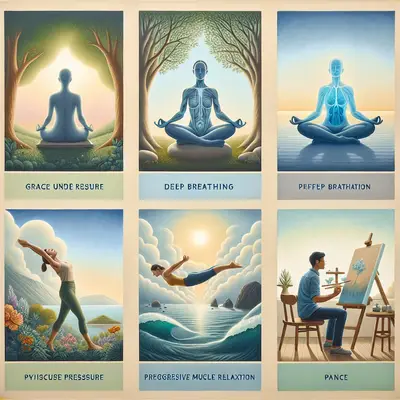
Modern life rarely grants a clean break between “on” and “off.” Messages arrive after midnight, expectations blur across time zones, and even rest is often scheduled like a meeting. For the discerning mind, stress relief is no longer about crude distraction or escapism; it is about cultivating a precise, elegant relationship with your own nervous system. This is not self-care as a trend, but stress relief as a quiet, exacting art form—one that respects nuance, subtlety, and long-term mental refinement.
Below are five exclusive, research-aligned insights designed for those who expect more from their wellness practices than scented candles and generic advice.
Insight 1: Treat Your Nervous System Like a Vintage Instrument
A fine instrument does not respond well to force; it responds to calibration. Your nervous system is similar—tunable, responsive, and capable of exquisite range when handled with care.
Chronic stress keeps the body in a prolonged state of sympathetic activation (the “fight or flight” mode), which over time can quietly alter sleep patterns, digestion, and mood regulation. Instead of trying to “relax” in a single dramatic gesture—a weekend away, a rare free evening—consider micro-adjustments throughout the day. A 60–90 second window of deliberate decompression (slow exhale-focused breathing, a change in posture, or stepping into natural light) acts as a subtle tuning mechanism.
The elegance here lies in specificity. For example, extending your exhale to be slightly longer than your inhale (such as inhaling for four counts, exhaling for six) activates the parasympathetic nervous system, the body’s “rest and restore” branch. Think of it as a discreet reset button you can press in the middle of a conversation, a meeting, or a crowded commute—no announcement required.
Insight 2: Design an “Off-Switch Signature” Instead of a Routine
Traditional advice recommends a “night routine” or “morning ritual.” For a more discerning approach, consider instead an “off-switch signature”—a personally curated sequence of sensory cues that signals to your brain that it is safe to downshift.
This signature might include three or four elements: a specific form of low lighting, a particular tactile sensation (such as linen, cashmere, or a preferred robe), and a recurring auditory texture (a certain playlist, white noise, or even curated silence). The point is not extravagance; it is consistency. When the brain repeatedly associates these same cues with disengagement from demands, they become a shorthand for safety.
Over time, this creates a kind of conditioned calm that reduces the effort required to unwind. You move from “trying to relax” to effortlessly slipping into a familiar, pre-negotiated state. The sophistication lies in editing: you intentionally remove any overstimulating elements from this signature—no bright screens, no fragmented multitasking, no notifications—so the nervous system receives a clean, unambiguous message: it is time to power down.
Insight 3: Upgrade Your Boundaries from Defensive to Curatorial
Most conversations around boundaries frame them as walls—defensive, rigid, sometimes even confrontational. A more refined lens sees boundaries as curation, more akin to editing an art collection than building a fortress.
Curatorial boundaries ask a single question: “What experiences earn the right to shape my inner state today?” This subtle shift transforms “saying no” into “choosing what is worthy of my limited mental bandwidth.” You are not fighting demands; you are selecting what aligns with your values and energetic capacity.
In practice, this can look like:
- Scheduling “unavailable” blocks in your calendar as non-negotiably as high-level meetings.
- Responding to non-urgent messages on a deliberate delay rather than as reflex.
- Creating tiers of access—who can interrupt you in real time, who receives a same-day reply, and who is acknowledged on a longer rhythm.
Research consistently shows that perceived control is a key factor in stress resilience. By treating your schedule, your conversations, and your digital life as a curated gallery rather than an open public square, you restore a sense of elegant authorship over your day.
Insight 4: Practice “Intellectual Grounding” in Place of Mere Distraction
Many people attempt to relieve stress by numbing: scrolling, streaming, or otherwise flooding the mind with low-effort stimuli. The discerning alternative is “intellectual grounding”—engaging the mind in a way that steadies it, rather than scatters it.
Intellectual grounding involves choosing mentally engaging activities that are absorbing but not overstimulating. This might be reading a thoughtfully written essay, working through a challenging yet satisfying puzzle, or learning a small, contained concept (such as a new word in a foreign language, or a short segment of history). The key is depth without urgency.
This form of mental engagement subtly redirects the brain away from ruminative, stress-driven loops into directed, structured thought. It leverages your cognitive strengths rather than suppressing them. You are not trying to “turn your brain off”; you are inviting it to occupy a more stable, ordered pattern—like moving from background static to a single, clear channel.
Over time, this becomes a refined coping strategy: when stress threatens to fray focus, you reach not for numbness, but for an anchoring mental pursuit that reminds your mind of its capacity for clarity and coherence.
Insight 5: Conduct Your Day in “Rhythms,” Not “Sprints”
Stress is amplified when the day feels like a single continuous sprint from morning to night. A more sustainable, elevated strategy is to think in rhythms—deliberate alternations between high engagement and subtle recovery.
This rhythm can be minimalist yet precise: 45–90 minutes of focused work followed by 5–15 minutes of genuine restoration. Not checking another tab or firing off a quick message, but stepping away to stretch, sip water, step outside, or simply stare out a window without agenda. These intervals are not a luxury; they are a physiological necessity if you want your cognitive performance and emotional composure to remain high over time.
Research supports this oscillatory model of productivity: we are at our best when we honor natural cycles of expenditure and renewal rather than demanding a flat line of unbroken output. Viewed this way, you become the conductor of your own day, shaping crescendos of effort and interludes of quiet. The result is a form of stress relief that does not wait until you are depleted, but is woven discreetly into the architecture of your schedule.
Conclusion
Stress relief, at its most refined, is not an escape from reality but a reconfiguration of how you inhabit it. It is the art of tuning the nervous system rather than overpowering it, of crafting signatures of rest rather than chasing occasional relief, of curating inputs rather than submitting to constant demands.
For the discerning mind, this is not about perfection or perpetual calm. It is about developing a highly personal, elegantly structured relationship with your own mental state—a relationship in which stress is acknowledged, understood, and met with nuanced, intelligent responses. Over time, these subtle choices accumulate into something quietly powerful: a life in which composure is not a rare event, but a cultivated baseline.
Sources
- National Institute of Mental Health – Stress Basics - Overview of how stress affects the brain and body, including chronic stress impacts.
- American Psychological Association – Stress: The Different Kinds of Stress - Explains types of stress and the importance of coping strategies and perceived control.
- Harvard Health Publishing – Understanding the Stress Response - Details the role of the sympathetic and parasympathetic nervous systems in stress and relaxation.
- Cleveland Clinic – Breathing Techniques for Stress Relief - Discusses exhale-focused and other breathing strategies to activate the body’s relaxation response.
- University of California, Berkeley – Greater Good Science Center: The Science of Rest and Recovery - Explores why alternating work and rest improves cognition, mood, and resilience.
Key Takeaway
The most important thing to remember from this article is that this information can change how you think about Stress Relief.