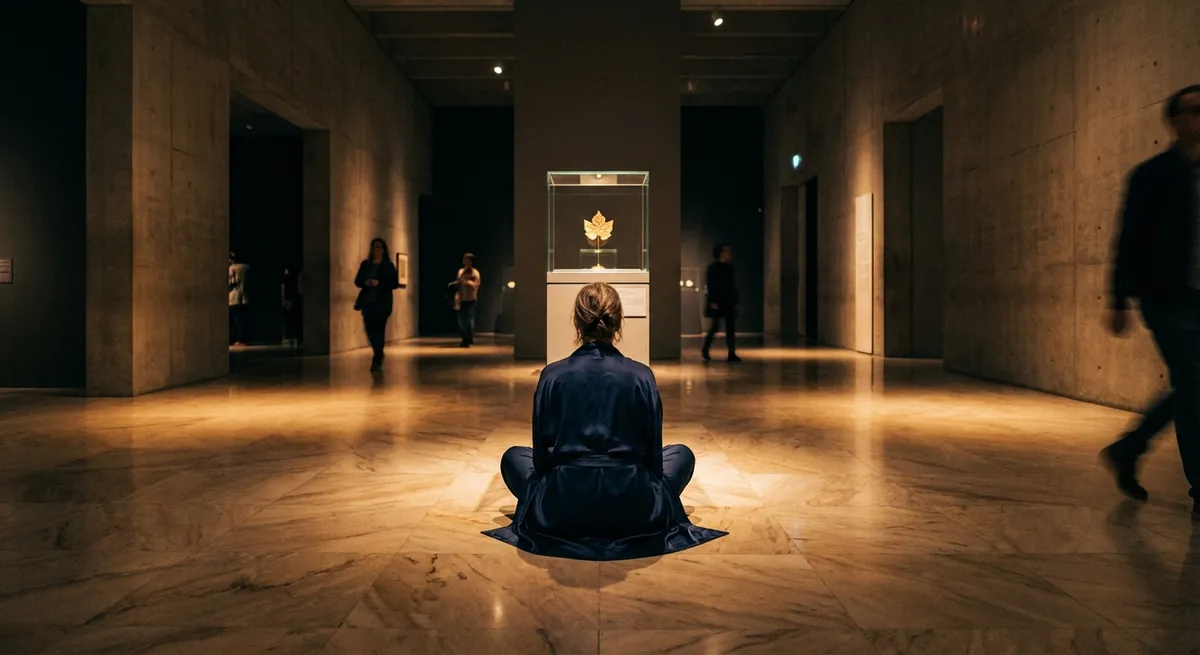
In a culture engineered for acceleration, genuine stillness has become a rare luxury. Meditation, when approached with discernment, is less a wellness trend and more an artful reorientation of how we relate to time, thought, and attention. Rather than promising a life without stress, it offers something more subtle and more enduring: an elegant recalibration of the inner world, so that clarity, composure, and quiet confidence become your default setting—not an occasional exception.
This is meditation not as escape, but as an elevated daily discipline. Below are five exclusive, often-overlooked insights that invite you to treat your inner life with the same precision and care you might devote to a curated wardrobe, a considered home, or an exquisite meal.
Meditation as Cognitive Refinement, Not Emotional Numbing
Many people approach meditation as a tool to “get rid of” stress or difficult emotions. A more refined understanding sees it as cognitive refinement: a systematic training of how you perceive, categorize, and respond to experience.
Over time, meditation strengthens the brain networks involved in attention regulation, emotional regulation, and self-awareness. Functional MRI studies show long-term meditators exhibit alterations in the prefrontal cortex and the anterior cingulate cortex, areas associated with executive function and impulse control. Rather than flattening emotional life, this training sharpens your ability to discern: Is this thought useful, or merely habitual noise? Is this worry data, or just narrative?
The result is an internal environment that feels edited rather than crowded. Thoughts still arise, but they no longer command the room. You gain the capacity to respond rather than react, to choose your next mental step with a sense of calm authorship.
Precision Rituals: Designing a Meditative Environment That Trains the Mind
For those who value craft and detail, the environment in which you meditate is not mere décor; it is a training instrument. Your space quietly instructs the nervous system how to behave.
Begin with a single, intentional anchor: a chair that supports an upright yet relaxed posture, a cushion that subtly encourages dignified alignment, or a bench that naturally balances the spine. Add one or two sensory cues only—perhaps a single, high-quality candle with a neutral, non-intrusive scent, or a textile whose texture you associate with calm. The goal is not aesthetic excess, but sensory clarity.
Keep the visual field simplified: minimal clutter, softened light, and muted colors. Over time, this becomes a conditioned signal to the brain—“here, we slow down.” Your environment then does part of the work for you, reducing the cognitive load of “getting into” meditation and allowing your practice to begin almost as soon as you enter the space.
The Subtle Practice of Mental Fasting
Just as intermittent fasting gives the digestive system deliberate intervals of rest, meditation can be framed as mental fasting—structured periods during which you abstain from constant input and interpretation.
During a mental fast, the intention is not to force silence but to refrain from feeding every thought with commentary. When a thought arises—about work, appearance, relationships—you observe its presence without elaboration. You neither agree nor argue; you simply do not “feed” it with further storylines.
This gentle abstention reduces cognitive inflammation: that feeling of mental heaviness and irritability that follows prolonged overstimulation. Over time, the brain becomes less reliant on constant novelty and more comfortable in spaciousness. What emerges is an understated sense of mental lightness—a quieter, more breathable interior landscape.
Luxury in Micro-Doses: The 90-Second Reset
Long retreats and extended sessions have their place, but the truly sophisticated practice recognizes the value of micro-dosing meditation throughout the day. Think of these as 90-second resets—brief intervals where you step out of habitual momentum and into deliberate presence.
A 90-second reset might look like this: you pause between tasks, feel your feet on the floor, notice the weight of your body in the chair, and follow the full arc of three slow breaths—in, pause, out. During this time, you temporarily suspend evaluation: no judging the day, no rehearsing the next conversation, no revisiting the last email.
Research suggests that even short, repeated bouts of mindfulness can reduce perceived stress and improve attention. When these resets are woven into natural transitions—before you open your laptop, as you wait for water to boil, in the moments after you park the car—they create a subtle architecture of calm throughout the day. Your nervous system begins to trust that rest is not a rare luxury, but a regularly scheduled feature.
Quiet Self-Respect: Using Meditation to Redefine Productivity
One of the most powerful, under-discussed benefits of meditation is how it reshapes your relationship with productivity. Rather than viewing yourself as a constantly available resource, you begin to see your attention as a precious asset to be allocated with care.
Meditation illuminates the cost of split focus: the mental scattering, the emotional residue of always being “on call.” As you become more intimate with your own cognitive rhythms, you learn when your mind is naturally sharp, when it is more reflective, and when it needs genuine disengagement. This awareness makes it easier to say no to unnecessary invitations, resist compulsive checking, and decline work that does not align with your deeper priorities.
This is a quiet form of self-respect: you no longer equate busyness with worth. Instead, you curate your commitments so that your best attention is reserved for what genuinely matters. Productivity becomes measured not by volume, but by the quality and intentionality of your contribution.
Conclusion
Meditation, practiced with discernment, is less about “fixing” the mind and more about refining it—polishing perception, clarifying priorities, and restoring a sense of inner elegance to daily life. Through cognitive refinement, precise environments, mental fasting, micro-resets, and a redefined sense of productivity, you begin to inhabit time differently.
The real luxury is not simply having fewer demands, but possessing the inner infrastructure to move through inevitable demands with composure. In that sense, meditation is not an escape from life but a sophisticated way of inhabiting it—fully awake, quietly grounded, and fiercely protective of the quality of your own attention.
Sources
- [National Institutes of Health – Meditation: In Depth](https://www.nccih.nih.gov/health/meditation-in-depth) – Overview of meditation types, benefits, and current research from a U.S. government health agency
- [Harvard Medical School – Mindfulness meditation may ease anxiety, mental stress](https://www.health.harvard.edu/mind-and-mood/mindfulness-meditation-may-ease-anxiety-mental-stress) – Summarizes key findings on how meditation affects stress and emotional regulation
- [American Psychological Association – Mindfulness meditation: A research-proven way to reduce stress](https://www.apa.org/topics/mindfulness/meditation) – Explores psychological mechanisms and evidence-based outcomes of mindfulness practices
- [National Center for Biotechnology Information – The Neuroscience of Mindfulness Meditation](https://www.ncbi.nlm.nih.gov/pmc/articles/PMC3679190/) – Research article detailing brain regions and neural changes associated with long-term meditation
- [Mayo Clinic – Meditation: A simple, fast way to reduce stress](https://www.mayoclinic.org/tests-procedures/meditation/in-depth/meditation/art-20045858) – Clinical perspective on benefits, practical guidance, and health impacts of meditation
Key Takeaway
The most important thing to remember from this article is that this information can change how you think about Meditation.