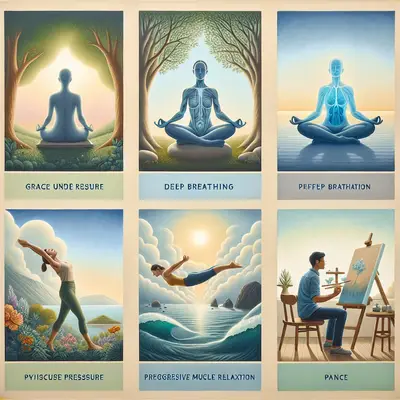
Stress relief, at its most refined, is less about escape and more about cultivation. Rather than scrambling for quick fixes, a truly composed life is built from small, exquisite decisions that protect your nervous system, preserve your attention, and honor your limits. In a culture that rewards overextension, learning to treat calm as a quiet luxury is both radical and necessary.
Below are five exclusive, elevated insights into stress relief—less about generic advice, more about the subtle upgrades that people seeking serious mental wellness will appreciate.
The Art of Cognitive Editing: Curating What Enters Your Mind
We speak often about curating our homes, wardrobes, or social feeds, yet far less about curating our input at the level of thought. Cognitive editing is the deliberate art of deciding which thoughts are worth your full attention—and which are not.
The brain’s “negativity bias” naturally clings to threats and friction, amplifying stress. Instead of trying to “think positive,” a more sophisticated approach is to practice selective amplification: notice a stressful thought, acknowledge it, and then consciously decide whether it deserves elaboration. If not, you redirect your mental lens to a more constructive question, such as, “What is the smallest useful action I can take right now?”
Over time, this looks like an internal editorial policy. Catastrophic narratives are fact-checked. Unverified assumptions are sent back for revision. Self‑criticism must provide evidence to be heard. This is not denial; it is discernment. You are still dealing with reality—but without granting every anxious interpretation the status of truth.
Neuroscience supports this subtle shift. Reframing and cognitive distancing reduce activity in the brain regions linked to emotional reactivity, particularly the amygdala, and increase engagement in areas responsible for rational evaluation and self‑control. In practice, cognitive editing becomes a daily, almost aesthetic choice: your mind as a carefully edited journal, not an unfiltered feed.
Precision Rest: Upgrading Recovery from Accidental to Intentional
Many people rest only when they crash. A refined mind does not leave restoration to chance. Instead, it treats rest as a precision practice—deliberate, scheduled, and matched to the type of stress you’re experiencing.
Mental overload (constant decision-making, information fatigue) benefits from sensory simplicity: dimmer light, fewer notifications, a single point of focus like gentle music or a candle flame. Emotional strain responds better to co-regulation—calm conversation with someone grounded, or even reading a reassuring voice in a well‑chosen book. Physical depletion, on the other hand, is restored through sleep quality, blood sugar stability, and gentle movement.
Rather than asking, “Am I resting enough?” you might ask, “Is my rest appropriate to my stress?” A ten-minute intentional decompression—phone in another room, slow breathing, eyes closed—often does more for the nervous system than an hour of scrolling.
Elite performers, from athletes to surgeons, treat recovery as part of the work, not its absence. Borrow that mindset. Consider micro‑intervals of restoration between demanding tasks: three minutes of deep breathing, a single slow walk around the room, a glass of water sipped without multitasking. Stress becomes far less corrosive when you refuse to let it accumulate unchecked.
Sensory Minimalism: Using Your Environment as a Nervous System Tool
The modern environment is visually and acoustically aggressive. Over time, this constant stimulation keeps your nervous system on subtle alert, elevating baseline stress even when “nothing is wrong.” Sensory minimalism is the practice of intentionally subtracting stimuli so your body can finally exhale.
Begin with visual noise. A cluttered desk, too many open tabs, bright overhead lights—these all demand micro-processing from your brain. Streamline your field of view: one task on the desk, softer lighting, fewer objects in direct sight. Your environment starts to behave less like a stimulus and more like a neutral backdrop.
Sound matters just as much. Continuous background noise, even at low levels, can raise cortisol and impair focus. Invest in high-quality earplugs or noise‑canceling headphones for selected periods of deep calm. Replace random noise with a chosen soundscape—gentle instrumentals, nature sounds, or even intentional silence.
Scent and touch can then be used as deliberate cues of safety: a stable daily fragrance during wind‑down time, a weighty throw, a favorite sweater with a particular texture. Over time, your nervous system learns to associate these sensory signatures with “off‑duty” mode, allowing you to downshift more quickly from high alert to subtle ease.
Boundaries as Nervous System Architecture, Not Personality Flaws
Boundaries are often miscast as confrontational, selfish, or dramatic. In a more elevated framework, they are simply architecture for your nervous system: the structural decisions that determine how much load your mind and body can carry without collapse.
Rather than starting with what you “should” tolerate, start with honest data: What kinds of interactions leave you feeling wired, depleted, or resentful? When during your week does your patience vanish? Which digital habits reliably leave you agitated? These are not moral questions; they are capacity questions.
From here, boundaries become design choices: no emotionally heavy conversations after a certain hour; limited availability for non-urgent messages; defined “buffer zones” before and after demanding meetings. You might decide that you will no longer respond instantly to every request. Instead, you build in a pause: “Let me think about that and get back to you.” That pause is nervous system gold.
Emerging research on stress and health highlights that chronic exposure to uncontrollable demands contributes significantly to burnout and physical illness. Boundaries restore a sense of control. Framed as self-respect rather than self-defense, they cease to be dramatic. They become the quiet scaffolding that allows you to show up more fully where it truly matters.
Ritualized Transitions: Protecting the Edges of Your Day
Stress is rarely created by a single overwhelming event. More often, it is the result of unmarked transitions—sliding from work into personal time, from screen into sleep, from conversation into solitude—with no decompression in between. The mind is left in constant gear‑shifts, never fully arriving anywhere.
Ritualized transitions are small, repeatable actions that signify, “This phase is over. A new one is beginning.” Their sophistication lies not in their grandeur, but in their consistency. After work, it might be a three‑minute stretching sequence, a specific playlist, or a walk around the block. Before sleep, it might be a gentle skincare ritual, a candle you light only at night, or three lines of journaling—what you’re grateful for, what you’re letting go of, and what can wait until tomorrow.
These rituals need not be spiritual or dramatic. They are practical punctuation marks in the sentence of your day. Physiologically, they help your nervous system shift out of “task mode” into a calmer baseline by signaling predictability and closure.
When practiced daily, these transitions become deeply reassuring. Your mind begins to trust that even demanding days will be bracketed by familiar moments of care. Over time, stress feels less like an endless gradient and more like a series of contained chapters—with clean beginnings, meaningful middles, and deliberate endings.
Conclusion
Stress relief, when elevated beyond quick fixes, becomes a quiet craft: editing the thoughts you grant power, upgrading rest from accidental to intentional, refining your sensory world, designing boundaries that honor your capacity, and protecting the subtle edges of your day with rituals.
This is not about constructing a life free from difficulty. It is about building a nervous system that feels supported rather than abandoned, even in complexity. In that space, calm stops being a rare event and becomes a quiet, daily luxury—chosen, protected, and deeply your own.
Sources
- [National Institute of Mental Health – 5 Things You Should Know About Stress](https://www.nimh.nih.gov/health/publications/stress) - Overview of how stress affects the body and mind, with evidence-based insights
- [American Psychological Association – Stress Effects on the Body](https://www.apa.org/topics/stress/body) - Detailed explanation of the physiological and psychological impact of chronic stress
- [Harvard Health Publishing – How to Boost Your Stress Resilience](https://www.health.harvard.edu/mind-and-mood/how-to-boost-your-stress-resilience) - Research-informed strategies for improving resilience and coping mechanisms
- [Mayo Clinic – Relaxation Techniques: Try These Steps to Reduce Stress](https://www.mayoclinic.org/healthy-lifestyle/stress-management/in-depth/relaxation-technique/art-20045368) - Practical, clinically informed methods for relaxation and stress reduction
- [Cleveland Clinic – Effects of Stress on Your Body](https://my.clevelandclinic.org/health/articles/11874-stress) - Clear breakdown of how ongoing stress influences overall health and well‑being
Key Takeaway
The most important thing to remember from this article is that this information can change how you think about Stress Relief.