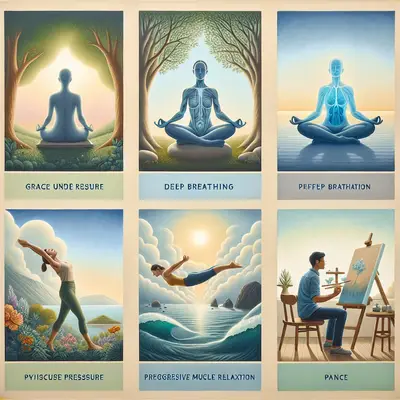
Stress, in its modern form, is no longer a sudden storm; it is a fine mist that accumulates silently—across inboxes, obligations, and the low hum of constant connectivity. For those who value a cultivated inner life, relief is not found in quick-fix hacks or noisy advice, but in subtle, deliberate practices that restore a sense of unhurried presence. Think of stress relief not as escape, but as an upgrade in the way you inhabit your own mind.
Below are five exclusive, refined insights—less about doing more, and more about doing differently—that invite you to experience calm as a quiet luxury rather than a rare accident.
1. Curating Cognitive Stillness: Designing a “Mental Silence Window”
Most people schedule their day around tasks; very few schedule around their nervous system. Yet the brain, like a fine instrument, benefits from precise periods of deliberate quiet. A “mental silence window” is not simply time off—it is a curated micro-ritual where you intentionally remove stimuli in service of recalibration.
Begin with a 7–12 minute daily window (long enough to matter, short enough to be non-negotiable). During this time, the goal is not productivity, reflection, or even “doing” meditation. Instead, the aim is to let your cognitive load settle: no screens, no conversations, no music with lyrics, no multitasking. You may sit in a chair facing a window, lie on a mat with eyes closed, or stand on a balcony watching the sky. The emphasis is on sensory simplicity.
The nervous system interprets this low-input state as safety, gently reducing stress hormones like cortisol and allowing the prefrontal cortex—responsible for decision-making and emotional regulation—to reset. Over time, these windows function like small structural beams in your psychological architecture, strengthening your resilience to external stressors. What transforms this from mere “break time” into a refined practice is the intention: you are not escaping your life, you are deliberately tuning your instrument.
2. Somatic Elegance: Refining the Way You Breathe, Stand, and Move
Stress rarely begins in the mind alone; it reveals itself first in the body—tight shoulders, shallow breaths, restless hands. Somatic elegance is the art of moving through the day as though your physical presence matters as much as your to-do list. It is not theatrical; it is a discreet refinement of how you inhabit your body.
Begin with breath. Instead of forcing deep breathing, aim for quieter, slower exhalations. A simple pattern: inhale slowly through the nose for four counts, exhale through slightly parted lips for six to eight. The extended exhale engages the parasympathetic nervous system, communicating “we are safe” far more effectively than positive affirmations alone.
Next, refine your posture not for aesthetics, but for nervous system ease. Imagine the crown of your head being gently suspended, your jaw unhooked from tension, your shoulders relaxing slightly down and back as if you are “wearing” your rib cage more lightly. When you walk between meetings, move as though you are carrying something delicate within your chest—because you are: your emotional equilibrium.
Micro-movements throughout the day—rolling the shoulders, unclenching the hands, releasing the tongue from the roof of the mouth—tell the body it does not need to prepare for constant threat. The result is not performative poise, but a quieter internal environment in which stress finds fewer places to anchor itself.
3. The Art of Selective Engagement: Treating Attention as a Finite Asset
Stress is often less about what is happening and more about how many things are demanding your attention at once. In a culture that treats attention as cheap and infinitely divisible, a premium approach to stress relief is to reclaim your attention as a scarce, high-value asset—worthy of protection and deliberate allocation.
Selective engagement begins with a simple question: “Does this truly require my nervous system right now?” Every notification, message, or request is not simply an item; it is a micro-activation of your stress circuitry. A sophisticated strategy is to create discrete “engagement zones” during the day—periods where you consciously allow demands in, and periods where you are intentionally less reachable.
For example, you might decide that the first 45 minutes of your day are notification-free, reserved for orientation rather than reaction. Later, you cluster email responses into two or three dense but bounded sessions, instead of allowing constant trickle access to your mental field. This is not digital asceticism; it is resource management.
Equally important is the art of selective “no”—not as resistance, but as curation. Declining a non-essential meeting, delaying a response until you can give it proper thought, or stepping away from an emotionally charged conversation until your system is settled, are all acts of quiet self-respect. When your attention is treated with discernment, your stress no longer feels like a flood; it becomes a stream you have chosen to wade into.
4. Sensory Minimalism: Using Environment as a Subtle Therapeutic Tool
The spaces we inhabit either soothe the nervous system or subtly agitate it. A refined approach to stress relief acknowledges that your environment is not background; it is a silent collaborator in your mental state. Sensory minimalism is less about stark aesthetics and more about curating stimuli so that your senses are not constantly overfed.
Consider three sensory dimensions: light, sound, and tactile elements. Soft, indirect lighting—lamps, warm bulbs, candlelight—signals evening safety to the brain far more effectively than harsh overhead lights. Gentle, consistent soundscapes (like low-volume instrumental music or white noise) can buffer the nervous system from jarring environmental sounds that keep you perpetually on alert.
Tactile experiences also matter: the feel of a well-weighted blanket, a smooth ceramic mug, or a natural fiber throw can be grounding points throughout the day. Rather than redesigning your entire home, think in terms of “sanctuary corners”—a reading chair, a particular spot at your desk, or a bedside arrangement that is visually uncluttered, softly lit, and texturally comforting.
Even small acts of environmental curation—clearing a single surface at the end of the day, placing fresh water in a glass carafe on your nightstand, arranging a minimalist bedside tray—signal to the nervous system that your life has room, and that not everything is urgent. Stress softens when the eye and body are no longer continually negotiating chaos.
5. Rituals of Completion: Closing Psychological Loops with Intention
One of the most subtle drivers of stress is not what we do, but what we leave unfinished—emails half-composed, decisions delayed, conversations unresolved. The brain keeps open loops active, quietly consuming cognitive bandwidth and amplifying a sense of internal clutter. Creating rituals of completion turns the end of each day into a gentle psychological exhale.
A completion ritual need not be elaborate. It might be a 10–15 minute evening practice where you do three things: (1) capture, (2) close, and (3) choose. First, capture any lingering tasks or ideas on paper or in a single, trusted digital list—removing them from mental storage. Second, close whatever can be finished in under two minutes: a quick reply, a single tidy-up action, a small decision. Third, choose your “first true priority” for the next day, so that your mind does not spend the night negotiating what will matter tomorrow.
The power of this ritual lies in its emotional effect: you signal to yourself that today’s efforts were sufficient, that nothing critical is hiding in the shadows, and that tomorrow already has a defined point of entry. Over time, your evenings transform from a slow spiral of rumination into a deliberate descent into rest. Stress becomes less about what is unresolved and more about what you have gracefully placed in order.
Conclusion
Stress will never fully disappear from a meaningful life, nor should it; a completely frictionless existence is neither realistic nor particularly alive. But stress can be refined—transformed from a constant, abrasive presence into an occasional, manageable signal. When you curate mental silence windows, move with somatic elegance, protect your attention, cultivate sensory minimalism, and close each day with conscious completion, calm ceases to be a luxury reserved for rare retreats. It becomes the tone of your everyday existence.
The unhurried mind is not an indulgence; it is an intelligent foundation from which clearer thinking, more nuanced relationships, and deeper satisfaction naturally emerge. In treating your inner world with the same discernment you might bring to art, design, or fine craftsmanship, you elevate stress relief from survival strategy to a quiet, enduring form of personal luxury.
Sources
- National Institute of Mental Health – 5 Things You Should Know About Stress – Overview of how stress affects the body and mind, with evidence-based coping strategies
- American Psychological Association – Stress Effects on the Body – Detailed explanation of the physiological impact of chronic stress and its mechanisms
- Harvard Health Publishing – Relaxation Techniques: Breath Control Helps Quell Errant Stress Response – Research-backed insights into breathing practices and nervous system regulation
- Cleveland Clinic – Sensory Overload: What It Is, Symptoms & Treatment – How environmental and sensory input influences stress and overwhelm
- Mayo Clinic – Stress Management: Strengthen Your Social Support – Practical guidance on lifestyle adjustments and habits that reduce stress and promote resilience
Key Takeaway
The most important thing to remember from this article is that this information can change how you think about Stress Relief.