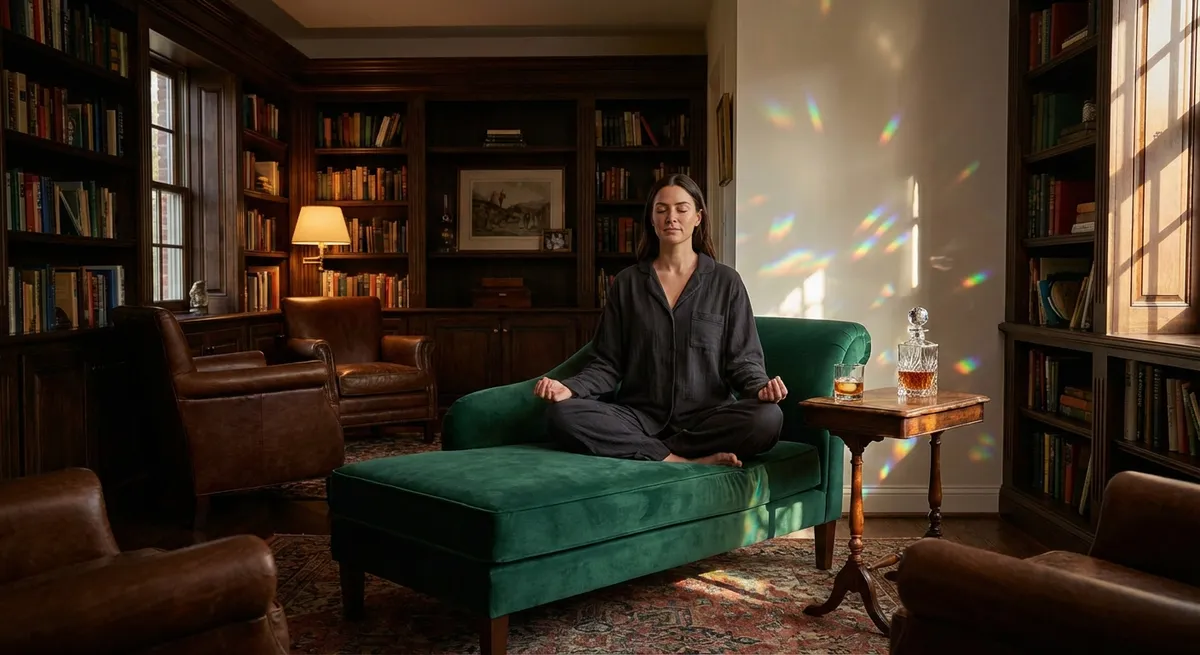
Meditation, at its most refined, is not an escape from life but a way of inhabiting it with exquisite precision. For the discerning mind, true calm is never blunt or numbing—it is sharp, clear, and quietly powerful. This is the realm where meditation stops being a “wellness hack” and becomes a cultivated art of presence, guiding you toward a more deliberate and artful way of living.
In what follows, you’ll find five exclusive, quietly transformative insights—less about technique as trend, more about meditation as an elegant framework for mental poise, emotional literacy, and subtle self-mastery.
Meditation as Cognitive Editing, Not Emotional Erasure
Contrary to the common myth, meditation is not an attempt to delete your thoughts or un-feel your feelings. In a more sophisticated practice, meditation acts as a form of cognitive editing—selective, discerning, and intentional.
Through deliberate attention, you begin to notice the difference between thoughts that are signal and thoughts that are noise. Instead of wrestling with every mental impulse, you observe which narratives are useful, grounding, and aligned with your values, and which are merely habitual reactions or inherited anxieties. This is not repression; it is curation.
Neuroscientific research shows that mindfulness practices can decrease activity in the brain’s default mode network, associated with rumination and self-referential chatter. Over time, you become less compelled to follow every mental storyline to its anxious conclusion. The result is a refined inner environment—less cluttered, more composed—where your thoughts feel chosen rather than intrusive.
For those seeking elevated mental wellness, this is the quiet luxury: not having fewer thoughts, but having a more elegant relationship with them.
The Luxury of Unhurried Perception
One of the rarest luxuries in modern life is the ability to experience anything—conversation, music, a sip of tea—without rushing through it internally. Meditation trains precisely this: unhurried perception.
In meditation, you practice extending the space between stimulus and response. The breath arrives; you notice it fully. A sound intrudes; you observe it rather than bristle. A memory surfaces; you witness its texture without immediately translating it into action. You are not slowing time, but you are refining how fully you inhabit each moment of it.
This unhurried perception quietly rewrites your day-to-day experience. A commute becomes less of a blur and more of a neutral, even contemplative interlude. A difficult conversation becomes less threatening because you are able to stay present with your own internal reactions rather than being swept away by them. Even pleasure becomes more luminous when you are not mentally already on to the next task.
Meditation, in this sense, becomes an elegant antidote to the culture of acceleration. It restores your right to experience life at a pace that honors your nervous system, your values, and your attention as premium resources.
Emotional Refinement: From Raw Reaction to Subtle Nuance
Many people approach meditation imagining that emotional calm means never feeling deeply again. In a more mature practice, the opposite occurs: you feel more, but with nuance and discernment.
Meditation heightens interoception—your awareness of sensations within the body. Over time, what once felt like a vague cloud of “stress” begins to differentiate into distinct experiences: a tightening in the chest that signals worry, a flutter in the stomach that hints at excitement, a dull heaviness that reveals unacknowledged fatigue. Emotional intelligence becomes less theoretical and more somatic, precise, and deeply personal.
With consistent practice, you learn to recognize the early whispers of emotional states rather than only their loud extremes. This allows for gentler interventions: a brief pause before irritation becomes anger; a moment of restorative quiet before mild depletion becomes full burnout; a small act of self-kindness before sadness hardens into numbness.
In this way, meditation transforms emotional regulation from a blunt instrument into a finely tuned art form. You are no longer managing crises; you are tending to subtleties.
The Hidden Architecture: Designing an Inner Environment of Calm
Most wellness advice focuses on what you do. Meditation, at its most sophisticated, also concerns where—internally—you are doing it from. It invites you to become an architect of your inner environment.
As you sit, you might begin to notice your baseline internal “tone”: rushed or spacious, brittle or open, guarded or receptive. Rather than judging these states, you treat them as atmospheric conditions you can influence. Your breath becomes a design tool; your posture, a structural choice; your attention, the lighting that softens or sharpens the whole interior.
Over time, you start to recognize that inner stillness does not depend on external silence. You can be in a busy airport and yet remain anchored; you can move through a demanding workday with a subtle sense of inner coherence that does not fracture with every new request.
This architectural perspective extends beyond meditation sessions. You begin to choose conversations, media, and obligations as if you were curating the furniture of your mind—removing what is unnecessarily loud, adding what is quietly nourishing, and preserving clean lines of mental space where your best thinking can breathe.
Precision Rest: Meditation as High-Fidelity Recovery
For high-functioning, mentally engaged individuals, rest often feels unsatisfying. Scrolling a screen is not truly restorative; collapsing on the sofa rarely resets the nervous system in a meaningful way. Meditation offers precision rest—short, high-fidelity resets that directly support cognitive clarity and emotional stability.
Brief, well-practiced meditation sessions can reduce sympathetic nervous system activation (your fight-or-flight response) and engage the parasympathetic system, which supports repair and recovery. Unlike sleep, which you cannot fully direct, these intentional pauses are consciously chosen touchpoints of restoration in your day.
The effect is cumulative. Instead of waiting for a vacation or weekend to finally “come down,” you are strategically punctuating your schedule with calibrated moments of decompression. A ten-minute midday practice can soften reactivity for the entire afternoon. A quiet evening sit can unclutter the mind before sleep, improving not just the quantity but the quality of your rest.
In a culture that glamorizes exhaustion, this level of intentional recovery is both rare and quietly radical—a discreet form of self-respect expressed through how carefully you restore your mind.
Conclusion
Meditation, when approached with discernment, is not a trend or a task—it is a cultivated standard for how you experience your own life. It refines your thinking without sterilizing it, deepens your emotional range without overwhelming you, and restores your attention as a resource you invest rather than scatter.
For the attuned mind, this is the true appeal: not the promise of a life without difficulty, but the capacity to meet each complexity with composure, clarity, and an inner environment that feels meticulously, quietly, under your own care.
Sources
- National Center for Complementary and Integrative Health – Meditation: What You Need To Know - Overview of meditation types, benefits, and key research findings
- Harvard Health Publishing – Mindfulness meditation may ease anxiety, mental stress - Discusses how mindfulness affects stress, anxiety, and brain function
- American Psychological Association – Mindfulness meditation: A research-proven way to reduce stress - Summarizes psychological research on meditation’s impact on cognition and emotion
- Mayo Clinic – Meditation: A simple, fast way to reduce stress - Explains physiological and mental health effects of meditation
- National Institutes of Health – Brain Mechanisms of Mindfulness Meditation - Research article detailing how meditation influences brain networks and emotional regulation
Key Takeaway
The most important thing to remember from this article is that this information can change how you think about Meditation.