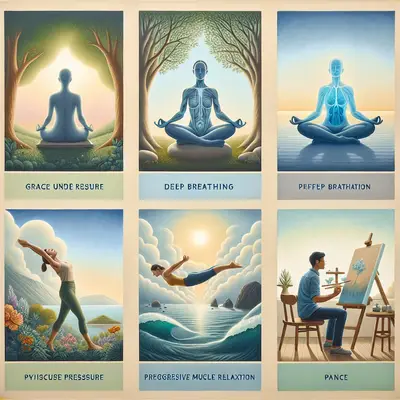
In a culture devoted to velocity, stress has become less a signal than a soundtrack—constant, humming, and too easily ignored. For the discerning, ambitious mind, the problem is not merely “too much to do,” but an inner tempo that never quite de-escalates. At Calm Mind Remedies, we are less interested in escape than in refinement: how to remain fully engaged with a demanding life while feeling distinctly unhurried on the inside. This is stress relief as a quiet luxury—subtle, deliberate, and deeply intelligent.
Below, you’ll find five exclusive insights designed for people who want more than basic advice. These are for the individual who curates their life with intention and expects their mental wellness practices to be equally considered.
The First Insight: Regulating Your Pace of Attention, Not Just Your Schedule
Conventional stress advice fixates on time management—rearranging hours, delegating tasks, trimming obligations. Useful, yes, but incomplete. Many high performers discover that even when their calendar is lighter, their mind still races. The deeper lever is not your schedule; it is your attentional tempo.
Pace of attention refers to the speed at which your focus jumps between stimuli: emails, notifications, conversations, thoughts. When this pace is rapid, your nervous system quietly assumes something important—or threatening—is happening, activating subtle stress responses even when nothing is objectively urgent. Refined stress relief begins with intentionally slowing the transitions between tasks. For example, take 20 deliberate seconds between a meeting and your next action: exhale slowly, feel your feet on the floor, and ask, “What truly deserves my attention next?” This micro-interruption signals safety to your nervous system.
Unlike grand, time-consuming wellness routines, regulating attentional pace is discreet and compatible with a demanding life. It does not require more free time; it requires more conscious switching. Over days and weeks, you may notice your inner narration softening, your body less clenched, and complex decisions arriving with far less mental friction.
The Second Insight: Curating Micro-Sensory Anchors as Daily “Calm Cues”
Stress lives in the body as much as in the mind. Elevated heart rate, tightened jaw, shallow breathing—these are physiological signals that something feels off. Rather than trying to argue with your stress cognitively (“I shouldn’t be stressed, everything is fine”), a more sophisticated approach is to speak to the body in its own language: sensation.
Micro-sensory anchors are small, repeatable physical experiences that your nervous system learns to associate with calm. These are not random comforts; they are intentionally chosen, consistently repeated cues. A particular essential oil on your wrists that you only use during focused, grounded work. A specific textured object in your pocket that you touch before entering a challenging conversation. A subtle temperature ritual: cool water on your wrists before bed, warm ceramic in your hands with herbal tea after a demanding call.
Over time, these sensory anchors become shorthand for “we are safe here.” Your body doesn’t have to analyze or negotiate; it simply recognizes. This approach is especially powerful during high-pressure environments where visible stress practices (like extended meditations) are impractical. A single breath with a familiar scent, or the remembered weight of a ring or bracelet you associate with poise, can gently recalibrate your nervous system without announcing anything to the outside world.
The Third Insight: Designing “Cognitive Boundaries” for a Mind That Never Clocks Out
For people who care deeply about their work, stress often comes not from the hours worked but from the blur between roles: leader, partner, parent, creator, friend. Without clear transitions, the mind remains half-anchored in the previous context, generating a subtle, chronic tension. The answer is not merely work–life balance; it is the artful construction of cognitive boundaries.
A cognitive boundary is a personal ritual or mental contract that distinctly closes one mental arena before you enter another. This could be a brief written “shutdown note” at the end of your workday: what you completed, what remains, and what your future self will handle tomorrow. It might be a particular short playlist that you only play when shifting from “producer mode” to “home mode.” Or a rule that the first 15 minutes after arriving home are tech-free, reserved solely for recalibrating your presence.
These boundaries are not restrictive; they are clarifying. When your mind knows that each domain of your life has a defined beginning and end, it can rest more fully in the current one. The sophisticated result is not less productivity but deeper, more elegant presence—at work, with loved ones, and in your own private interior world.
The Fourth Insight: Treating Sleep as a Performance Asset, Not a Recovery Afterthought
For the high-achieving mind, sleep frequently becomes a negotiation: how little can I get away with? Yet modern research is unequivocal—chronic sleep deprivation quietly magnifies anxiety, erodes emotional regulation, and distorts how threatening or stressful events feel. In other words, insufficient sleep doesn’t just make you tired; it makes normal life appear more stressful.
Elevated stress relief requires rebranding sleep as a strategic performance asset. This reframing is subtle but powerful: rather than seeing rest as a passive absence of doing, treat it as the most advanced technology for mental clarity, emotional composure, and creative precision. Protecting a sophisticated evening routine—dimmed lights, reduced blue light exposure, a predictable sleep window, and a consistent wind-down ritual—becomes an investment decision, not an indulgence.
Experiment with one high-quality change at a time: perhaps a 30–45 minute no-screen buffer before bed paired with a single offline activity that feels quietly luxurious—a hardcover book, a silk eye mask, or a dedicated herbal sleep blend. The goal is to train your body to associate the late evening not with overflow work, but with systemic decompression. Over time, you may notice that situations which previously triggered disproportionate stress simply register as manageable, no longer amplified by an exhausted brain.
The Fifth Insight: Practicing Emotional Precision Instead of Generic “Stress”
Most people describe their internal state in blunt terms: “stressed,” “overwhelmed,” “burned out.” These phrases are understandable, but imprecise, and imprecision keeps the nervous system in a fog. Stress relief becomes far more effective when you cultivate emotional granularity—being able to name what you feel with nuance and accuracy.
Underneath “stress” might be: anticipatory anxiety, social fatigue, decision paralysis, quiet resentment, disappointment, or even excitement without enough recovery. Each of these experiences requires a different remedy. Anticipatory anxiety might call for rehearsal and planning. Social fatigue might need solitude and silence. Resentment may require renegotiated boundaries. Decision paralysis may respond best to constraints and pre-made criteria rather than more information.
A simple but elevated practice: when you notice the word “stressed,” pause and ask yourself, “If I couldn’t use that word, what exactly is happening inside?” You might write a few lines, or quietly name two or three more precise emotions. This subtle act of refinement shifts you from vague discomfort to specific understanding—and specific understanding naturally suggests more tailored, effective action. Emotional precision transforms stress from a monolith into something you can work with intelligently.
Conclusion
Stress, for the discerning mind, is rarely about a single event. It is about the accumulated texture of one’s days: the rush between tasks, the blurred boundaries, the unexamined pace of attention, and the quiet erosion of rest. Elevating your stress relief practices means approaching them as you might approach any other refined aspect of life—intentionally designed, sensorially considered, and chosen for both beauty and impact.
By regulating your attentional tempo, curating micro-sensory anchors, establishing cognitive boundaries, honoring sleep as a performance asset, and cultivating emotional precision, you begin to experience a different quality of inner life. The external demands may remain, but the interior atmosphere shifts from reactive to composed. In that shift lies a new standard of mental wellness: not merely coping, but moving through a demanding world with a distinctly velvet calm.
Sources
- American Psychological Association – Stress Effects on the Body - Overview of how stress impacts multiple systems in the body, including the nervous system and sleep.
- National Institute of Mental Health – 5 Things You Should Know About Stress - Evidence-based information on what stress is, how it affects health, and strategies for management.
- Harvard Medical School – Sleep and Mental Health - Discussion of the relationship between sleep quality, emotional regulation, and mental health.
- National Institutes of Health – Stress Management - MedlinePlus resource outlining techniques and research on stress management approaches.
- Yale Center for Emotional Intelligence – Emotional Intelligence Research - Research and insights on emotional granularity and how precise emotion labeling can support better mental wellness.
Key Takeaway
The most important thing to remember from this article is that this information can change how you think about Stress Relief.