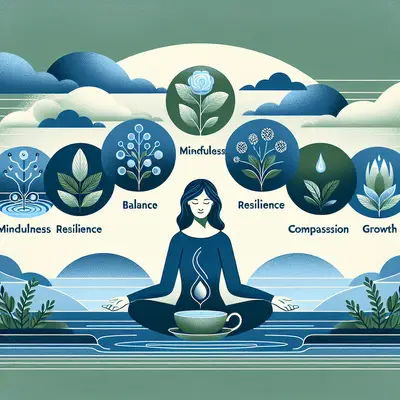
Mental wellness, at its most refined, is less about crisis management and more about curation—of thoughts, stimuli, habits, and even silence. In a world that rewards constant visibility, the true luxury is an interior life that feels composed, lucid, and quietly powerful. This is not about perfection or relentless optimization; it is about orchestrating a mental environment that supports depth, discernment, and ease.
What follows are five exclusive insights—deliberately understated yet profoundly effective—that speak to those who seek mental wellness not as a trend, but as a cultivated standard of living.
Insight 1: Treat Your Mental State as a Private Members’ Club
A well-run members’ club is defined less by its décor and more by its door policy. Your mind deserves the same level of curation. Every conversation, notification, and obligation is an “applicant” seeking entry into your attention.
Begin to ask, quietly and consistently: Does this deserve access to my cognitive bandwidth?
This subtle shift reframes mental wellness from reactive coping to proactive gatekeeping. Emails can be triaged at set times rather than answered on impact. Social invitations can be evaluated for emotional return, not just social expectation. News consumption can be time-boxed, not endlessly scrolled.
Over time, this selective entry policy:
- Reduces cognitive overload and decision fatigue
- Preserves emotional energy for relationships and projects that genuinely matter
- Creates a sense of interior spaciousness, even on demanding days
You are not required to attend every drama you are invited to—digitally or in real life. A premium approach to mental wellness begins by declining, graciously and consistently, what does not align with your inner standards.
Insight 2: Design Micro-Rituals that Signal “Psychological Tailoring”
Bespoke tailoring is defined by precision—the small stitches you barely notice but feel every time you move. Your mental wellness deserves the same quiet calibration through micro-rituals: brief, intentionally designed actions that tell your nervous system, You are safe. You are held. You are in control.
These micro-rituals need not be elaborate:
- A specific herbal tea you reserve only for evening decompression
- A particular playlist that signals “deep work mode” to your brain
- A 90-second breathing pattern before opening your laptop each morning
- A deliberate transition object—changing your watch strap or scent—when shifting from work to personal time
The key is consistency and association. Over time, these subtle acts become psychological tailoring—small but powerful adjustments that help your mind fall into the right “fit” for the moment: focused, receptive, calm, or reflective.
Research on habit formation suggests that attaching new behaviors to existing routines (“habit stacking”) makes them far more sustainable. Instead of overhauling your life, you are refining its seams.
Insight 3: Cultivate “Cognitive Minimalism” Without Emotional Austerity
Minimalism is often misunderstood as sterility or deprivation. In the realm of mental wellness, cognitive minimalism is something different: it is the deliberate reduction of mental clutter without sacrificing emotional richness.
This means:
- Limiting multitasking in favor of single-task immersion
- Reducing your “mental tab count” by writing down, rather than mentally juggling, to-dos and ideas
- Pruning your digital environment—unsubscribing, muting, and filtering to clear informational noise
Cognitive minimalism is not about feeling less; it is about making space to feel fully.
The nervous system is not designed for incessant information switching. Neuroscience research indicates that constant task-switching degrades performance and increases perceived stress. By clearing mental clutter, you create room for:
- Nuanced conversations that are not rushed
- Deep enjoyment of art, music, or literature without checking your phone
- Emotional processing that is not perpetually postponed to “later”
Your mind becomes less like a crowded inbox and more like a well-appointed gallery—each experience given the room it deserves.
Insight 4: Use Sleep as Your Most Sophisticated Mental Technology
In a culture obsessed with the latest wellness innovation, it is easy to overlook the most elegant technology your body possesses: restorative sleep. For mental wellness, premium sleep is less about duration alone and more about quality architecture—the cycles of deep, REM, and light sleep that support emotional regulation, memory, and resilience.
Refine your sleep as you would refine an investment portfolio:
- Protect the hour before bed as “blue-chip time”: no emotionally charged conversations, no doomscrolling, no intense work
- Keep light sources warm and dim in the evening; treat bright, blue-toned light as a morning-only luxury
- Make your bedroom a sensory sanctuary: cool temperature, breathable fabrics, intentional scent (lavender, chamomile, or sandalwood can be especially soothing)
High-quality sleep improves mood stability, attention, and emotional processing. Chronic sleep restriction, by contrast, subtly erodes mental poise, making minor irritations feel monumental and small uncertainties feel threatening.
Think of sleep not as the absence of productivity, but as invisible high-yield maintenance—an unglamorous, irreplaceable cornerstone of mental grace.
Insight 5: Honor Emotional Complexity as a Sign of Inner Sophistication
There is an increasingly pervasive notion that “positive vibes only” is the hallmark of wellness. In truth, mental wellness at a refined level is not about perpetual lightness; it is about emotional literacy and range.
Sophisticated mental health acknowledges:
- You can feel gratitude and grief in the same afternoon
- You can respect someone and still hold clear boundaries with them
- You can cherish your life and still want certain chapters to change
Psychologists refer to this as “emotional complexity”—the capacity to hold multiple, seemingly conflicting feelings without forcing yourself into premature resolution. Instead of labeling emotions as “good” or “bad,” a more discerning approach asks: What is this feeling trying to tell me? What data is it carrying?
Anxiety might be signaling misalignment with your current commitments. Irritability might be a quiet protest against overextension. Sadness might be evidence of deep attachment, not weakness.
By treating emotions as nuanced data rather than threats or inconveniences, you transform your inner life from a place of judgment to a place of informed, compassionate governance. This is mental wellness as stewardship, not suppression.
Conclusion
Mental wellness, when approached as a curated inner experience, becomes less about quick fixes and more about enduring refinement. You begin to guard your attention like a private club, stitch your days with precise micro-rituals, clear cognitive clutter without emotional narrowing, treat sleep as a core mental technology, and honor emotional complexity as a mark of maturity—not failure.
The result is not a life free of challenge, but a mind that moves through those challenges with quiet authority. In a world that prizes volume and velocity, this level of interior calibration is not just wellness—it is a discreet form of luxury.
Sources
- [National Institute of Mental Health – Caring for Your Mental Health](https://www.nimh.nih.gov/health/topics/caring-for-your-mental-health) - Overview of evidence-based strategies and foundations for maintaining mental wellness
- [Harvard Medical School – Sleep and Mental Health](https://www.health.harvard.edu/newsletter_article/sleep-and-mental-health) - Explores the bidirectional relationship between sleep quality and mental health
- [American Psychological Association – Multitasking: Switching Costs](https://www.apa.org/research/action/multitask) - Details research on cognitive overload and the mental costs of constant task-switching
- [Yale University – The Science of Well-Being (Open Course)](https://online.yale.edu/courses/science-well-being) - Provides research-based insights into habits and practices that support psychological well-being
- [Mayo Clinic – Stress Management](https://www.mayoclinic.org/healthy-lifestyle/stress-management/in-depth/stress-relief/art-20044476) - Practical, medically reviewed guidance on lowering stress and supporting mental health
Key Takeaway
The most important thing to remember from this article is that this information can change how you think about Mental Wellness.