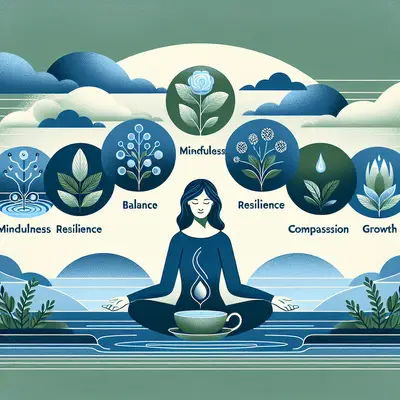
Mental wellness is often framed as an emergency repair—something we reach for only when life begins to fray. But for a discerning mind, equilibrium is not an afterthought; it is a daily luxury, cultivated with quiet precision. Think of mental wellness as the most bespoke item in your life’s wardrobe: perfectly tailored, deeply personal, and deserving of exquisite care. This is not about grand gestures or rigid routines, but about subtle, elevated practices that invite the nervous system to exhale and the mind to move through the day with velvet clarity.
Below, you’ll find five exclusive, refined insights designed for those who seek mental wellness as a deliberate, elegant standard rather than an occasional intervention.
1. Treat Your Nervous System as a Design Priority, Not an Afterthought
We often arrange our homes, schedules, and digital lives for productivity or aesthetics, but rarely for nervous system ease. Yet your environment continuously instructs your brain: “We are safe” or “We are under siege.”
Begin by curating a sensory landscape that signals quiet assurance. This might mean a deliberate decluttering of visual noise—fewer open tabs, fewer notifications, fewer objects in your line of sight. Soft but defined lighting, consistent fragrance notes (such as a single essential oil you reserve for winding down), and a restrained color palette can all subtly reduce cognitive load.
On a physiological level, the nervous system responds profoundly to predictability and micro-rituals. A consistent wake time, a daily moment of intentional stillness (even three minutes), and a stable wind-down sequence at night all serve as cues of safety. These are not simply “habits”; they are design elements for emotional stability. When you treat your nervous system as a central design brief in your life, mental wellness stops feeling like something you chase and becomes something your environment quietly sustains.
2. Elevate Your Inner Dialogue to the Level of Private Concierge
The finest hotels anticipate needs with exceptional discretion: a glass of water appears before you ask, a room is subtly adjusted to your preferences. Most of us, in contrast, speak to ourselves with a harshness we would never tolerate in external service.
A sophisticated approach to mental wellness involves upgrading your inner dialogue to concierge-level care. This does not mean relentless positivity; it means precise, respectful language that acknowledges difficulty while offering practical support. For example:
- Instead of: “I can’t handle this.”
Try: “This is a lot. What is the next smallest step I can handle?”
- Instead of: “I’m so behind.”
Try: “I’m not where I hoped to be yet. What would meaningful progress look like in the next 30 minutes?”
This refinement of self-talk leverages cognitive reappraisal—a process where we reinterpret our experiences to reduce emotional impact—without drifting into denial. Over time, this style of inner language becomes a private standard of emotional luxury: you are both the guest and the concierge, the one who needs care and the one exquisitely equipped to provide it.
3. Practice “Selective Immersion” Instead of Mindless Escape
Modern life tempts us with endless mental escape routes: scrolling, streaming, snacking, overworking. These activities are not inherently harmful, but when they operate as unconscious anesthesia, they erode clarity and heighten baseline anxiety.
Selective immersion is a more refined alternative. Rather than consuming anything that distracts, you intentionally choose experiences that absorb you fully and return you to yourself with greater calm. Examples include:
- Reading long-form writing that slows your pace of thought instead of fragmented headlines.
- Listening to one album from start to finish, without multitasking, to create a single continuous arc of attention.
- Engaging in a tactile activity—handwriting, sketching, arranging flowers, polishing silverware—that leverages your senses and gently anchors you in the present.
The distinction is agency. Mindless escape leaves you slightly more scattered than before; selective immersion leaves you subtly more integrated. When you consistently choose high-quality mental “inputs,” your inner world begins to feel less like a cluttered feed and more like a thoughtfully edited gallery.
4. Adopt “Strategic Quiet” as a Performance Tool, Not a Luxury
Quiet is often experienced as something that accidentally appears: the rare empty evening, the canceled meeting, the unexpected moment when your phone is in another room. For a mind that values both excellence and ease, quiet becomes something else entirely—a strategic asset.
Strategic quiet is intentionally placed silence or stillness used to enhance performance, not oppose it. Consider:
- A brief, device-free interval before entering demanding conversations or presentations, allowing your brain to switch from reactive to deliberate thinking.
- A daily “white space” appointment in your calendar—15 to 20 minutes protected as fiercely as any client meeting, dedicated to unstructured thought, reflection, or simple stillness.
- Transition rituals between roles (professional, partner, parent, friend) that may be as understated as three slow breaths at the threshold of a room, or a single sentence you repeat—“New room, new role, present mind.”
Instead of seeing quiet as “unproductive,” you begin to recognize it as the infrastructure that upholds sustained focus, emotional regulation, and creative problem-solving. When quiet is scheduled with the same seriousness as high-stakes commitments, your mind learns that recovery is not indulgence—it is strategy.
5. Curate a Personal “Emotional Protocol” for High-Stress Moments
Sophisticated systems rely on protocols: clear, rehearsed procedures for when everything feels urgent. Most people, however, enter high-stress situations with no prepared script—only instinct, habit, and adrenaline.
An emotional protocol is a pre-designed sequence you follow when your mental state begins to fray. It is deeply personal, yet structured enough to be reliable. It might look like this:
- Name the state with precision.
Replace vague overwhelm (“I’m stressed”) with nuanced language (“I feel mentally crowded and physically tense”).
- Apply a brief, non-negotiable regulation practice.
For example, 60–90 seconds of extended exhale breathing (inhale to a count of 4, exhale to a count of 6–8) to gently cue the parasympathetic nervous system.
- Reduce the field of decision-making.
Identify a single priority task or action, even if it is as small as “Reply to one email” or “Write three sentences of this report.”
- Set a defined container of time.
Commit to 10–15 focused minutes. A short, clearly bounded effort is far less daunting to an agitated mind than an indefinite demand for productivity.
- Reserve judgment.
Decide that evaluation (“Was this enough?” “Did I do well?”) will occur later—after completion, when your nervous system has stabilized. This protects you from layering self-criticism on top of an already strained state.
By rehearsing this protocol in low-stakes moments, you make it available when it matters most. It becomes a private standard of care you can call upon in any context, from boardrooms to late-night anxieties.
Conclusion
For those who regard mental wellness as an essential luxury rather than an optional add-on, refinement lies in the details: the tone of your inner voice, the architecture of your environment, the intentionality of your quiet moments, and the protocols you rely on when life becomes dense. This is not about perfection or rigid discipline; it is about cultivating a life where your mind feels hosted, not hurried.
When you invest in these subtle, elevated practices, mental wellness ceases to be a project you are always chasing and becomes the quiet, stable foundation beneath everything else you do. In that space, clarity feels less like a rare visitor and more like the natural atmosphere of your days.
Sources
- [National Institute of Mental Health – Caring for Your Mental Health](https://www.nimh.nih.gov/health/topics/caring-for-your-mental-health) – Overview of evidence-based strategies for maintaining mental well-being
- [American Psychological Association – Reframing Thoughts](https://www.apa.org/topics/cognitive-behavioral-therapy/reframing-thoughts) – Explains cognitive reappraisal and how changing self-talk influences emotional health
- [Harvard Health Publishing – Understanding the Stress Response](https://www.health.harvard.edu/staying-healthy/understanding-the-stress-response) – Describes the physiology of stress and the role of the nervous system
- [Cleveland Clinic – Deep Breathing Exercises](https://health.clevelandclinic.org/deep-breathing-exercises) – Practical guidance on breathwork techniques that support calming the nervous system
- [Yale University – Emotional Intelligence and Well-Being](https://medicine.yale.edu/news-article/emotional-intelligence-is-key-to-our-well-being) – Discusses how emotional awareness and regulation contribute to overall mental wellness
Key Takeaway
The most important thing to remember from this article is that this information can change how you think about Mental Wellness.