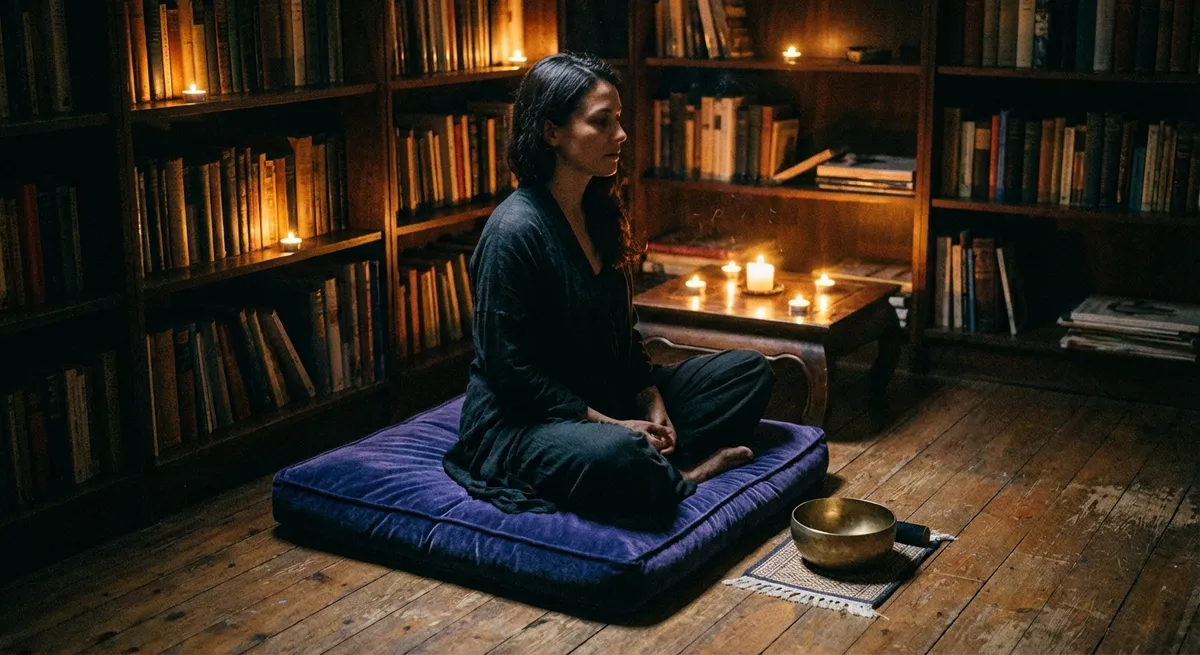
In a culture that equates busyness with importance, the ability to direct your attention with elegance has become a rare luxury. Meditation, approached with discernment rather than desperation, offers more than stress relief; it becomes a quiet refinement of how you inhabit your own mind. This is not about escaping your life, but about inhabiting it with greater clarity, composure, and subtle power. When curated with intention, a meditation practice feels less like a wellness chore and more like an intimate, daily appointment with your highest self.
Below are five exclusive, nuanced insights into meditation that speak to those who view mental wellness as an art form rather than a checklist.
Insight 1: Meditation as Cognitive Curation, Not Mental Emptiness
The most persistent misconception about meditation is the idea that one must “empty the mind.” In reality, you are not erasing thought; you are refining your relationship with it. Imagine your mind as a beautifully designed gallery. Thoughts enter like visitors. Traditional reactivity throws open every door and follows each visitor around the room. Meditation, practiced with sophistication, turns you into the curator rather than the crowd.
Neurological research consistently shows that meditation alters activity in regions tied to attention and emotional regulation, such as the prefrontal cortex and amygdala. Over time, this doesn’t eliminate thought—rather, it changes the quality of your mental dialogue. Irritations still arise, but they lose their authority. You become less compelled to narrate, explain, justify, or dramatize what passes through. This is cognitive curation: you choose what deserves your engagement, what deserves a nod, and what is allowed to drift away without comment.
For people who lead demanding, high-stakes lives, this shift is priceless. You’re no longer hostage to every mental impulse. Instead, your attention becomes a deliberate resource, deployed with care, much like a well-managed investment portfolio.
Insight 2: The Luxury of Slower Perception in a Fast World
One of meditation’s most underappreciated gifts is its impact on perceived time. When attention is scattered, your day fractures into a thousand micro-moments of distraction. Hours vanish into notification loops, and you’re left wondering where the day went. Meditation gently extends your sense of psychological “space” within each moment, as if time itself breathes more deeply.
This slowing is not laziness; it is luxury. As meditation improves your capacity for sustained attention, you begin to experience more of what is already happening. The taste of your tea has more layers. A five-minute conversation with someone you care about feels more like ten. Even transitions—between meetings, modes of transport, or roles—become small, conscious thresholds instead of blurred, hurried collisions.
Physiologically, this often corresponds to lower stress hormones, more balanced heart-rate variability, and a greater sense of internal order. Subjectively, it feels like this: your day no longer rushes past you—you move through it. The world remains fast; you do not. That contrast is the quiet, understated opulence of a well-trained mind.
Insight 3: Precision Rituals: Designing a Personal Meditation Palette
Meditation is often presented as a generic “sit quietly and breathe” prescription. For a refined practice, this one-size-fits-all approach is insufficient. Consider your meditation as a personal palette, with distinct practices for different mental states—each chosen with the care you might give to selecting a fragrance or a wine.
For mental overload and cognitive fatigue, a simple breath-based, eyes-softly-open meditation can anchor the mind without forcing intensity. For emotional turbulence, a body-scan or somatic-based practice invites you to notice sensations with neutrality, allowing the emotional charge to spread and soften. When clarity and creative insight are your priorities, a focused-attention practice—gently resting your awareness on a question or theme without forcing an answer—can unlock deeper perspectives.
This approach transforms meditation from a blunt instrument into a collection of precision rituals. Over time, you learn to select the appropriate method for your internal weather: grounding when scattered, cooling when agitated, spacious when constricted. Your practice becomes not just consistent, but intelligent—an evolving conversation with your nervous system instead of a rigid routine.
Insight 4: Emotional Minimalism: Carrying Less Without Numbing
Emotional wellness is often confused with emotional detachment. Yet refined meditation does not make you feel less; it teaches you to carry feelings with less friction. Think of it as emotional minimalism: removing the clutter surrounding emotions so that only the essential message remains.
Neuroscientific studies indicate that meditation can change how we relate to emotional stimuli, reducing their capacity to provoke disproportionate reactions. You still experience anger, disappointment, desire, or sadness—but the mental scaffolding that usually surrounds them (catastrophic thinking, self-criticism, looping narratives) is less automatic.
In practice, this looks like being able to sit in a difficult conversation without instantly defending, attacking, or withdrawing. It means allowing grief to move through you without turning it into an identity. It allows joy and pleasure to be felt deeply without the fear that they will inevitably be taken away. You become emotionally present, not emotionally porous.
Emotional minimalism does not flatten your inner life; it refines it. You stop carrying the extra weight of stories about your feelings and allow the feelings themselves to come and go like weather—real, sometimes intense, always changing.
Insight 5: The Discreet Power of Micro-Meditations
Formal meditation sessions—10, 20, or 30 minutes—are powerful anchors, but the mind is sculpted in the margins of ordinary life. Micro-meditations—precise, 30–120 second practices—allow you to subtly thread intention through your entire day without announcing it to the world.
These might include:
- A three-breath pause before opening your email or stepping into a meeting, using the exhale to subtly lengthen and soften your nervous system.
- A brief, eyes-down, single-point focus on an object (a pen, a cup, a ring) when you notice your thoughts spiraling.
- A quiet body check-in while washing your hands or waiting for an elevator: “Jaw, shoulders, stomach—what can soften by 5%?”
- A one-minute loving-kindness micro-practice before sending a challenging message, silently wishing the recipient clarity and ease.
Research on brief mindfulness interventions suggests that even short practices can improve focus and reduce stress responses when repeated across the day. The elegance of micro-meditations lies in their discretion. No one needs to know that your stillness in the boardroom or your composure during conflict is reinforced by dozens of invisible, micro-moments of recalibration.
Over time, these tiny interludes create a subtle but profound re-patterning: you stop treating calm as a special event and begin experiencing it as the underlying texture of your day.
Conclusion
Meditation, when approached with nuance and care, is far more than a tool for “relaxation.” It is a quiet refinement of attention, a gentle elongation of perceived time, a personalized palette of mental rituals, a practice of emotional minimalism, and a subtle thread of micro-moments woven through your day. This is mental wellness as quiet luxury: not loud declarations of self-care, but the understated assurance of an inner life that is ordered, spacious, and deeply your own.
You do not need hours of silence or retreats in remote locations to experience this level of refinement. You need consistency, curiosity, and a willingness to meet your mind with the same respect you might extend to a finely crafted object. In doing so, meditation evolves from a wellness trend into a lifelong, elegant companionship with your own awareness.
Sources
- National Center for Complementary and Integrative Health – Meditation: In Depth – Overview of meditation, types, and evidence-based benefits
- Harvard Health Publishing – Mindfulness meditation may ease anxiety, mental stress – Summary of research on meditation’s impact on stress and emotional health
- American Psychological Association – Mindfulness meditation: A research-proven way to reduce stress – Review of psychological mechanisms and outcomes of meditation practices
- National Institutes of Health – Meditation and the Brain (Harvard Gazette via Harvard.edu) – Discussion of structural brain changes associated with regular meditation
- Mayo Clinic – Mindfulness exercises – Practical guidance on short, daily mindfulness practices and their health relevance
Key Takeaway
The most important thing to remember from this article is that this information can change how you think about Meditation.