In an internet era dominated by hot takes and headline anxiety, a quieter revolution is unfolding in illustrated squares. Today, mental health–focused comics—like those by artist Haley Weaver, known online as “Haley Drew This” and currently trending for her tender series on anxiety, relationships, and self-worth—are being shared millions of times across Instagram, X, and TikTok. They are not just entertainment; they are becoming a form of collective self-soothing and emotional education.
The success of these minimalist, emotionally intelligent comics signals something profound: people are craving gentleness, nuance, and psychological insight in a world that often feels emotionally abrasive. At Calm Mind Remedies, we see this as a cultural moment worth pausing for. Behind every viral panel about burnout or intrusive thoughts lies an invitation—to notice, to name, and to nourish our inner world with far more elegance than the usual “self-care” cliché.
Below are five refined insights inspired by this current wave of mental health comics, designed for those who value mental wellness as a daily, intentional practice rather than a last resort when everything falls apart.
1. The Rise of “Soft Mirrors”: How Gentle Visuals Help Us See Ourselves Clearly
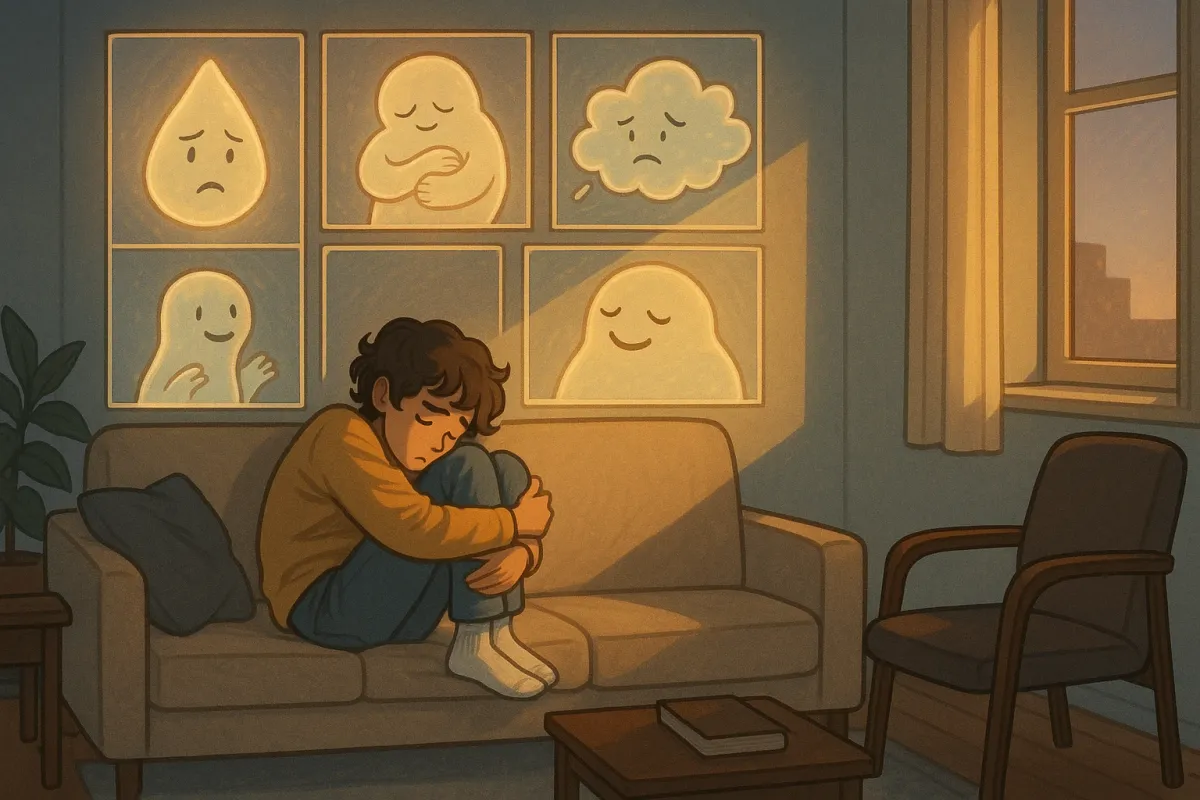
One reason artists like Haley Weaver are resonating right now is that her panels act as “soft mirrors”: they reflect back our emotional reality, but in a tone that feels kind rather than condemning. In a typical comic, you might see a character sitting with their anxiety on the couch, speaking to it as if to an old friend. The visual softens the experience without trivializing it.
From a mental wellness perspective, this is powerful. Our nervous systems respond differently to images than to text-heavy advice. A simple, uncluttered drawing can bypass our defensiveness and reach the part of us that simply wants to be understood. This is why so many people are quietly saving and sharing these comics—often more than they share long-form mental health articles. The illustration becomes an elegant shorthand for complex feelings: “This is me today.” For your own practice, consider curating a small, private “visual library” of images that mirror your inner experience—art, photography, or comics that feel emotionally accurate. Treat it as a gallery of self-recognition, not self-critique.
2. Micro-Validation: Why A Single Panel Can Calm An Overstimulated Mind
In the wake of constant news cycles and digital noise, our attention spans feel fractured. Yet, amidst this overstimulation, a single, well-crafted comic panel can function as what psychologists sometimes call a “micro-intervention.” Haley Weaver’s work, for instance, often distills an entire therapy insight into a few lines of dialogue: a character learning that rest is not laziness, or that asking for reassurance does not make them “too much.”
This form of micro-validation matters. When you scroll past a panel that perfectly captures your private fear—“What if I’m the only one who feels like this?”—and see it liked and shared by thousands, your brain receives a quiet corrective: you are not alone. In clinical terms, this normalizes your experience; in human terms, it reduces shame. You can bring this principle into your wellness routine by creating your own micro-validations: a single sentence on a sticky note, a minimalist phone lock screen with one reassuring phrase, or a daily one-line check-in in your journal. The aim is to offer your mind brief, concentrated drops of truth that counteract the anxious narratives that tend to run unchecked.
3. Emotional Minimalism: The Luxury Of Saying Less, But Saying It Precisely
The best mental health comics trending right now share a distinctive aesthetic: clean lines, muted palettes, intentional white space. This visual minimalism is more than a design choice; it mirrors a deeper psychological luxury—the ability to say less, but say it precisely. In a world that rewards overexplaining, over-apologizing, and emotional clutter, there is something profoundly regulating about a single, well-drawn scene and a handful of carefully chosen words.
This “emotional minimalism” is a practice worth adopting. Instead of journaling pages of spirals, you might experiment with capturing your entire emotional state in one sentence or symbol. Instead of defending your boundaries in a thousand-word message, you refine your language to a few clear, kind lines. Think of it as haute couture for communication: fewer pieces, better tailored. This disciplined brevity reduces mental noise and lowers the emotional cost of self-expression. As you observe the current wave of comics, notice how rarely they over-justify; they simply state, reveal, and allow. That is a mental wellness skill in itself.
4. Turning Self-Observation Into An Art Form, Not A Performance
One subtle theme in Haley Drew This and similar creators’ work is the shift from performance to observation. Rather than presenting perfectly healed, hyper-productive versions of themselves, these artists are drawing the in-between spaces: the mornings when getting out of bed is the victory, the tiny acts of courage that never appear on a résumé, the quiet compromises with one’s own nervous system.
In an online landscape still dominated by performative “wellness” and productivity flexes, this is refreshingly honest. It teaches an important mental wellness principle: observing your inner life is not a performance for others; it is an intimate, ongoing art practice with yourself. You are not curating your healing for likes—you are witnessing it, documenting it, sometimes with humor, sometimes with gravity. You can borrow this lens by reframing your own self-reflection rituals. Think of your daily check-ins—whether written, sketched, or spoken—as small studies in an artist’s notebook, not finished gallery pieces. The pressure drops, but the sincerity deepens.
5. From Solitary Struggle To Shared Language: Why Relatable Art Feels So Healing Right Now
The remarkable engagement around today’s mental health comics—comment sections filled with “This is literally me,” “I feel seen,” and “I didn’t know how to explain this to my partner until now”—highlights a crucial function of this trend: it gives us shared language for experiences that were once solitary and unnamed. Anxiety, burnout, attachment wounds, and emotional exhaustion become characters, scenes, and metaphors that are easier to talk about.
Shared language is one of the most understated luxuries in emotional life. It enables more precise support: you can send a comic to a loved one instead of fumbling for words, or bring a screenshot to therapy to anchor a conversation. It also softens the isolation that so often compounds mental distress. If you choose to integrate this into your wellness practice, consider creating a small “visual vocabulary” with the people closest to you—images or comics that mean, “I’m overwhelmed, but I’m safe,” or “I need gentleness today.” It’s a modern, gracefully efficient way to communicate emotional states without overtaxing your already tired mind.
Conclusion
The current wave of mental health comics—spotlighted today by artists like Haley Weaver of “Haley Drew This”—is more than a passing internet trend. It is a quiet cultural correction, a move toward gentler mirrors, more precise language, and more humane expectations of ourselves. In every carefully drawn panel, there is an invitation to treat your inner life with the same attentiveness an artist gives to a blank page.
As you scroll through today’s headlines and timelines, you might allow yourself a deliberate pause when one of these comics appears. Let it be more than a quick double-tap; let it be a moment of recognition, a micro-practice in emotional minimalism, a reminder that even in a loud world, your mind is worthy of being met with softness, nuance, and exquisite care.
Key Takeaway
The most important thing to remember from this article is that this information can change how you think about Mental Wellness.