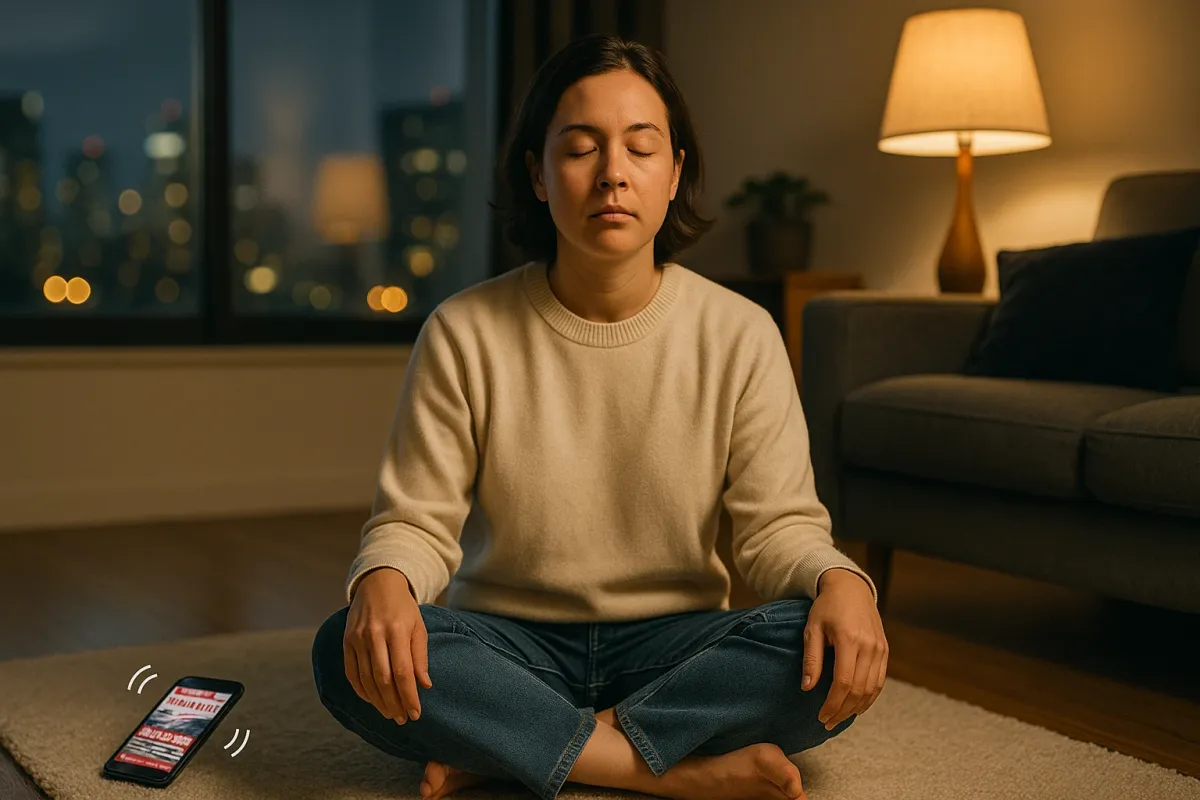
The digital front page has become a gallery of shock: crypto scandals, dismemberment cases, chilling 911 calls, and heartbreaking stories of violence that spread in seconds and linger in our nervous systems for hours. Today’s news of a crypto scammer found dismembered with his wife in Dubai—Roman and Anna Novak, allegedly kidnapped, held for ransom, and brutally killed in a desert resort—has ricocheted across social feeds, delivering exactly what the algorithm rewards: horror, outrage, and an inability to look away.
This is not “just another story.” It is a textbook example of what neuroscientists call vicarious trauma and what meditation teachers quietly see every day: people who feel strangely “off” after doom‑scrolling, unable to rest, irritable without knowing why. Our minds were never designed to hold this much brutality before breakfast.
For the Calm Mind Remedies reader, the question is not whether we should care—compassion is non‑negotiable. The question is how we stay exquisitely human and deeply present, without allowing every violent headline to colonize our inner space. Below, you’ll find five refined, meditation‑driven insights designed specifically for this age of digitally distributed horror—so you can remain informed, but not internally shattered.
1. The “Second Crime Scene” Is Your Nervous System
When a story like the Novak murders goes viral, the first crime scene is physical. The second is neurochemical—inside the body of everyone who repeatedly consumes it. Your amygdala does not distinguish between a desert resort in Dubai and the chair you are sitting in; it simply processes threat.
Meditation, in this context, is not a vague call to “relax,” but a deliberate intervention in the stress cascade. A brief, formal practice can interrupt the way your body absorbs ongoing horror as if it were personal danger. Try this when you catch yourself reading yet another graphic detail:
- Gently close your eyes and acknowledge, silently: “This is not happening to my body right now.”
- Place a hand on your chest or abdomen and follow ten slow, unforced breaths.
- On each exhale, imagine returning from the screen back into the room: the temperature of the air, the weight of your body, the texture under your fingertips.
This is a dignified boundary: you allow your nervous system to recognize safety in the present moment, even while your mind registers that something unimaginably unsafe has occurred elsewhere. Over time, this practice preserves your capacity for empathy without burning it out.
2. From Voyeur to Witness: A Meditative Shift in How You Consume Tragedy
The way most of us encounter stories like this dismemberment case is inherently voyeuristic. We are pulled toward “horrifying new details,” refreshing updates not because we can help, but because our brains are wired to monitor threats. This leaves a subtle residue of shame and agitation.
Meditation offers a more elegant role: the witness. A witness is not detached in a cold way, but consciously present, aware of both the event and their own interior response. Before you open yet another article or thread about a disturbing case, pause and ask:
- What, exactly, am I seeking right now—information, sensation, distraction, or a sense of control?
- Will this next click help me be more humane today, or merely more aroused and unsettled?
Then sit for three minutes with your eyes softly closed. Let images, snippets of text, and emotional tones surface as they will. Instead of chasing or suppressing them, imagine you are seated in a quiet, high‑ceilinged gallery, watching them pass across a wall. No commentary. No judgment. Just awareness.
This small shift—from voyeur to conscious witness—subtly restores your dignity. You are no longer passively hijacked; you are actively deciding how much of your inner space is available to any given story.
3. Designing a “Crisis Capsule”: A Luxurious Ritual For Media Intake
When the news cycle is dominated by brutality—be it a kidnapping in Dubai, a chilling 911 call, or violence against children—most people either binge on coverage or avoid it altogether. Both extremes can fray mental wellness: overexposure agitates, total avoidance can leave you strangely anxious and disconnected.
A more refined approach is to create what I call a Crisis Capsule: a beautifully curated, time‑bound container in which you allow yourself to be fully informed, then gently escorted back to calm.
Consider this structure when a story becomes inescapable:
- Set a window. 20–30 minutes once or twice a day. Outside that window, you are simply not available for breaking details.
- Choose sources intentionally. One or two reputable outlets, no click‑bait, no “graphic content” unless you have a professional reason to view it.
- Open with grounding. Two minutes of breath awareness before you read or watch. Remind yourself: “I am here to understand, not to be entertained by suffering.”
- Close with integration. When your window ends, step away from screens. Sit for five minutes with a simple anchor—your breath, a candle flame, or ambient sound—and let your system downshift.
By wrapping your news intake in a ritual of composure, you transform a chaotic drip‑feed of trauma into a deliberate encounter, softened by mindfulness and framed by care.
4. Practicing “Compassion With Edges” in the Age of Relentless Tragedy
High‑sensitivity and empathy are gifts, but when faced with a continual stream of violent crime, they can become liabilities. Reading about hostages, ransom notes, and dismembered bodies, you might feel waves of grief or fear that seem disproportionate to your personal life, yet entirely appropriate to the scale of suffering.
Meditation enables a refined style of compassion—what I call compassion with edges. It is warm, but not porous; responsive, but not engulfed.
A simple evening practice:
- Sit comfortably and bring to mind the individuals involved in the day’s most disturbing story—victims first, then, if you are able, even the perpetrators and those complicit.
- On each inhale, imagine breathing in their pain as a dark mist. On each exhale, imagine releasing a soft, luminous warmth back toward them.
- After a few minutes, reverse the direction: now breathe in light, and on the exhale, let any residual heaviness leave your body and dissolve into the space around you.
End by placing both hands over your heart and whispering internally: “My compassion is real. My limits are also real.” You are neither numbing out nor drowning; you are cultivating a stable, elegant capacity to care without self‑erasure.
5. Turning Disturbing Headlines Into a Daily Mindfulness Checkpoint
Stories like the Dubai crypto dismemberment case, or any of the other chilling reports currently trending, can either become another layer of background anxiety—or a daily bell of mindfulness. The event itself is not within your control. Your response can be meticulously crafted.
Each time you encounter a headline that makes your stomach tighten, treat it as a built‑in prompt to return to yourself:
- Name your state. Quietly label what arises: fear, disgust, curiosity, anger, helplessness.
- Locate it. Where, precisely, in the body is this feeling living right now—throat, jaw, solar plexus, hands?
- Offer it breath. Direct three slow, luxurious breaths into that area, as if you’re sending warmth into cold marble.
- Choose your next move. Ask: “Do I continue engaging, or is it time to step back?” Then honor the answer.
Over days and weeks, this practice transforms sensational headlines from psychological predators into unexpected allies. Each jolt becomes a reminder to refine your awareness, to inhabit your body more fully, and to reclaim your attention from the machinery of shock.
Conclusion
The world is not growing more brutal; it is growing more visible. What has changed is not only the scale and speed of violence, but our uninterrupted exposure to it—from resort kidnappings in Dubai to intimate betrayals in small towns, all carried in the same glowing rectangle we use to order dinner.
Meditation, in this moment of history, is not a soft escape but a sophisticated discipline: a way of ensuring that your inner world remains a sanctuary, not a secondary crime scene. By becoming a conscious witness, designing crisis capsules, practicing compassion with edges, and using each disturbing headline as a mindfulness checkpoint, you create an environment inside yourself that is both exquisitely sensitive and impeccably protected.
You are allowed to stay informed and still sleep deeply. You are allowed to care fiercely and still guard your nervous system like something rare and irreplaceable—because it is.
Key Takeaway
The most important thing to remember from this article is that this information can change how you think about Meditation.