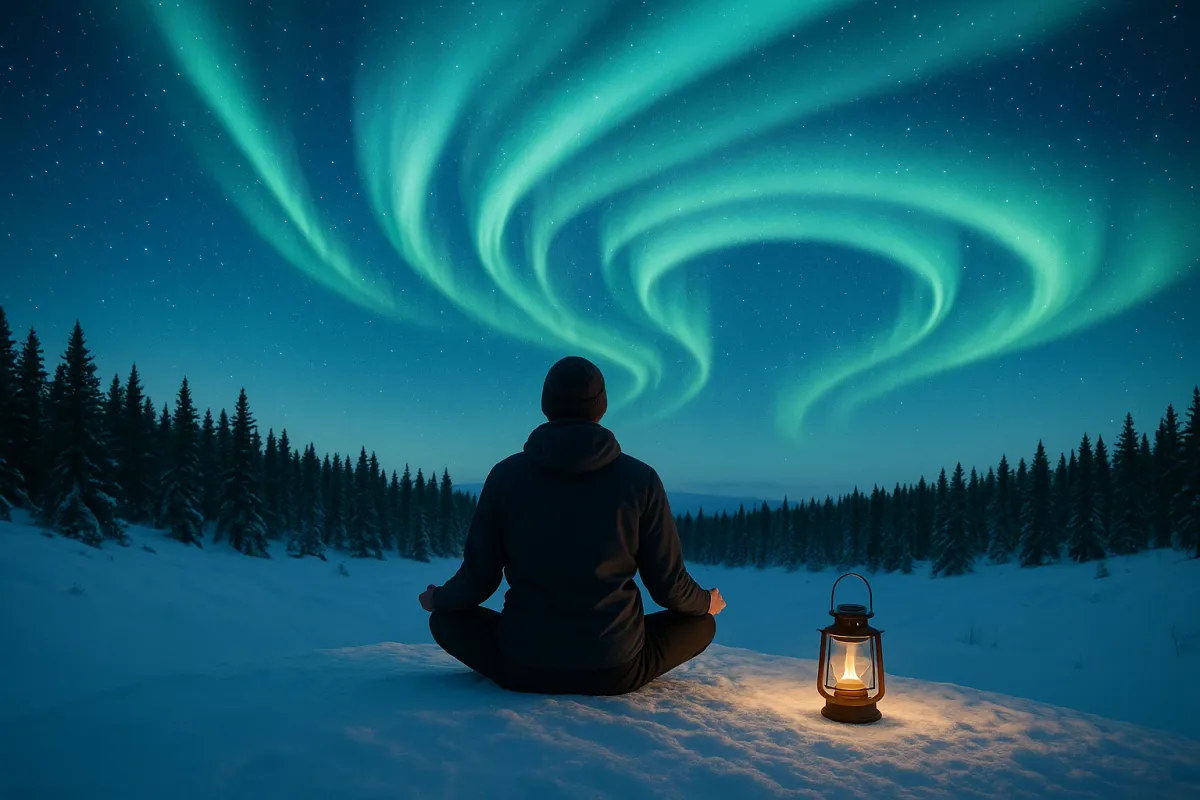
There is a particular stillness that descends on the world just before the Northern Lights appear. In Nordic skies right now, as travelers follow aurora forecasts and photographers chase the perfect shot (inspired by pieces like “The Best Places And Times To See The Northern Lights From My Own Experience”), something more subtle is unfolding: a global yearning for awe. People are flying across continents to stand in frozen silence, necks craned, waiting for the sky to perform. That longing is, at its essence, a meditation impulse.
At Calm Mind Remedies, we see this surge of aurora tourism as more than wanderlust. It is a collective instinct to be humbled, quieted, and reordered by natural beauty. You may not be in Tromsø or the Icelandic Highlands tonight, but you can borrow the architecture of this celestial event to craft a deeply calming, aurora‑inspired meditation ritual at home—one that feels as luxurious and rare as the lights themselves.
Below are five exclusive, refined insights to transform the Northern Lights from a distant spectacle into a personal, nightly sanctuary for the mind.
The Luxury of Anticipation: Treating Calm Like a Scheduled Phenomenon
Aurora chasers live by predictions—space-weather forecasts, geomagnetic indices, and patiently refreshing their apps in the dark. This intentional anticipation is a surprisingly powerful template for meditation. Rather than “fitting in” a quick mindfulness session between emails, elevate your practice by treating it as an event with a forecast: a precise time, conditions prepared, and your presence promised.
Choose a consistent evening “aurora hour” and protect it with the same seriousness you’d give a flight to Scandinavia. Dim lights 30 minutes before, silence notifications, and let your day’s momentum gently decelerate. The mind responds exquisitely to ritualized cues; anticipation itself becomes a pre-meditative state, easing the nervous system into receptivity. When you finally sit, you are not grinding your thoughts to a halt—you are arriving at something you have been quietly approaching all day. This shift from opportunistic to orchestrated calm is a hallmark of truly premium mental wellness.
Designing an Aurora Chamber: Atmospheric Minimalism for the Mind
Photographers know that to capture the Northern Lights well, distractions must vanish: no intrusive city glow, no harsh artificial lighting, no visual clutter at the horizon. For meditation, your environment deserves the same curated restraint. Instead of a generic “quiet corner,” imagine designing an aurora chamber—a space that feels as intentional as a boutique hotel suite overlooking Arctic skies.
Keep the palette deep and understated: midnight blues, charcoal, muted moss. Add one or two luminous accents—a candle with a soft, dancing flame, or an LED lamp set to gentle gradients of green and violet—to echo the sky’s slow shimmer without overwhelming the senses. Remove unnecessary textures and noise: no piles of books, no stray cables, no blinking electronics. The visual silence becomes part of the practice. When the eye has less to process, the mind does not need to work as hard to filter the world, freeing more attention to rest, observe, and heal. In this way, your space itself becomes a co-meditator—quiet, dignified, and exquisitely restrained.
Magnetic Breathing: Regulating the Nervous System with “Solar Wind” Cycles
Auroras are born from solar winds colliding gracefully with Earth’s magnetic field. There is a poetic symmetry here: your nervous system is also an invisible field, constantly interacting with internal “storms” of thought and emotion. To mirror this, adopt what we call Magnetic Breathing—a breath pattern structured like a gentle geomagnetic fluctuation.
Inhale slowly through the nose for six counts, imagining a refined stream of light entering the body, tracing the spine like an elegant beam. Hold for three counts, sensing that light softly resting within your chest, magnetizing calm. Exhale through the nose for eight counts, as if releasing a subtle veil of color into the room, diffusing tension and static. Repeat for 10–15 cycles. This breath ratio (longer exhale than inhale) is known to stimulate the parasympathetic nervous system, but framing it as a solar-wind ritual gives the practice a sensory richness that feels less clinical, more ceremonial. Over time, Magnetic Breathing becomes an internal aurora—predictable, soothing, and beautifully self-generated.
Practicing Noble Awe: A Refined Alternative to Escapist Numbing
Travelers under the Northern Lights often fall silent, not from shyness but from awe. It is an emotion that research increasingly links to reduced stress, greater life satisfaction, and a more spacious perception of time. In a culture obsessed with quick distraction—doomscrolling, impulsive shopping, endlessly refreshing feeds—seeking awe is a radically elegant alternative to numbing out.
During your meditation, instead of focusing solely on “emptying the mind,” experiment with cultivating what we call Noble Awe. Gently visualize the sky above you opening like a slow curtain of color. Let your thoughts pass through the scene: your to-do lists as faint stars, your worries as clouds moving behind the light. Do not push them away; simply allow them to appear small against the vastness of your inner sky. This reframing is subtle yet profound: problems shrink not because they are denied, but because they are contextualized. Noble Awe restores a dignified sense of proportion—your life remains important, but not oppressive. It is a mental posture that feels quietly majestic rather than merely “relaxed.”
Temporal Reset: Aligning Your Inner Clock with Celestial Rhythm
Witnessing the Northern Lights requires surrendering to the night. People rearrange sleep schedules, stay up through the early hours, and step outside of rigid daily structures in service of a fleeting, luminous moment. This dance with irregular timing can inspire a powerful meditation insight: your internal clock does not have to be fully dictated by productivity culture.
Consider creating a weekly “celestial reset”—a late-night or pre-dawn meditation that gently disrupts your usual rhythm, not in a chaotic way, but in a sacred one. Dim your space, open a window if possible, and let the darkness itself become part of the practice. Our bodies are biologically attuned to cycles of light and shadow; meditating in low light, when the world is quieter, can deepen introspection and emotional processing. Rather than collapsing into late-night scrolling, you are choosing a refined, conscious wakefulness. Over time, this ritual helps decouple “being awake” from “being online,” and reconnects it with simply being—present, unhurried, and exquisitely attuned to the subtle shifts within you.
Conclusion
As aurora hunters stand beneath Nordic skies this season, they are participating in something larger than a travel trend: a global reminder that the most luxurious experiences are often the quietest. You may never photograph the perfect curtain of green, but you can invite its essence into your evenings—a sense of anticipation, a carefully curated environment, a body breathing in luminous cycles, a mind softened by awe, and an inner clock that occasionally chooses wonder over routine.
When the sky starts to glow, somewhere in the world, you can let your inner landscape respond in kind. Your meditation does not need a passport—only a willingness to craft your own private Northern Lights: subtle, sovereign, and serenely spectacular.
Key Takeaway
The most important thing to remember from this article is that this information can change how you think about Meditation.