Holiday travel is trending again for all the wrong reasons: endless security lines, overbooked flights, and airports that feel more like emotional pressure cookers than gateways to wonder. A recent piece on “25 Travel Gadgets For Anyone Who Is Already Mentally Preparing For The Chaos Of Holiday Travel” captured the mood perfectly—Mariah Carey in the background, gingerbread in the air, and a thousand weary travelers quietly unraveling in line.
At Calm Mind Remedies, we see this annual chaos as more than a seasonal inconvenience. It’s a revealing test of how resilient your nervous system truly is when comfort, control, and predictability disappear. Instead of simply tolerating the stress of modern travel, you can transform these liminal spaces—airports, train stations, highway rest stops—into discreet sanctuaries for your mind.
Below, discover five elevated, travel‑tested insights to help you arrive not only at your destination, but in your own body—calm, clear, and composed.
The “Micro‑Sanctuary” Mindset: Redefining Luxury in Transit
Most travel content today focuses on objects: noise‑canceling headphones, ergonomic neck pillows, compact massagers. Useful, certainly—but true luxury under pressure is psychological: the ability to create a sense of sanctuary in a place designed for throughput, not tranquility.
A micro‑sanctuary is not a specific location; it’s a deliberate shift in how you occupy any space. Instead of waiting for conditions to improve, you decide, “This seat, this gate, this queue is my studio for calm.” That decision alone lowers the mind’s sense of threat. You move from helpless passenger to intentional curator of your inner environment.
Experiment at your next gate or station: straighten your posture as if you are in the quiet corner of a boutique hotel lounge, not a crowded terminal. Arrange your small personal items—water, book, eye mask—neatly in front of you. Place one hand gently over your abdomen, rest your gaze softly on a fixed point, and breathe as if this moment were designed for restoration. The external world doesn’t change, but your nervous system notices the order, the intention, the quiet claim to dignity. This is mental first‑class, regardless of your boarding group.
Nervous System Etiquette: Regulating Before You React
The article about “mentally preparing for the chaos of holiday travel” resonated because so many people now expect to be triggered by crowds, delays, and policies. Yet stress resilience begins not with positive thinking, but with nervous system etiquette: a set of subtle habits that regulate your physiology before your emotions escalate.
Think of your nervous system as a distinguished guest you are escorting through the journey. Each stressful event—an announcement of delay, a lost bag, a missed connection—either reassures that guest or alarms them. Your job is to send continuous signals of safety, even when the logistics are anything but smooth.
Elite nervous system etiquette during travel might include:
- Pre‑boarding breathwork: Three minutes of slow, silent exhales while in the security line, focusing only on lengthening the out‑breath. This quietly cues your vagus nerve and reduces the intensity of the body’s stress response.
- Elegant emotional boundaries: Not absorbing the agitation of others. You can acknowledge the collective frustration without joining it. Saying internally, “That energy does not belong to me,” is a small but powerful mental boundary.
- Graceful delay rituals: When a delay is announced, have a pre‑chosen response—sip water, roll your shoulders, read two paragraphs of something grounding instead of refreshing the airline app obsessively. The pattern becomes: disruption → regulation → response.
The result is less reactivity, fewer outbursts, and a surprising sense of composure, even when the situation around you feels unrefined.
Sensory Curation: Designing Calm When You Can’t Control the Room
The travel gadget boom acknowledges something important: our senses are overwhelmed in transit. Bright lights, constant announcements, recycled air, and visual clutter all quietly exhaust the nervous system. Real stress relief begins when you stop enduring this assault and begin curating your sensory intake with intention.
Instead of accumulating random gadgets, think in terms of a sensory capsule—a refined, minimal collection chosen to soothe specific senses. For example:
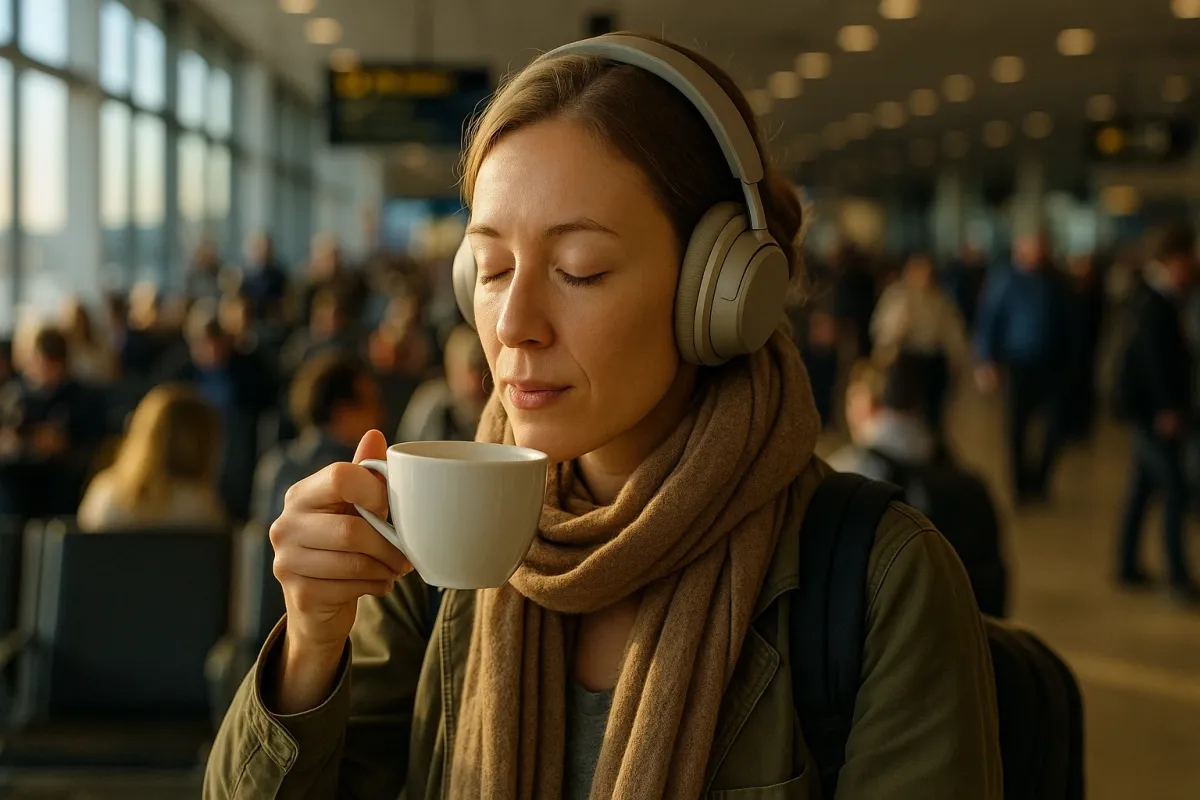
- Sound: Noise‑canceling headphones or soft in‑ear plugs paired with a calm audio track (ambient soundscapes, low‑tempo jazz, or guided breathwork). Commit to a single playlist that becomes your “travel nervous system reset.”
- Smell: A micro‑vial of high‑quality essential oil (lavender, neroli, or sandalwood) lightly dabbed on a scarf or tissue. Inhaling slowly through the nose for four counts, exhaling for six, teaches your brain to associate that scent with “I am safe.”
- Touch: One discreet grounding object—a textured bracelet, smooth stone, or beaded worry ring. When anxiety spikes, let your fingers explore every detail. This tactile focus gently redirects the brain from catastrophic thinking to present‑moment sensation.
- Sight: When possible, soften your gaze: look slightly downward or at a neutral surface instead of scanning crowds and screens. If you have tinted glasses or a hat with a brim, use them as visual boundaries.
By curating your sensory experience, you’re not escaping reality—you’re refining it. Your mind reads this curation as care, and care is deeply regulating.
Time Alchemy: Turning Waiting into Restoration
The viral description of holiday travel as a “beautiful, chaotic ballet” captures a hidden truth: the worst stress comes from feeling that your time is being wasted or stolen. Delays, queues, and cancellations offend our sense of control. Yet with a subtle shift, these very inconveniences can become your allies.
Consider every unexpected pause—an extra hour at the gate, a long line for boarding—as alchemy time: minutes or hours you quietly reclaim for nervous system restoration and mental decluttering. Instead of framing it as “lost time,” you decide it is “reserved time” you were previously too busy to grant yourself.
Curate an elegant “alchemy list” before you travel: activities that nourish you but never feel urgent enough at home. Examples might include:
- Reading three pages of a book that deepens your perspective rather than just distracts you.
- Journaling one concise page on a prompt such as “What am I ready to leave behind this year?”
- Practicing a five‑minute body scan, starting from your feet and moving upward, simply noticing tension without judgment.
- Quietly planning one boundary or one joy you’ll prioritize in the coming month.
In this frame, a delay becomes a private retreat disguised as inconvenience. You may still prefer punctuality, but you are no longer emotionally hostage to it.
The Art of Arriving: Protecting the First Hour After the Journey
Most wellness advice focuses on surviving the journey itself, yet the first hour after you arrive is when your nervous system decides whether this trip is restorative or depleting. If you rush from baggage claim into social obligations, emails, or family dynamics, you lock in a stress‑imprinted arrival.
Instead, treat arrival as a ceremony. Before your trip, decide how you will spend your first sixty minutes at your destination with the same precision you might use to book a luxury experience. This could look like:
- A non‑negotiable shower or bath to symbolically rinse off transit stress, even if it’s brief.
- Ten barefoot minutes (or in soft socks) standing or walking slowly in your space, allowing your body to register, “We are here. We are no longer moving.”
- A single, nourishing beverage—tea, warm water with citrus, or a calming herbal infusion—sipped in silence or soft conversation, without screens.
- Two or three slow stretches that open the parts of your body most compressed by travel: hips, chest, and neck.
If you’re visiting family or attending an event, communicate this ritual in advance: “I’ll be so much more present if I take thirty to sixty minutes to shower and decompress when I arrive.” People who respect you will respect this boundary. People who don’t may be part of the reason your nervous system has felt overextended.
When you honor the art of arriving, your body exits “emergency logistics mode” and re‑enters “living mode.” The mind interprets this as safety—and deep safety is the ultimate stress remedy.
Conclusion
The renewed conversation around holiday travel chaos—gadgets, hacks, and collective complaints—reveals how deeply modern life strains the nervous system. Yet the most exquisite form of wellness is not the absence of disruption; it is the ability to maintain inner refinement when the outer world is crowded, loud, and unpredictable.
By embracing micro‑sanctuaries, practicing nervous system etiquette, curating your senses, alchemizing wait times, and protecting the ritual of arrival, you transform travel from a test of endurance into a moving meditation in composure.
Your boarding pass may say economy or business, but your mind can travel first‑class—quietly, gracefully, and entirely on your own terms.
Key Takeaway
The most important thing to remember from this article is that this information can change how you think about Stress Relief.