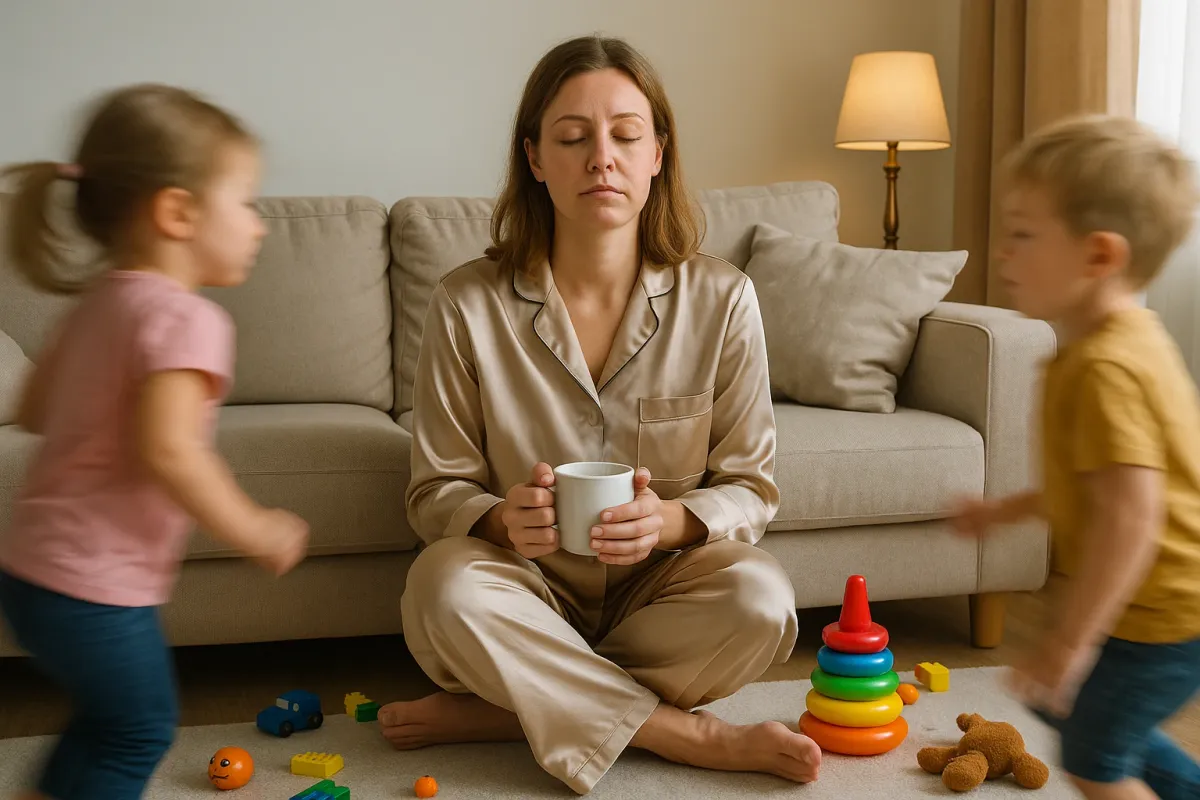
Parenting was never meant to feel like emotional survival—yet for many mothers and fathers right now, it does. Inspired by the recent viral story “My Children Are Really Unpleasant And I’m Worried,” where a deeply exhausted mother describes feeling worn down by her kids’ constant hostility, we’re seeing a new, unfiltered conversation emerging online: what happens to your mental wellness when the people you love most are also your greatest source of daily stress?
This is not the glossy, curated version of family life. It’s the quiet reality of parents scrolling Reddit at midnight, searching phrases like “I love my kids but I don’t like them right now” or “Is it normal to feel resentful?” The modern parent is expected to be endlessly patient, emotionally available, and perpetually grateful—while navigating economic pressure, digital overload, and the relentless scrutiny of social media. The result is a form of parental burnout that is both common and, too often, cloaked in shame.
At Calm Mind Remedies, we approach this tender territory with elegance and honesty. Below are five exclusive, refined insights for parents who feel emotionally depleted by their children’s behavior—and are ready to reclaim a sense of inner composure without abandoning the people they love.
Reframing “Unpleasant” Behaviour as Emotional Static, Not a Moral Verdict
In the recent “My Children Are Really Unpleasant” story, what stands out is not just the children’s rudeness, but the mother’s haunting worry: “What if this is who they really are—and I’ve failed?” This is where mental wellness begins: with a gentle disentangling of behavior from identity, both theirs and yours.
When your child is sulking, snapping, or provoking, it can feel like a personal attack. Yet under stress, many children behave like unfiltered amplifiers of the emotional climate around them—school pressures, friendship turbulence, social media comparisons, and even your own unspoken fatigue. Their “unpleasantness” is often emotional static: noisy, uncomfortable, but not permanent and not a cruelty staged against you.
Cultivating this perspective creates spaciousness. Instead of silently absorbing their words as proof of failure, you begin to observe: “Their nervous system is dysregulated. Mine is, too.” This does not excuse harmful behavior, but it does prevent you from spiraling into shame and despair. A sophisticated mental wellness practice is not about pretending everything is fine; it is about narrating what is happening in a way that preserves your dignity—and theirs.
Establishing “Emotional Concierge Hours” Instead of Constant Availability
One of the unspoken pressures highlighted by parents online is the expectation to be emotionally on-call 24/7. Questions, complaints, demands, and conflicts can infiltrate every waking moment. Over time, this erodes your nervous system in the same way constant notifications destroy focus.
Borrowing from luxury hospitality, consider introducing “emotional concierge hours.” Not as a rigid rule but as a refined rhythm in your home. There are times when you are fully available—present, soft-eyed, and engaged—and times when you are intentionally less available, not as punishment, but as preservation.
You might articulate it simply:
- “From 7 to 8 p.m., I am fully here to listen and help you with anything on your mind.”
- “After 9 p.m., unless it’s urgent, we keep things quiet and simple so everyone’s mind can rest.”
- It reassures your children that they have access to you—just not all the time.
- It signals that emotional labor has gentle boundaries, just like work hours.
- It gives you permission to rest without guilt, which is crucial when your kids’ attitudes have already frayed your patience.
This structure does several powerful things:
In the same way a luxury hotel offers exceptional service within clear hours, you, too, are allowed to deliver high-quality emotional presence within humane limits.
Designing Micro-Rituals of Recovery Between Conflicts
The parent in the trending story describes feeling “worn down,” a phrase that suggests not one catastrophic event, but a thousand micro-erosions: the eye-roll at breakfast, the argument over homework, the slammed door at bedtime. Each small rupture chips away at your inner equilibrium.
The most elegant mental wellness strategy here is not a weekend retreat; it is the artful design of micro-rituals of recovery between these everyday frictions.
Examples of refined micro-rituals:
- Transitional handwash: After an argument, wash your hands slowly with warm water and a favorite scented soap, consciously imagining the emotional residue rinsing away. It’s decorously simple, yet somatically powerful.
- Doorway pause: Before entering a room where conflict just occurred, place your hand lightly on the doorframe, take three quiet breaths, and silently choose one word for how you wish to arrive (steady, calm, clear).
- Chair of composure: Designate one beautiful chair or corner as your “reset” space. When you sit there for two minutes, phone away, you are not problem-solving—you are re-collecting yourself.
The point is not drama; it is precision. These micro-rituals are the emotional equivalent of exquisite tailoring: small adjustments that dramatically change the way your inner world fits you.
Detaching Your Self-Worth from Your Children’s Current Season
Online discussions around the “unpleasant children” story reveal a common, painful narrative: “If my kids are rude, angry, or ungrateful, I must be a bad parent—and therefore a lesser person.” This fusion is corrosive. It traps you in a cycle where every eye-roll becomes a referendum on your character.
A more elevated mental posture recognizes that:
- Your children are in a season—developmental, hormonal, social, sometimes chaotic.
- You are in a season—perhaps overextended, under-supported, or healing from your own childhood.
- Seasons shift. Identity is deeper.
- When conflict ends, quietly tell yourself: “Their behavior is feedback, not a verdict.”
- When guilt surges, ask: “Is this an accurate assessment of my parenting, or a flare of inherited shame?”
- When comparing yourself to other families online, remember: social feeds are highlight reels, while your inner world holds the director’s cut.
To protect your mental wellness, practice a deliberate, almost ceremonial uncoupling:
This detachment is not emotional distance; it is emotional sophistication. You can take responsibility for your parenting without surrendering your entire sense of self to your children’s rough days.
Curating a Discreet Circle of Adults Who Can Hold the Whole Truth
The mother in the viral story turns to the internet because, in many circles, it remains socially dangerous to confess: “I am struggling to like my own children right now.” Polite conversation rewards curated narratives; mental wellness, however, requires rooms where the whole truth can breathe.
Your mind needs what luxury spaces understand intuitively: discreet, well-appointed environments where it is safe to exhale. This might look like:
- One trusted friend with whom you have a silent agreement: no judgment, no fixing, just honesty.
- A therapist or counselor—online or in-person—who understands parental burnout as a real phenomenon, not a failure.
- A small, carefully chosen online community (Reddit threads, support groups, or moderated forums) where anonymity allows authenticity, but negativity is not left unchecked.
Curating this circle is an act of emotional curation, akin to selecting art for a private gallery. Not everyone gets access. Not every opinion is invited. The ones that are chosen must be able to hold complexity: that you can adore your children and dread certain hours of the day, that you can be committed to them and still committed to yourself.
In a culture that pressures parents to perform, this quiet network is your private sanctuary—a place where you are not “Mom” or “Dad” first, but a human being with needs, limits, and longing for peace.
Conclusion
The story of a mother whispering into the digital void that her children are “really unpleasant” is not a scandal; it is a mirror. It reflects the strain placed on modern parents expected to be endlessly patient in a world that offers them very little rest, privacy, or understanding.
Mental wellness, in this context, is not a spa-day fantasy. It is the cultivated ability to remain internally composed amid relational turbulence—to decode your children’s behavior without letting it erode your self-worth, to create boundaries without abandoning tenderness, and to seek support without shame.
If your spirit feels dulled by daily conflict, know this: you are not defective, and you are not alone. With deliberate reframing, elegant boundaries, restorative micro-rituals, identity detachment, and a carefully curated circle of support, it is possible to stay present for your children while remaining profoundly loyal to your own calm mind.
This is not about perfect parenting. It is about exquisite, sustainable presence—first for yourself, and then, more gently, for them.
Key Takeaway
The most important thing to remember from this article is that this information can change how you think about Mental Wellness.